



 Chat with AI
Exam 8: Perfect Competition

Exam 1: Introducing the Economic Way of Thinking85 Questions
Exam 2: Production Possibilities Opportunity Cost and Economic Growth107 Questions
Exam 3: Market Demand and Supply176 Questions
Exam 4: Markets in Action137 Questions
Exam 5: Price Elasticity of Demand and Supply151 Questions
Exam 6: Consumer Choice Theory96 Questions
Exam 7: Production Costs131 Questions
Exam 8: Perfect Competition126 Questions
Exam 9: Monopoly81 Questions
Exam 10: Monopolistic Competition and Oligopoly97 Questions
Exam 11: Labor Markets105 Questions
Exam 12: Income Distribution Poverty and Discrimination57 Questions
Exam 13: Antitrust and Regulation96 Questions
Exam 14: Environmental Economics47 Questions
Exam 15: Gross Domestic Product109 Questions
Exam 16: Business Cycles and Unemployment94 Questions
Exam 17: Inflation56 Questions
Exam 18: The Keynesian Model111 Questions
Exam 19: The Keynesian Model in Action105 Questions
Exam 20: Aggregate Demand and Supply94 Questions
Exam 21: Fiscal Policy108 Questions
Exam 22: The Public Sector55 Questions
Exam 23: Federal Deficits Surpluses and the National Debt42 Questions
Exam 24: Money and the Federal Reserve System75 Questions
Exam 25: Money Creation117 Questions
Exam 26: Monetary Policy106 Questions
Exam 27: The Phillips Curve and Expectations Theory59 Questions
Exam 28: International Trade and Finance127 Questions
Exam 29: Economies in Transition46 Questions
Exam 30: Growth and the Less Developed Countries55 Questions
Exam 31: Understanding Direct and Inverse Relationships between Variables172 Questions
Select questions type


If a potato farmer expands output, he finds that the increase in total revenue is less than the increase in total costs. This means that:
(Multiple Choice)
4.8/5  (68)
(68) Exhibit 8-12 Marginal revenue and cost per unit curves
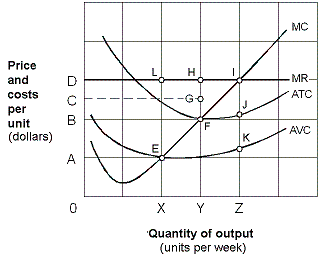 As shown in Exhibit 8-12, the price that will yield zero economic profit is:
 (Multiple Choice)
4.8/5 (67)
(67) Suppose that price is below the minimum average total cost but above the minimum average variable cost. In the short run, a firm that is a price taker would:
(Multiple Choice)
4.9/5 (78)
(78) Exhibit 8-6 A firm's cost and MC curves
 In Exhibit 8-6, if this firm is currently producing 20 units of output, this firm is
 (Multiple Choice)
4.9/5 (63)
(63) Suppose a single egg farmer alters the number of eggs she produces but the change in egg output does not have any effect on the market price. This example describes which of the following characteristics of perfect competition?
(Multiple Choice)
4.8/5 (82)
(82) Exhibit 8-11 A firm's cost and marginal revenue curves
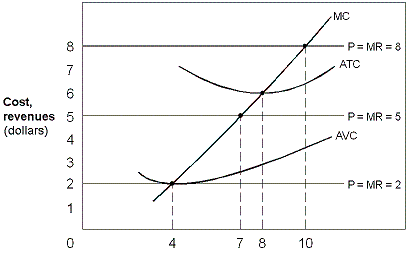 In Exhibit 8-11, the profit-maximizing output level at the price of $8 is:
 (Multiple Choice)
4.9/5 (85)
(85) If the price of a product is $12, its average total cost is $2 and its average total cost is $15 at the profit-maximizing output level, in the short run the firm:
(Multiple Choice)
4.9/5 (85)
(85) As market price increases in the short run, a profit-maximizing firm in a perfectly competitive market will expand output along its:
(Multiple Choice)
4.8/5 (75)
(75) Which of the following best illustrates perfect competition?
(Multiple Choice)
4.7/5 (76)
(76) Suppose that 1000 identical sellers each set their profit-maximizing output level at 18 units when price equals $10. Then what is market quantity supplied at a price of $10?
(Multiple Choice)
4.8/5 (76)
(76) Which of the following could be a perfectly competitive market?
(Multiple Choice)
4.7/5 (78)
(78) In long-run equilibrium, which of the following is not equal to price for a perfectly competitive firm?
(Multiple Choice)
4.9/5 (79)
(79) Which of the following is not a characteristic of the structure of perfectly competitive markets?
(Multiple Choice)
4.8/5 (88)
(88) Exhibit 8-8 A firm's cost and marginal revenue curves
 In Exhibit 8-8, product price in this market is fixed at $35. This firm is currently operating where MR = MC. Which of the following is true ?
 (Multiple Choice)
4.8/5 (91)
(91) The large-number-of-sellers condition of perfect competition is met when
(Multiple Choice)
4.9/5 (95)
(95) Exhibit 8-12 Marginal revenue and cost per unit curves
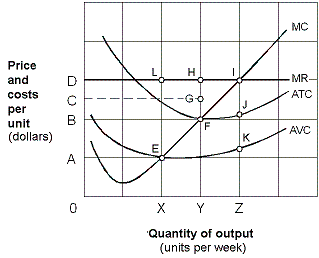 If price is equal to OD for the firm shown in Exhibit 8-12, total profit is maximized when:
 (Multiple Choice)
4.9/5 (77)
(77) Assume the short-run average total cost for a perfectly competitive industry decreases as the output of the industry expands. In the long run, the industry supply curve will:
(Multiple Choice)
4.8/5 (86)
(86) Exhibit 8-2 Total revenue and total cost graph
 In Exhibit 8-2, economic profit for the firm is at a maximum when output per week equals:
 (Multiple Choice)
4.8/5 (80)
(80) 
Filters
- Essay(0)
- Multiple Choice(0)
- Short Answer(0)
- True False(0)
- Matching(0)