



 Chat with AI
Exam 8: Perfect Competition

Exam 1: Introducing the Economic Way of Thinking85 Questions
Exam 2: Production Possibilities Opportunity Cost and Economic Growth107 Questions
Exam 3: Market Demand and Supply176 Questions
Exam 4: Markets in Action137 Questions
Exam 5: Price Elasticity of Demand and Supply151 Questions
Exam 6: Consumer Choice Theory96 Questions
Exam 7: Production Costs131 Questions
Exam 8: Perfect Competition126 Questions
Exam 9: Monopoly81 Questions
Exam 10: Monopolistic Competition and Oligopoly97 Questions
Exam 11: Labor Markets105 Questions
Exam 12: Income Distribution Poverty and Discrimination57 Questions
Exam 13: Antitrust and Regulation96 Questions
Exam 14: Environmental Economics47 Questions
Exam 15: Gross Domestic Product109 Questions
Exam 16: Business Cycles and Unemployment94 Questions
Exam 17: Inflation56 Questions
Exam 18: The Keynesian Model111 Questions
Exam 19: The Keynesian Model in Action105 Questions
Exam 20: Aggregate Demand and Supply94 Questions
Exam 21: Fiscal Policy108 Questions
Exam 22: The Public Sector55 Questions
Exam 23: Federal Deficits Surpluses and the National Debt42 Questions
Exam 24: Money and the Federal Reserve System75 Questions
Exam 25: Money Creation117 Questions
Exam 26: Monetary Policy106 Questions
Exam 27: The Phillips Curve and Expectations Theory59 Questions
Exam 28: International Trade and Finance127 Questions
Exam 29: Economies in Transition46 Questions
Exam 30: Growth and the Less Developed Countries55 Questions
Exam 31: Understanding Direct and Inverse Relationships between Variables172 Questions
Select questions type


If a perfectly competitive firm sells 50 units of output at a market price of $10 per unit, its marginal revenue is:
(Multiple Choice)
4.9/5  (91)
(91) Exhibit 8-11 A firm's cost and marginal revenue curves
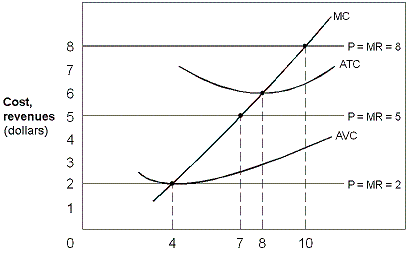 In Exhibit 8-11, when the price rises from $5 to $8, the profit-maximizing (or loss-minimizing) firm goes from making a:
 (Multiple Choice)
4.9/5 (84)
(84) Exhibit 8-19 Long-run perfectly competitive industry
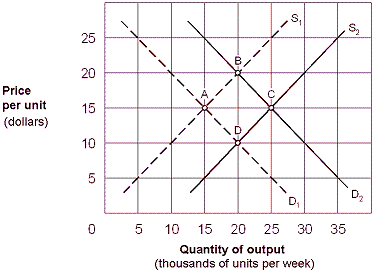 As shown in Exhibit 8-19, assume that a perfectly competitive industry is in long-run equilibrium at point A. If the demand curve shifts from D1 to D2, the adjustment sequence between points will be:
 (Multiple Choice)
5.0/5 (90)
(90) In the perfectly competitive market, individual firms exert no effect on the market price. Therefore, the firm's marginal revenue is:
(Multiple Choice)
4.9/5 (77)
(77) If a firm is currently equating MR and MC and product price = $24, AVC = $22, and ATC = $26, then in the long run this firm:
(Multiple Choice)
4.8/5 (79)
(79) Exhibit 8-16 Short-run cost curves for a competitive firm
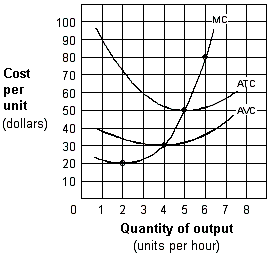 In Exhibit 8-16, if the market price of its product is $50 per unit, then the firm will:
 (Multiple Choice)
4.9/5 (86)
(86) Under perfect competition, a firm is a price taker because:
(Multiple Choice)
4.9/5 (78)
(78) If a fishing boat owner brings 10,000 fish to market and the market price is $7 per fish, she will have $70,000 in total revenue. If the average variable cost of 10,000 fish is $4 and the fixed cost of the boat is $20,000, what is her profit?
(Multiple Choice)
4.9/5 (70)
(70) In the short run, a firm should shut down its operation if:
(Multiple Choice)
4.9/5 (75)
(75) Under perfect competition, which of the following are equal at all levels of output?
(Multiple Choice)
4.8/5 (81)
(81) Which of the following is a key characteristic of the long-run competitive equilibrium that distinguishes it from the short-run competitive equilibrium?
(Multiple Choice)
4.8/5 (83)
(83) If a perfectly competitive industry's long-run supply curve is downward sloping, we can conclude that input prices will:
(Multiple Choice)
5.0/5 (71)
(71) Exhibit 8-3 Cost per unit curves
 In Exhibit 8-3, if the price of the firm's product is $2.00 per unit, the firm will produce:
 (Multiple Choice)
4.9/5 (89)
(89) Exhibit 8-9 A firm's cost and marginal revenue curves
 In Exhibit 8-9, product price in this market is fixed at $7. This firm is currently operating where MR = MC. What do you advise this firm to do?
 (Multiple Choice)
4.8/5 (70)
(70) Exhibit 8-15 Short-run cost curves for E-Z Care lawn mowing company
 In Exhibit 8-15, what market price would cause E-Z-Care to just break even?
 (Multiple Choice)
4.9/5 (96)
(96) Which of the following offers the best explanation of why "marginal revenue equals marginal cost" is the rule that indicates the profit-maximizing output level?
(Multiple Choice)
4.8/5 (80)
(80) Which of the following is not a characteristic of a perfectly competitive market?
(Multiple Choice)
4.9/5 (81)
(81) The long-run equilibrium condition for perfect competition is:
(Multiple Choice)
5.0/5 (79)
(79) 
Filters
- Essay(0)
- Multiple Choice(0)
- Short Answer(0)
- True False(0)
- Matching(0)