



 Chat with AI
Exam 16: Interest Rates and Monetary Policy

Exam 2: The Market System and the Circular Flow274 Questions
Exam 3: Demand, Supply, and Market Equilibrium357 Questions
Exam 4: Market Failures Caused by Externalities Asymmetric Information222 Questions
Exam 5: Public Goods, Public Choice, and Government Failure242 Questions
Exam 6: An Introduction to Macroeconomics243 Questions
Exam 7: Measuring Domestic Output and National Income238 Questions
Exam 8: Economic Growth274 Questions
Exam 9: Business Cycles, Unemployment, and Inflation298 Questions
Exam 10: Basic Macroeconomic Relationships233 Questions
Exam 11: The Aggregate Expenditures Model126 Questions
Exam 12: Aggregate Demand and Aggregate Supply320 Questions
Exam 13: Fiscal Policy, Deficits, and Debt401 Questions
Exam 14: Money, Banking, and Financial Institutions265 Questions
Exam 15: Money Creation285 Questions
Exam 16: Interest Rates and Monetary Policy405 Questions
Exam 17: Financial Economics356 Questions
Exam 18: Extending the Analysis of Aggregate Supply268 Questions
Exam 19: Current Issues in Macro Theory and Policy279 Questions
Exam 20: International Trade339 Questions
Exam 21: The Balance of Payments, Exchange Rates, and Trade Deficits315 Questions
Exam 22: The Economics of Developing Countries269 Questions
Select questions type


According to the Taylor rule, when the economy is at full employment and inflation is at its target rate of 2 percent, the Fed should
(Multiple Choice)
4.9/5  (89)
(89) According to the Taylor rule, if the inflation rate is one percentage point below the target of 2 percent but at full employment, then the Fed should
(Multiple Choice)
4.8/5 (78)
(78) The largest asset item in the Federal Reserve Banks' consolidated balance sheet (as of February 2019) is
(Multiple Choice)
5.0/5 (67)
(67) The largest single liability of the Federal Reserve Banks is their outstanding loans to commercial banks.
(True/False)
4.9/5 (73)
(73) Monetary policy is expected to have its greatest impact on
(Multiple Choice)
4.9/5 (83)
(83) The price of a bond with no expiration date is $1,000, and the fixed annual interest payment is $100. If the price of the bond falls to
$800, the interest rate to a new buyer of the bond is now 20 percent.
(True/False)
4.9/5 (91)
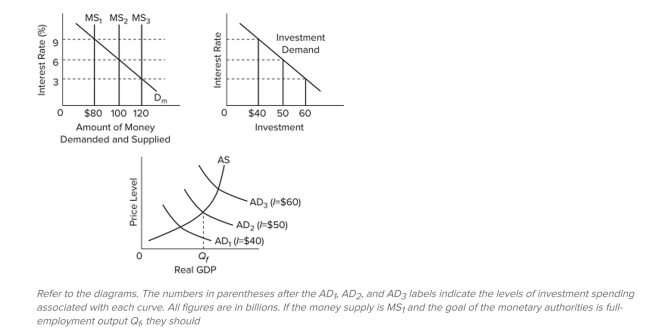
(91) 
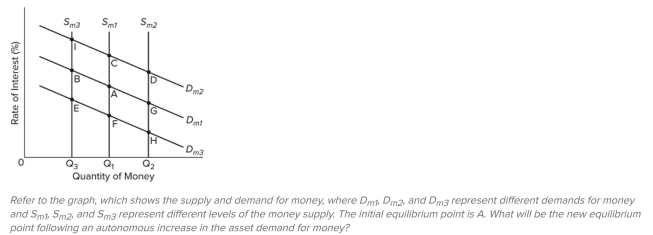
Restrictive monetary policy since the mortgage debt crisis
(Multiple Choice)
4.8/5 (70)
(70) Assume that the MPC is 0.75 and that the price level is "sticky." If the Federal Reserve increases the money supply and investment spending increases by $8 billion, then aggregate demand is likely to
(Multiple Choice)
4.9/5 (76)
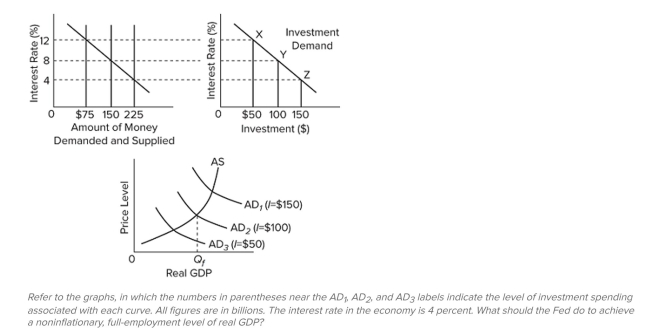
(76) 
When the Fed sells government securities in the open market, its intent is to try to increase aggregate demand.
(True/False)
4.8/5 (84)
(84) Assume the legal reserve ratio is 25 percent and the Fourth National Bank borrows $10,000 from the Federal Reserve Bank in its district. As a result,
(Multiple Choice)
4.9/5 (84)
(84) Prior to the mortgage debt crisis, the most frequently employed monetary policy tool was
(Multiple Choice)
4.9/5 (80)
(80) 
Filters
- Essay(0)
- Multiple Choice(0)
- Short Answer(0)
- True False(0)
- Matching(0)