



 Chat with AI
Exam 16: Interest Rates and Monetary Policy

Exam 2: The Market System and the Circular Flow274 Questions
Exam 3: Demand, Supply, and Market Equilibrium357 Questions
Exam 4: Market Failures Caused by Externalities Asymmetric Information222 Questions
Exam 5: Public Goods, Public Choice, and Government Failure242 Questions
Exam 6: An Introduction to Macroeconomics243 Questions
Exam 7: Measuring Domestic Output and National Income238 Questions
Exam 8: Economic Growth274 Questions
Exam 9: Business Cycles, Unemployment, and Inflation298 Questions
Exam 10: Basic Macroeconomic Relationships233 Questions
Exam 11: The Aggregate Expenditures Model126 Questions
Exam 12: Aggregate Demand and Aggregate Supply320 Questions
Exam 13: Fiscal Policy, Deficits, and Debt401 Questions
Exam 14: Money, Banking, and Financial Institutions265 Questions
Exam 15: Money Creation285 Questions
Exam 16: Interest Rates and Monetary Policy405 Questions
Exam 17: Financial Economics356 Questions
Exam 18: Extending the Analysis of Aggregate Supply268 Questions
Exam 19: Current Issues in Macro Theory and Policy279 Questions
Exam 20: International Trade339 Questions
Exam 21: The Balance of Payments, Exchange Rates, and Trade Deficits315 Questions
Exam 22: The Economics of Developing Countries269 Questions
Select questions type


According to the Taylor rule, if the target rate of inflation for the Fed is 2 percent and inflation rises to 3 percent at full unemployment, then the Fed should
(Multiple Choice)
4.7/5  (70)
(70) What does it mean when economists say that the Fed has attempted to "normalize" monetary policy after the Great Recession?
(Multiple Choice)
4.9/5 (69)
(69) There is an asset demand for money because households and business firms use money as a store of value.
(True/False)
4.9/5 (85)
(85) Which of the following statements about quantitative easing is most accurate?
(Multiple Choice)
4.9/5 (88)
(88) The Federal Reserve System regulates the money supply primarily by
(Multiple Choice)
4.8/5 (84)
(84) A consumer holds money to meet spending needs. This would be an example of the
(Multiple Choice)
4.9/5 (86)
(86) The purpose of an expansionary monetary policy is to shift the
(Multiple Choice)
5.0/5 (92)
(92) Interest Rate Asset Demand for Money (Billions) 7\% \ 200 6 300 5 400 4 500 Suppose that the transactions demand for money is equal to 20 percent of the nominal GDP, the supply of money is $800 billion, and the asset demand for money is that shown in the table. If the nominal GDP is $2,000 billion, the equilibrium interest rate is
(Multiple Choice)
4.9/5 (65)
(65) An increase in nominal GDP increases the demand for money because
(Multiple Choice)
4.7/5 (69)
(69) The price of a bond having no expiration date is originally $8,000 and has a fixed annual interest payment of $800. A fall in the price of the bond by $3,000 will provide a new buyer of the bond an interest rate of
(Multiple Choice)
4.8/5 (79)
(79) A wealthy executive is holding money, waiting for a good time to invest in the stock market. This action would be an example of the
(Multiple Choice)
5.0/5 (82)
(82) Which of the following is a difference between "quantitative easing" and ordinary open-market operations?
(Multiple Choice)
4.9/5 (72)
(72) If the Fed wants to maintain current interest rates, it would be buying government bonds in the open market when
(Multiple Choice)
4.9/5 (77)
(77) If the demand for money and the supply of money both decrease, the equilibrium
(Multiple Choice)
5.0/5 (84)
(84) 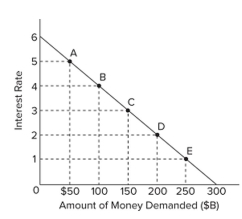 Refer to the graph. If the interest rate rises from 2 percent to 3 percent, the supply of money must have
 (Multiple Choice)
4.9/5 (75)
(75) 
Filters
- Essay(0)
- Multiple Choice(0)
- Short Answer(0)
- True False(0)
- Matching(0)