



 Chat with AI
Exam 16: Interest Rates and Monetary Policy

Exam 2: The Market System and the Circular Flow274 Questions
Exam 3: Demand, Supply, and Market Equilibrium357 Questions
Exam 4: Market Failures Caused by Externalities Asymmetric Information222 Questions
Exam 5: Public Goods, Public Choice, and Government Failure242 Questions
Exam 6: An Introduction to Macroeconomics243 Questions
Exam 7: Measuring Domestic Output and National Income238 Questions
Exam 8: Economic Growth274 Questions
Exam 9: Business Cycles, Unemployment, and Inflation298 Questions
Exam 10: Basic Macroeconomic Relationships233 Questions
Exam 11: The Aggregate Expenditures Model126 Questions
Exam 12: Aggregate Demand and Aggregate Supply320 Questions
Exam 13: Fiscal Policy, Deficits, and Debt401 Questions
Exam 14: Money, Banking, and Financial Institutions265 Questions
Exam 15: Money Creation285 Questions
Exam 16: Interest Rates and Monetary Policy405 Questions
Exam 17: Financial Economics356 Questions
Exam 18: Extending the Analysis of Aggregate Supply268 Questions
Exam 19: Current Issues in Macro Theory and Policy279 Questions
Exam 20: International Trade339 Questions
Exam 21: The Balance of Payments, Exchange Rates, and Trade Deficits315 Questions
Exam 22: The Economics of Developing Countries269 Questions
Select questions type


A liquidity trap occurs when the Federal Reserve reduces reserves in the system, choking off aggregate demand.
(True/False)
4.8/5  (70)
(70) The commercial banking system borrows from the Federal Reserve Banks. As a result, the checkable deposits
(Multiple Choice)
5.0/5 (73)
(73) If the Fed seeks to maintain a fixed targeted interest rate, then it will have to increase the money supply when the demand for money
increases as income increases.
(True/False)
4.8/5 (75)
(75)  Refer to the diagram of the market for money. The equilibrium interest rate is
 (Multiple Choice)
5.0/5 (76)
(76) The most frequently used instrument of the Federal Reserve System to control the money supply is the required reserve ratio.
(True/False)
4.8/5 (90)
(90) The interest rate at which the Federal Reserve Banks lend to commercial banks is called the
(Multiple Choice)
4.9/5 (82)
(82) If the quantity of money demanded exceeds the quantity supplied,
(Multiple Choice)
4.7/5 (71)
(71) The Federal Reserve Banks buy government securities from commercial banks. As a result, the checkable deposits
(Multiple Choice)
4.8/5 (89)
(89) (Advanced analysis) Assume the equation for the total demand for money is L = 0.4Y + 80 − 4i, where L is the amount of money demanded, Y is gross domestic product, and i is the interest rate. If gross domestic product is $200 and the interest rate is 10 (percent),
What amount of money will society want to hold?
(Multiple Choice)
4.9/5 (61)
(61) An interesting development that happened in late 2008, relating to the Fed and bank reserves, was that the Fed
(Multiple Choice)
4.8/5 (79)
(79) One new element of the Fed's open market operations is the use of government securities as collateral for loans to banks and other
financial institutions.
(True/False)
4.8/5 (84)
(84) Which of the monetary policy tools can alter both the level of excess reserves and the money multiplier?
(Multiple Choice)
4.8/5 (76)
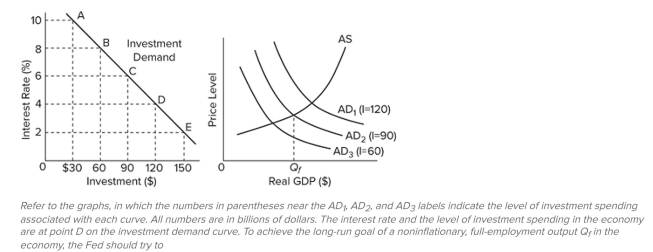
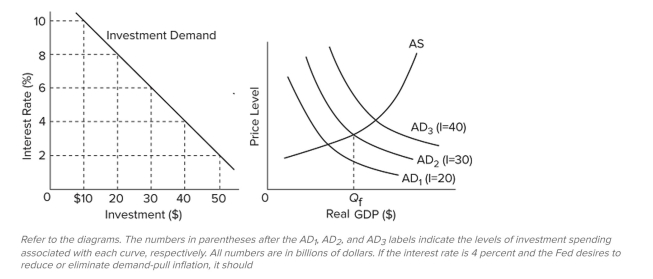
(76) 

Filters
- Essay(0)
- Multiple Choice(0)
- Short Answer(0)
- True False(0)
- Matching(0)