



 Chat with AI
Exam 17: Financial Economics

Exam 2: The Market System and the Circular Flow274 Questions
Exam 3: Demand, Supply, and Market Equilibrium357 Questions
Exam 4: Market Failures Caused by Externalities Asymmetric Information222 Questions
Exam 5: Public Goods, Public Choice, and Government Failure242 Questions
Exam 6: An Introduction to Macroeconomics243 Questions
Exam 7: Measuring Domestic Output and National Income238 Questions
Exam 8: Economic Growth274 Questions
Exam 9: Business Cycles, Unemployment, and Inflation298 Questions
Exam 10: Basic Macroeconomic Relationships233 Questions
Exam 11: The Aggregate Expenditures Model126 Questions
Exam 12: Aggregate Demand and Aggregate Supply320 Questions
Exam 13: Fiscal Policy, Deficits, and Debt401 Questions
Exam 14: Money, Banking, and Financial Institutions265 Questions
Exam 15: Money Creation285 Questions
Exam 16: Interest Rates and Monetary Policy405 Questions
Exam 17: Financial Economics356 Questions
Exam 18: Extending the Analysis of Aggregate Supply268 Questions
Exam 19: Current Issues in Macro Theory and Policy279 Questions
Exam 20: International Trade339 Questions
Exam 21: The Balance of Payments, Exchange Rates, and Trade Deficits315 Questions
Exam 22: The Economics of Developing Countries269 Questions
Select questions type


If an investor owns a well-diversified portfolio, then

Free
(Multiple Choice)
4.9/5  (79)
(79) Correct Answer: Verified
B
A change in investors' feelings about risk will change the intercept (and therefore shift) the Security
Market Line.
Free
(True/False)
4.8/5 (75)
(75) Correct Answer:Verified
VerifiedFalse
Which of the following statements best describes the relationship between risk and the average expected return of investments?
Free
(Multiple Choice)
4.7/5 (94)
(94) Correct Answer:Verified
VerifiedC
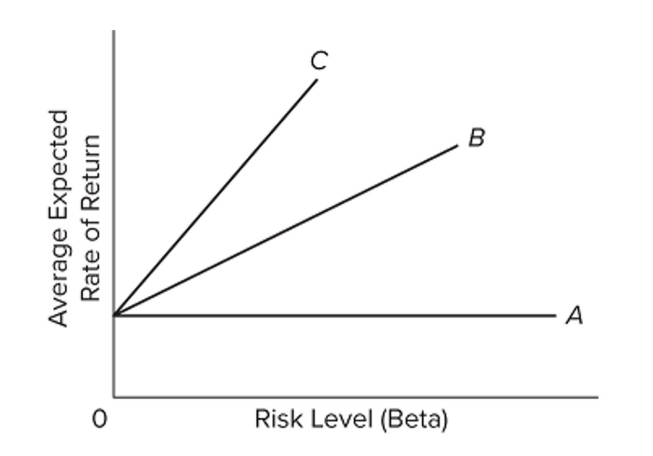 Refer to the graph. An increase in investor concern about risk would be shown by
 (Multiple Choice)
5.0/5 (71)
(71) The idea that money has "time value" refers to the fact that
(Multiple Choice)
4.8/5 (86)
(86) Lottery winners who take the lump-sum payouts instead of payments spread out over many years
(Multiple Choice)
4.8/5 (96)
(96) The maximum amount of money that company shareholders can lose on their investment in the corporation is
(Multiple Choice)
4.8/5 (85)
(85) Which of the following is a difference between stocks and bonds?
(Multiple Choice)
4.7/5 (89)
(89) After 4 years, a $5,000 investment earning a 6 percent annual interest rate will be worth more than
a $6,000 investment earning 1 percent annual interest.
(True/False)
4.7/5 (61)
(61) One fundamental concept in financial economics is that an investment's rate of return is
(Multiple Choice)
4.7/5 (67)
(67) 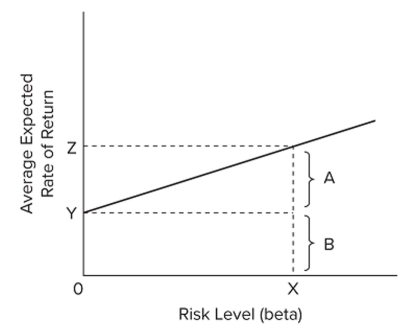 In the accompanying graph, point Y represents the
$800 invested at an annually compounded interest rate of 6 percent will be worth how much at the end of 10 years?
(Multiple Choice)
4.9/5 (79)
(79) What is considered to be the best measure of the risk-free interest rate?
(Multiple Choice)
4.8/5 (81)
(81) Meb owns stock in two similar, large, financially sound corporations. Company A consistently earns rates of return of 12 percent per year, while company B regularly generates rates of return of 8
Percent per year. If Meb is attempting to arbitrage, he will
(Multiple Choice)
4.7/5 (61)
(61) Economic investment refers to the buying or selling of any asset in expectation of a financial gain.
(True/False)
4.9/5 (81)
(81) 
Filters
- Essay(0)
- Multiple Choice(0)
- Short Answer(0)
- True False(0)
- Matching(0)