



 Chat with AI
Exam 17: Financial Economics

Exam 2: The Market System and the Circular Flow274 Questions
Exam 3: Demand, Supply, and Market Equilibrium357 Questions
Exam 4: Market Failures Caused by Externalities Asymmetric Information222 Questions
Exam 5: Public Goods, Public Choice, and Government Failure242 Questions
Exam 6: An Introduction to Macroeconomics243 Questions
Exam 7: Measuring Domestic Output and National Income238 Questions
Exam 8: Economic Growth274 Questions
Exam 9: Business Cycles, Unemployment, and Inflation298 Questions
Exam 10: Basic Macroeconomic Relationships233 Questions
Exam 11: The Aggregate Expenditures Model126 Questions
Exam 12: Aggregate Demand and Aggregate Supply320 Questions
Exam 13: Fiscal Policy, Deficits, and Debt401 Questions
Exam 14: Money, Banking, and Financial Institutions265 Questions
Exam 15: Money Creation285 Questions
Exam 16: Interest Rates and Monetary Policy405 Questions
Exam 17: Financial Economics356 Questions
Exam 18: Extending the Analysis of Aggregate Supply268 Questions
Exam 19: Current Issues in Macro Theory and Policy279 Questions
Exam 20: International Trade339 Questions
Exam 21: The Balance of Payments, Exchange Rates, and Trade Deficits315 Questions
Exam 22: The Economics of Developing Countries269 Questions
Select questions type


Arbitrage refers to the buying and selling activities that cause an equalization of the rates of return
on assets that have substantially different characteristics.
(True/False)
4.8/5  (64)
(64) Brinley holds stock in large high-tech companies in his portfolio. The best way for Brinley to diversify his risk would be to buy
(Multiple Choice)
4.8/5 (73)
(73) 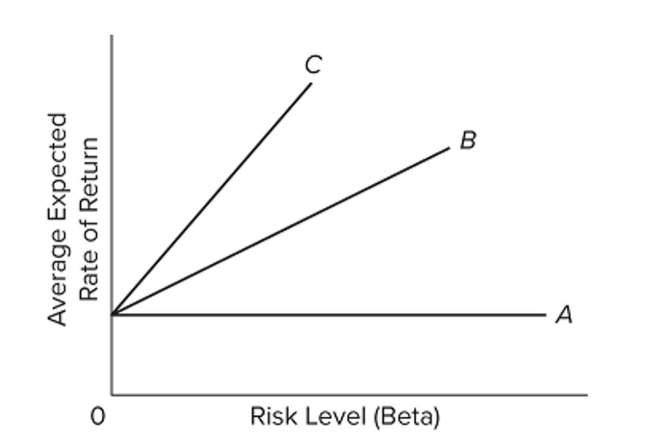 Refer to the graph. The intercept of the three Security Market Lines is determined by
 (Multiple Choice)
4.8/5 (80)
(80) Which of the following is a difference between stocks and bonds?
(Multiple Choice)
4.8/5 (91)
(91) Arbitrage occurs when investors try to profit from situations where
(Multiple Choice)
4.9/5 (72)
(72) Suppose that Betty takes out a loan for $300 at an annually compounded interest rate of 6 percent to be repaid after five years. How much will be required to pay off the loan at the end of the five
Years?
(Multiple Choice)
4.7/5 (81)
(81) Indy owns 100 shares of stock in Pet Mart Corporation that he purchased for $20 per share. Every year he has received, from company profits, $1 for each share he owns. If Indy sells all his shares at
A price of $30 per share, he will receive a
(Multiple Choice)
4.8/5 (80)
(80) 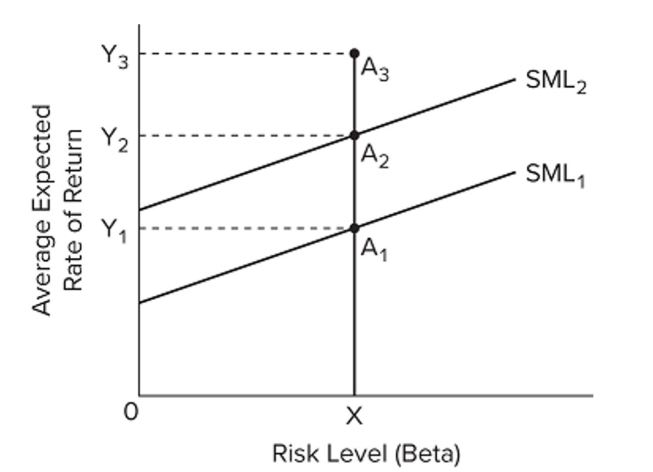 Refer to the graph. Which of the following would best be explained by an expansionary monetary policy?
 (Multiple Choice)
4.9/5 (89)
(89) A bond pays a coupon (or interest) rate of 5 percent each year for five years, with a future (face) value of $200. If the bond were sold today, what would be the present value of the bond?
(Multiple Choice)
4.9/5 (79)
(79) 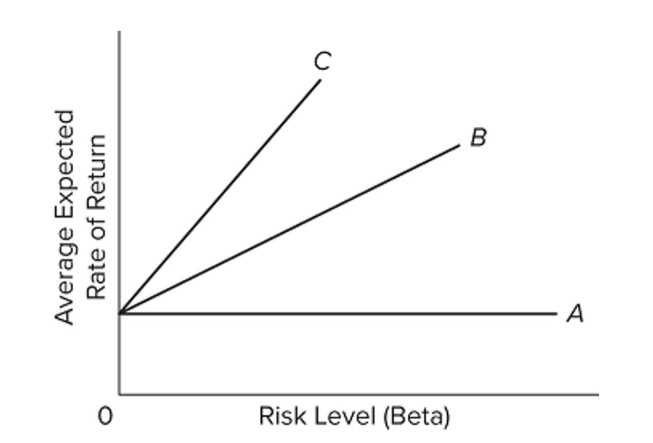 Refer to the graph. Which of the three Security Market Lines depicts the situation where investors most dislike risk?
 (Multiple Choice)
4.9/5 (81)
(81) Future value measures the present-day value of returns or costs expected to arrive in the future.
(True/False)
4.8/5 (81)
(81) "An investment's rate of return is inversely related to its price." Explain.
(Essay)
4.8/5 (70)
(70) Mutual funds allow individuals to own corporate stocks or bonds indirectly.
(True/False)
4.9/5 (79)
(79) Shawna bought an antique table for $200 last year and is now selling it for $250. Her rate of return on the table is
(Multiple Choice)
4.9/5 (86)
(86) Denny buys a rare coin for $200 and sells the coin one year later for $220. Denny's rate of return is
(Multiple Choice)
4.8/5 (83)
(83) Payments to shareholders from corporate profits are known as
(Multiple Choice)
4.9/5 (86)
(86) 
Filters
- Essay(0)
- Multiple Choice(0)
- Short Answer(0)
- True False(0)
- Matching(0)