



 Chat with AI
Exam 16: Interest Rates and Monetary Policy

Exam 2: The Market System and the Circular Flow274 Questions
Exam 3: Demand, Supply, and Market Equilibrium357 Questions
Exam 4: Market Failures Caused by Externalities Asymmetric Information222 Questions
Exam 5: Public Goods, Public Choice, and Government Failure242 Questions
Exam 6: An Introduction to Macroeconomics243 Questions
Exam 7: Measuring Domestic Output and National Income238 Questions
Exam 8: Economic Growth274 Questions
Exam 9: Business Cycles, Unemployment, and Inflation298 Questions
Exam 10: Basic Macroeconomic Relationships233 Questions
Exam 11: The Aggregate Expenditures Model126 Questions
Exam 12: Aggregate Demand and Aggregate Supply320 Questions
Exam 13: Fiscal Policy, Deficits, and Debt401 Questions
Exam 14: Money, Banking, and Financial Institutions265 Questions
Exam 15: Money Creation285 Questions
Exam 16: Interest Rates and Monetary Policy405 Questions
Exam 17: Financial Economics356 Questions
Exam 18: Extending the Analysis of Aggregate Supply268 Questions
Exam 19: Current Issues in Macro Theory and Policy279 Questions
Exam 20: International Trade339 Questions
Exam 21: The Balance of Payments, Exchange Rates, and Trade Deficits315 Questions
Exam 22: The Economics of Developing Countries269 Questions
Select questions type


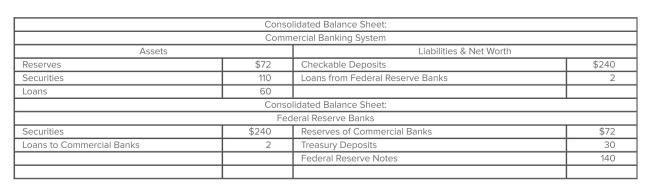 Refer to the given balance sheets. If the reserve ratio is 25 percent, the maximum money-creating potential of the commercial banking system is
 (Multiple Choice)
5.0/5  (58)
(58) 
Assume that the required reserve ratio is 25 percent. If the Federal Reserve sells $120 million in government securities to the general public, the money supply will immediately
(Multiple Choice)
4.8/5 (82)
(82) The Federal Reserve gives much more weight to inflation than to unemployment when considering policy actions.
(True/False)
4.8/5 (75)
(75) Other things equal, an increase in taxes on businesses will
(Multiple Choice)
4.8/5 (84)
(84) All else equal, when the Federal Reserve Banks engage in a restrictive monetary policy, the prices of government bonds usually
(Multiple Choice)
4.9/5 (74)
(74) Which of the following actions by the Fed most likely increase commercial bank lending?
(Multiple Choice)
5.0/5 (94)
(94) Assume that the commercial banking system has checkable deposits of $10 billion and excess reserves of $1 billion at a time when the reserve requirement is 20 percent. If the reserve requirement is now raised to 30 percent, the banking system then has
(Multiple Choice)
4.8/5 (68)
(68) Which of the following statements is most accurate about the Fed's use of the federal funds rate target since the 2008 financial crisis?
(Multiple Choice)
4.9/5 (81)
(81) 
If, in the market for money, the amount of money supplied exceeds the amount of money households and businesses want to hold, the interest rate will
(Multiple Choice)
4.7/5 (66)
(66) 
If nominal GDP is $600 billion and, on the average, each dollar is spent three times per year, then the amount of money demanded for transactions purposes will be
(Multiple Choice)
4.8/5 (76)
(76) Which of the following will increase commercial bank reserves?
(Multiple Choice)
5.0/5 (82)
(82) Money Supply Money Demand Interest Rate Investment (at Interest Rate Shown) \ 400 \ 600 2\% \ 700 \ 400 500 3 600 \ 400 400 4 500 \ 400 300 5 300 \ 400 200 6 200 Answer the question based on the information in the table. The equilibrium interest rate in this economy is
(Multiple Choice)
4.9/5 (78)
(78) Assume the Fed creates excess reserves in the banking system by buying government bonds, but banks do not make more loans because economic conditions are bad. This situation is a problem of
(Multiple Choice)
5.0/5 (80)
(80) If nominal GDP is $4,000 billion and the amount of money demanded for transactions purposes is $800 billion, it can generally be concluded that
(Multiple Choice)
4.7/5 (75)
(75) 
Filters
- Essay(0)
- Multiple Choice(0)
- Short Answer(0)
- True False(0)
- Matching(0)