



 Chat with AI
Exam 16: Interest Rates and Monetary Policy

Exam 2: The Market System and the Circular Flow274 Questions
Exam 3: Demand, Supply, and Market Equilibrium357 Questions
Exam 4: Market Failures Caused by Externalities Asymmetric Information222 Questions
Exam 5: Public Goods, Public Choice, and Government Failure242 Questions
Exam 6: An Introduction to Macroeconomics243 Questions
Exam 7: Measuring Domestic Output and National Income238 Questions
Exam 8: Economic Growth274 Questions
Exam 9: Business Cycles, Unemployment, and Inflation298 Questions
Exam 10: Basic Macroeconomic Relationships233 Questions
Exam 11: The Aggregate Expenditures Model126 Questions
Exam 12: Aggregate Demand and Aggregate Supply320 Questions
Exam 13: Fiscal Policy, Deficits, and Debt401 Questions
Exam 14: Money, Banking, and Financial Institutions265 Questions
Exam 15: Money Creation285 Questions
Exam 16: Interest Rates and Monetary Policy405 Questions
Exam 17: Financial Economics356 Questions
Exam 18: Extending the Analysis of Aggregate Supply268 Questions
Exam 19: Current Issues in Macro Theory and Policy279 Questions
Exam 20: International Trade339 Questions
Exam 21: The Balance of Payments, Exchange Rates, and Trade Deficits315 Questions
Exam 22: The Economics of Developing Countries269 Questions
Select questions type


After the 2008 financial crisis, why did the Federal Reserve effectively lose its ability to increase the money supply by manipulating the federal funds rate target?
(Multiple Choice)
4.9/5  (87)
(87) In a repo transaction (or repurchase agreement), the one "buying" the collateral asset (with the promise of selling it back soon) is the
(Multiple Choice)
4.9/5 (97)
(97) According to the Taylor rule, when the economy has a zero-unemployment gap and the inflation rate is equal to its target rate of 2 percent, the Fed's targeted interest rate should be
(Multiple Choice)
4.9/5 (69)
(69) Interest Rate Transactions Demand for Money Asset Demand for Money Money Supply 2\% \ 220 \ 300 4460 4 220 280 460 6 220 260 460 8 220 240 460 10 220 220 460 Based on the given table, an increase in the money supply of $20 billion will cause the equilibrium interest rate to
(Multiple Choice)
4.8/5 (79)
(79) Other things equal, an improvement in the expected rate of net profit would
(Multiple Choice)
4.8/5 (82)
(82) In the cause-effect chain linking changes in the banks' excess reserves and the resulting changes in output and employment in the economy,
(Multiple Choice)
4.8/5 (82)
(82) When the Fed pays interest on excess reserves held at Fed banks, the interest rate used is the discount rate.
(True/False)
4.9/5 (90)
(90) A decrease in the nominal GDP, other things remaining the same, will decrease both the total demand for money and the equilibrium
rate of interest in the economy.
(True/False)
4.7/5 (89)
(89) Suppose the economy is at full employment with a high inflation rate. Which combination of government policies is most likely to reduce the inflation rate?
(Multiple Choice)
4.9/5 (70)
(70)  Refer to the diagram of the market for money. Other things equal, the money demand curve in the diagram would shift leftward if
 (Multiple Choice)
4.8/5 (74)
(74) In 2008, at the depth of the Great Recession, the Fed moved toward a ZIRP when it aimed to keep the Federal funds rate between
(Multiple Choice)
4.8/5 (97)
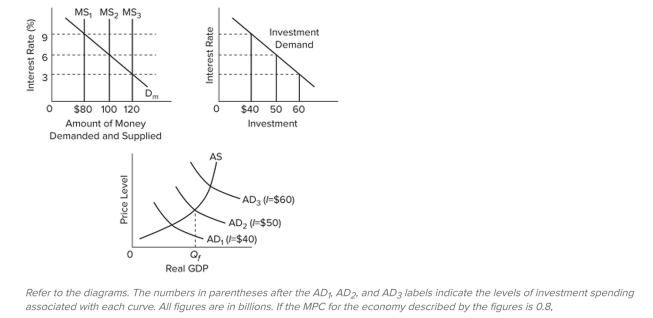
(97) 
A restrictive monetary policy reduces investment spending and shifts the economy's aggregate demand curve to the right.
(True/False)
4.8/5 (83)
(83) The major problem facing the economy is high unemployment and weak economic growth. The inflation rate is low and stable. Therefore, the Federal Reserve decides to pursue a policy to increase the rate of economic growth. Which policy changes by the Fed
Would tend to offset each other in trying to achieve that objective?
(Multiple Choice)
4.9/5 (87)
(87) All else equal, when the Federal Reserve Banks engage in an expansionary monetary policy, the interest rates received on government bonds usually
(Multiple Choice)
4.9/5 (92)
(92) A few years ago, you bought a bond with no expiration and a fixed annual interest payment of $1,000 at a price of $10,000. If the interest rate in the economy is now 12.5 percent a year and you want to sell the bond, the maximum price that you can get for it is
(Multiple Choice)
4.9/5 (86)
(86) The price of a bond with no expiration date is originally $1,000 and has a fixed annual interest payment of $150. If the price of the bond then falls by $100, what will be the interest rate yield to a new buyer of the bond?
(Multiple Choice)
4.8/5 (78)
(78) Other things equal, an expansionary monetary policy will shift the economy's aggregate demand curve to the right.
(True/False)
4.9/5 (70)
(70) 
Filters
- Essay(0)
- Multiple Choice(0)
- Short Answer(0)
- True False(0)
- Matching(0)