



 Chat with AI
Exam 16: Interest Rates and Monetary Policy

Exam 2: The Market System and the Circular Flow274 Questions
Exam 3: Demand, Supply, and Market Equilibrium357 Questions
Exam 4: Market Failures Caused by Externalities Asymmetric Information222 Questions
Exam 5: Public Goods, Public Choice, and Government Failure242 Questions
Exam 6: An Introduction to Macroeconomics243 Questions
Exam 7: Measuring Domestic Output and National Income238 Questions
Exam 8: Economic Growth274 Questions
Exam 9: Business Cycles, Unemployment, and Inflation298 Questions
Exam 10: Basic Macroeconomic Relationships233 Questions
Exam 11: The Aggregate Expenditures Model126 Questions
Exam 12: Aggregate Demand and Aggregate Supply320 Questions
Exam 13: Fiscal Policy, Deficits, and Debt401 Questions
Exam 14: Money, Banking, and Financial Institutions265 Questions
Exam 15: Money Creation285 Questions
Exam 16: Interest Rates and Monetary Policy405 Questions
Exam 17: Financial Economics356 Questions
Exam 18: Extending the Analysis of Aggregate Supply268 Questions
Exam 19: Current Issues in Macro Theory and Policy279 Questions
Exam 20: International Trade339 Questions
Exam 21: The Balance of Payments, Exchange Rates, and Trade Deficits315 Questions
Exam 22: The Economics of Developing Countries269 Questions
Select questions type


If the Fed buys government securities from commercial banks in the open market,
(Multiple Choice)
4.8/5  (99)
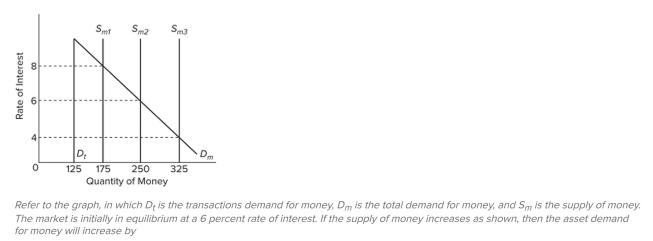
(99) 
Commercial bank reserves, most of which are held by the Federal Reserve Banks, are
(Multiple Choice)
4.8/5 (72)
(72) In recent years (after the financial crisis of 2008), the Fed has added a new element to its open-market operations, which is
(Multiple Choice)
4.8/5 (81)
(81) The Fed's inability to stimulate the economy by reducing interest rates is known as the
(Multiple Choice)
4.8/5 (91)
(91) Which of the following Fed actions increases the excess reserves of commercial banks?
(Multiple Choice)
4.8/5 (82)
(82) Assume that a single commercial bank has no excess reserves and that the reserve ratio is 20 percent. If this bank sells a bond for $1,000 to a Federal Reserve Bank, it can expand its loans by a maximum of
(Multiple Choice)
4.8/5 (97)
(97) Interest Rate Asset Demand for Money (Billions) 7\% \ 200 6 300 5 400 4 500 Refer to the table. Suppose that the transactions demand for money is $300 billion and the money supply is $700 billion. A decrease in the money supply to $600 billion would cause the interest rate to
(Multiple Choice)
4.9/5 (70)
(70) An expansionary monetary policy may be less effective than a restrictive monetary policy because
(Multiple Choice)
4.9/5 (77)
(77) The discount rate is the interest rate at which commercial banks lend to their best corporate customers.
(True/False)
4.7/5 (81)
(81) The interest rate that banks charge one another for the loan of excess reserves is the
(Multiple Choice)
4.8/5 (93)
(93) Item in Balance Sheet Amount 1) Treasury Deposits \ 7 2) Reserves of Commercial Banks 31 3) Federal Reserve Notes 275 4) Loans to Commercial Banks 1 5) All Other Assets 64 6) Securities 255 7) All Other Liabilities and Net Worth 7 The table shows items and ?gures taken from a consolidated balance sheet of the 12 Federal Reserve Banks. All ?gures are in billions of dollars. In this balance sheet, the liabilities and net worth would be items 7 and
(Multiple Choice)
4.8/5 (66)
(66) Before the financial crisis of 2008, expansionary monetary policy would have entailed the Fed targeting a lower federal funds rate and
using open-market purchases to increase bank reserves to cause the federal funds rate to hit its target.
(True/False)
4.7/5 (82)
(82) A television report states: "The Federal Reserve will lower the discount rate for the fourth time this year." This report indicates that the Federal Reserve is most likely trying to
(Multiple Choice)
4.7/5 (73)
(73) If the Board of Governors of the Federal Reserve System increases the legal reserve ratio, this change will
(Multiple Choice)
4.9/5 (71)
(71) If the demand for money increases and the Fed wants interest rates to remain unchanged, which of the following would be appropriate policy?
(Multiple Choice)
4.8/5 (67)
(67)  Refer to the diagram of the market for money. The downward slope of the money demand curve is best explained in terms of the
 (Multiple Choice)
4.9/5 (87)
(87) Which of the following best describes what occurs when monetary authorities sell government securities?
(Multiple Choice)
4.8/5 (75)
(75) The Fed, at the end of 2015, announced its intent to start "normalizing" monetary policy and returning short-term interest rates to their normal range. Its normalization plan had two major tools,
(Multiple Choice)
4.8/5 (77)
(77) 
Filters
- Essay(0)
- Multiple Choice(0)
- Short Answer(0)
- True False(0)
- Matching(0)