



 Chat with AI
Exam 16: Interest Rates and Monetary Policy

Exam 2: The Market System and the Circular Flow274 Questions
Exam 3: Demand, Supply, and Market Equilibrium357 Questions
Exam 4: Market Failures Caused by Externalities Asymmetric Information222 Questions
Exam 5: Public Goods, Public Choice, and Government Failure242 Questions
Exam 6: An Introduction to Macroeconomics243 Questions
Exam 7: Measuring Domestic Output and National Income238 Questions
Exam 8: Economic Growth274 Questions
Exam 9: Business Cycles, Unemployment, and Inflation298 Questions
Exam 10: Basic Macroeconomic Relationships233 Questions
Exam 11: The Aggregate Expenditures Model126 Questions
Exam 12: Aggregate Demand and Aggregate Supply320 Questions
Exam 13: Fiscal Policy, Deficits, and Debt401 Questions
Exam 14: Money, Banking, and Financial Institutions265 Questions
Exam 15: Money Creation285 Questions
Exam 16: Interest Rates and Monetary Policy405 Questions
Exam 17: Financial Economics356 Questions
Exam 18: Extending the Analysis of Aggregate Supply268 Questions
Exam 19: Current Issues in Macro Theory and Policy279 Questions
Exam 20: International Trade339 Questions
Exam 21: The Balance of Payments, Exchange Rates, and Trade Deficits315 Questions
Exam 22: The Economics of Developing Countries269 Questions
Select questions type


What are the two reasons that people want to hold money? In other words, what are the two types of demand for money?
(Essay)
4.8/5  (79)
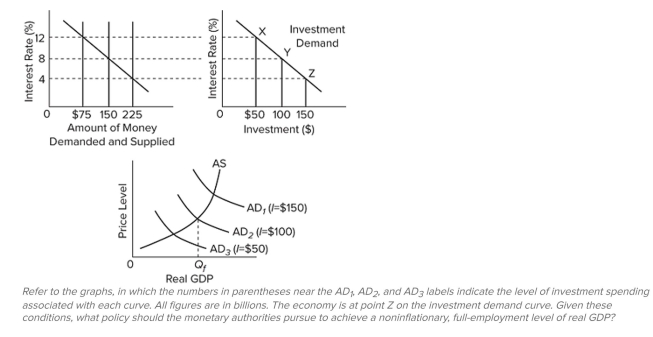
(79) 
In a repo transaction, the Fed _______ money; in a reverse repo transaction, the Fed _______ money.
(Multiple Choice)
4.7/5 (84)
(84) Which of the following statements about quantitative easing (or "QE") and open-market purchase is true?
(Multiple Choice)
5.0/5 (78)
(78) Assume that the required reserve ratio is 20 percent. If the Federal Reserve buys $80 million in government securities from the general public, then the money supply will immediately
(Multiple Choice)
4.8/5 (92)
(92) It is inconceivable and impossible for a central bank to pursue a negative-interest rate policy because interest rates simply cannot turn
negative.
(True/False)
4.9/5 (82)
(82) The asset demand for money is most closely related to money functioning as a
(Multiple Choice)
4.9/5 (78)
(78) A change in the reserve ratio will affect both the amount of the banking system's excess reserves and the multiple by which the system
can lend based on excess reserves.
(True/False)
4.8/5 (89)
(89) Which of the following Fed actions will decrease the money supply?
(Multiple Choice)
4.8/5 (79)
(79) The major advantages of monetary policy include its flexibility, speed, and political palatability.
(True/False)
4.8/5 (86)
(86) In traditional (before 2008) analysis, an autonomous increase in investment spending when the economy is at full employment will
cause the Fed to seek a lower target for the federal funds rate by buying securities in the open market.
(True/False)
4.9/5 (71)
(71) Which of the following is the most accurate description of events when monetary authorities increase the size of commercial banks' excess reserves?
(Multiple Choice)
4.9/5 (70)
(70) The total demand for money curve will shift to the right as a result of
(Multiple Choice)
4.8/5 (69)
(69) Which of the following statements is most accurate about the Fed's zero interest rate policy (ZIRP)?
(Multiple Choice)
4.9/5 (94)
(94) If the monetary authorities wished to rein in inflation, they would buy government securities in the open market.
(True/False)
4.8/5 (75)
(75) When the Fed loans money in exchange for government bonds being posted as collateral, this is known as a
(Multiple Choice)
4.8/5 (85)
(85) Suppose the Federal Reserve Banks sell $2 billion of government bonds to the public, which pays for them by drawing checks. As a result, commercial bank reserves will
(Multiple Choice)
4.9/5 (82)
(82) 
Filters
- Essay(0)
- Multiple Choice(0)
- Short Answer(0)
- True False(0)
- Matching(0)