



 Chat with AI
Exam 16: Interest Rates and Monetary Policy

Exam 2: The Market System and the Circular Flow274 Questions
Exam 3: Demand, Supply, and Market Equilibrium357 Questions
Exam 4: Market Failures Caused by Externalities Asymmetric Information222 Questions
Exam 5: Public Goods, Public Choice, and Government Failure242 Questions
Exam 6: An Introduction to Macroeconomics243 Questions
Exam 7: Measuring Domestic Output and National Income238 Questions
Exam 8: Economic Growth274 Questions
Exam 9: Business Cycles, Unemployment, and Inflation298 Questions
Exam 10: Basic Macroeconomic Relationships233 Questions
Exam 11: The Aggregate Expenditures Model126 Questions
Exam 12: Aggregate Demand and Aggregate Supply320 Questions
Exam 13: Fiscal Policy, Deficits, and Debt401 Questions
Exam 14: Money, Banking, and Financial Institutions265 Questions
Exam 15: Money Creation285 Questions
Exam 16: Interest Rates and Monetary Policy405 Questions
Exam 17: Financial Economics356 Questions
Exam 18: Extending the Analysis of Aggregate Supply268 Questions
Exam 19: Current Issues in Macro Theory and Policy279 Questions
Exam 20: International Trade339 Questions
Exam 21: The Balance of Payments, Exchange Rates, and Trade Deficits315 Questions
Exam 22: The Economics of Developing Countries269 Questions
Select questions type


The Federal Reserve Banks sell government securities to the public. As a result, the checkable deposits
(Multiple Choice)
4.8/5  (75)
(75) The possible asymmetry of monetary policy is the central idea of the
(Multiple Choice)
4.8/5 (66)
(66) When the Federal Reserve acts to tighten money and credit in the economy, it is trying to reduce
(Multiple Choice)
4.8/5 (81)
(81) Raising the interest paid on reserves has the effect of making it
(Multiple Choice)
4.9/5 (73)
(73) Assuming government wishes to either increase or decrease the level of aggregate demand, which of the following pairs are not consistent policy measures?
(Multiple Choice)
4.9/5 (82)
(82) Suppose that, for every 1-percentage-point decline in the discount rate, commercial banks collectively borrow an additional $2 billion from Federal Reserve Banks. Also assume that the reserve ratio is 10 percent. If the Fed lowers the discount rate from 4.0 percent to
3)5 percent, bank reserves will
(Multiple Choice)
4.9/5 (84)
(84) One of the advantages of monetary policy is its speed and flexibility, but there are limitations. Explain.
(Essay)
4.8/5 (81)
(81) When the interest rate in the economy was 10 percent, the price of a bond with no expiration date that paid a fixed annual interest of $500 was $5,000. If the interest rate in the economy falls to 6 percent, the price of this bond will be about
(Multiple Choice)
4.7/5 (96)
(96) 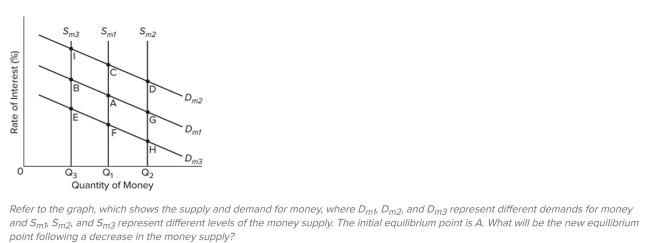
 Refer to the given market-for-money diagrams. If each dollar held for transactions is spent four times per year on the average, we can infer that
 (Multiple Choice)
4.7/5 (72)
(72)  Refer to the given market-for-money diagrams. If the interest rate was at 3 percent, people would
 (Multiple Choice)
4.8/5 (83)
(83) Define the Federal Reserve's dual mandate, and explain how the Fed complies with this congressional directive.
(Essay)
4.8/5 (70)
(70) 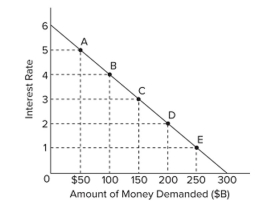 Refer to the graph. If the supply of money was $200 billion, the interest rate would be
 (Multiple Choice)
4.8/5 (78)
(78) Repos are a tool used by the Fed to increase bank reserves and encourage lending.
(True/False)
4.9/5 (86)
(86) In the recent financial and economic crises, the economy fell into a so-called liquidity trap, which means that
(Multiple Choice)
4.9/5 (87)
(87) If the Fed sells government securities to the general public in the open market,
(Multiple Choice)
4.7/5 (67)
(67) The lending ability of commercial banks increases when the
(Multiple Choice)
4.9/5 (72)
(72) 
Filters
- Essay(0)
- Multiple Choice(0)
- Short Answer(0)
- True False(0)
- Matching(0)