



 Chat with AI
Exam 16: Interest Rates and Monetary Policy

Exam 2: The Market System and the Circular Flow274 Questions
Exam 3: Demand, Supply, and Market Equilibrium357 Questions
Exam 4: Market Failures Caused by Externalities Asymmetric Information222 Questions
Exam 5: Public Goods, Public Choice, and Government Failure242 Questions
Exam 6: An Introduction to Macroeconomics243 Questions
Exam 7: Measuring Domestic Output and National Income238 Questions
Exam 8: Economic Growth274 Questions
Exam 9: Business Cycles, Unemployment, and Inflation298 Questions
Exam 10: Basic Macroeconomic Relationships233 Questions
Exam 11: The Aggregate Expenditures Model126 Questions
Exam 12: Aggregate Demand and Aggregate Supply320 Questions
Exam 13: Fiscal Policy, Deficits, and Debt401 Questions
Exam 14: Money, Banking, and Financial Institutions265 Questions
Exam 15: Money Creation285 Questions
Exam 16: Interest Rates and Monetary Policy405 Questions
Exam 17: Financial Economics356 Questions
Exam 18: Extending the Analysis of Aggregate Supply268 Questions
Exam 19: Current Issues in Macro Theory and Policy279 Questions
Exam 20: International Trade339 Questions
Exam 21: The Balance of Payments, Exchange Rates, and Trade Deficits315 Questions
Exam 22: The Economics of Developing Countries269 Questions
Select questions type


When the Fed undertakes reverse repo transactions with financial institutions, it is trying to
(Multiple Choice)
4.8/5  (74)
(74) Changes in the interest rate are more likely to affect investment spending than consumer spending.
(True/False)
4.9/5 (88)
(88) Even after the financial crisis, the federal funds rate target remains the most frequently used monetary policy tool.
(True/False)
4.7/5 (77)
(77) According to the Taylor rule, if the current inflation rate is 5 percent and the current unemployment rate is 3.8 percent, the Fed's targeted interest rate should be
(Multiple Choice)
4.8/5 (82)
(82) Assume that the required reserve ratio for the commercial banks is 25 percent. If the Federal Reserve Banks buy $3 billion in government securities from the nonbank securities dealers, then, as a result of this transaction, the lending ability of the commercial
Banking system will increase by
(Multiple Choice)
4.8/5 (63)
(63) Other things equal, an appreciation of the U.S. dollar would
(Multiple Choice)
4.8/5 (78)
(78)  Refer to the given balance sheets. If the reserve ratio is 25 percent, commercial banks have excess reserves of
 (Multiple Choice)
4.8/5 (70)
(70) On a diagram where the interest rate and the quantity of money demanded are shown on the vertical and horizontal axes respectively, the asset demand for money can be represented by
(Multiple Choice)
4.8/5 (81)
(81) Assume the reserve ratio is 25 percent and Federal Reserve Banks buy $4 million of U.S. securities from the public, which deposits this amount into checking accounts. As a result of these transactions, the supply of money is
(Multiple Choice)
4.7/5 (78)
(78) Assume the commercial banking system has checkable deposits of $20 billion and excess reserves of $2 billion when the reserve ratio is 25 percent. If the reserve ratio is then lowered to 20 percent, we can conclude that the
(Multiple Choice)
4.8/5 (72)
(72) In economics, the expression "You can lead a horse to water, but you can't make it drink" illustrates the
(Multiple Choice)
4.9/5 (73)
(73) When the Fed raises interest rates on excess reserves, they are attempting to encourage bank lending.
(True/False)
4.9/5 (76)
(76) When the Fed undertakes a "repo" transaction with a financial institution, the Fed in essence
(Multiple Choice)
5.0/5 (66)
(66) 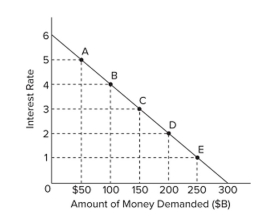 Refer to the graph. If the initial equilibrium interest rate was 5 percent and the money supply increased by $100 billion, then the new interest rate would be
 (Multiple Choice)
4.9/5 (82)
(82) Suppose the economy is experiencing a recession and high unemployment. How would an expansionary monetary policy address this
problem?
(Essay)
4.9/5 (88)
(88) Other things equal, a restrictive monetary policy during a period of demand-pull inflation will
(Multiple Choice)
4.9/5 (87)
(87) If the Fed is trying to make interest rates go down, it may want
(Multiple Choice)
4.9/5 (92)
(92) Before the financial crisis of 2008, restrictive monetary policy by the Fed involved
(Multiple Choice)
4.9/5 (84)
(84) 
Filters
- Essay(0)
- Multiple Choice(0)
- Short Answer(0)
- True False(0)
- Matching(0)