



 Chat with AI
Exam 16: Interest Rates and Monetary Policy

Exam 2: The Market System and the Circular Flow274 Questions
Exam 3: Demand, Supply, and Market Equilibrium357 Questions
Exam 4: Market Failures Caused by Externalities Asymmetric Information222 Questions
Exam 5: Public Goods, Public Choice, and Government Failure242 Questions
Exam 6: An Introduction to Macroeconomics243 Questions
Exam 7: Measuring Domestic Output and National Income238 Questions
Exam 8: Economic Growth274 Questions
Exam 9: Business Cycles, Unemployment, and Inflation298 Questions
Exam 10: Basic Macroeconomic Relationships233 Questions
Exam 11: The Aggregate Expenditures Model126 Questions
Exam 12: Aggregate Demand and Aggregate Supply320 Questions
Exam 13: Fiscal Policy, Deficits, and Debt401 Questions
Exam 14: Money, Banking, and Financial Institutions265 Questions
Exam 15: Money Creation285 Questions
Exam 16: Interest Rates and Monetary Policy405 Questions
Exam 17: Financial Economics356 Questions
Exam 18: Extending the Analysis of Aggregate Supply268 Questions
Exam 19: Current Issues in Macro Theory and Policy279 Questions
Exam 20: International Trade339 Questions
Exam 21: The Balance of Payments, Exchange Rates, and Trade Deficits315 Questions
Exam 22: The Economics of Developing Countries269 Questions
Select questions type


 Refer to the given market-for-money diagrams. The total demand for money is shown by
 (Multiple Choice)
4.7/5  (90)
(90) Which of the following is correct? When the Federal Reserve buys government securities from the public, the money supply
(Multiple Choice)
4.8/5 (81)
(81) Explain what is meant by a collateralized money loan. Provide an example.
(Essay)
4.9/5 (79)
(79) Assume that U.S. National Bank has no excess reserves and that the reserve ratio is 20 percent. If U.S. National borrows $5 million from a Federal Reserve Bank through a repo transaction, it can expand its loans by a maximum of
(Multiple Choice)
4.8/5 (94)
(94) The interest rate that banks charge one another on overnight loans is called the
(Multiple Choice)
4.8/5 (74)
(74)  Refer to the given market-for-money diagrams. The asset demand for money is shown by
 (Multiple Choice)
4.8/5 (71)
(71) 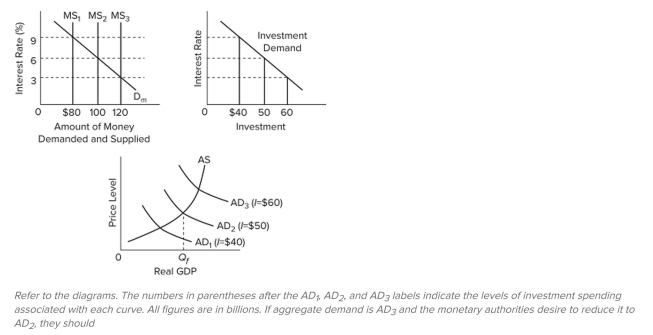
Which of the following tools of monetary policy is flexible and able to affect bank reserves quickly and by relatively specific amounts?
(Multiple Choice)
4.9/5 (85)
(85) Upon which of the following industries is a restrictive monetary policy likely to be most effective?
(Multiple Choice)
4.8/5 (78)
(78) In traditional monetary policy, if the Fed targeted a lower federal funds rate, then it was pursuing a restrictive monetary policy.
(True/False)
5.0/5 (87)
(87) The increase in excess reserves that occurred as a result of the mortgage debt crisis
(Multiple Choice)
4.9/5 (78)
(78) Which of the following would not be a consequence of negative interest rates?
(Multiple Choice)
5.0/5 (84)
(84) Which of the following actions by the Fed would cause the money supply to increase?
(Multiple Choice)
4.7/5 (78)
(78) Item in Balance Sheet Amount 1) Treasury Deposits \ 7 2) Reserves of Commercial Banks 31 3) Federal Reserve Notes 275 4) Loans to Commercial Banks 1 5) All Other Assets 64 6) Securities 255 7) All Other Liabilities and Net Worth 7 The table shows items and ?gures taken from a consolidated balance sheet of the 12 Federal Reserve Banks. All ?gures are in billions of dollars. In this balance sheet, there would be assets of
(Multiple Choice)
4.7/5 (83)
(83) The major purpose of the Federal Reserve buying government securities in open-market operations is to
(Multiple Choice)
4.8/5 (94)
(94) When commercial banks borrow from the Federal Reserve Banks, they decrease their excess reserves and their money-creating
potential.
(True/False)
4.9/5 (97)
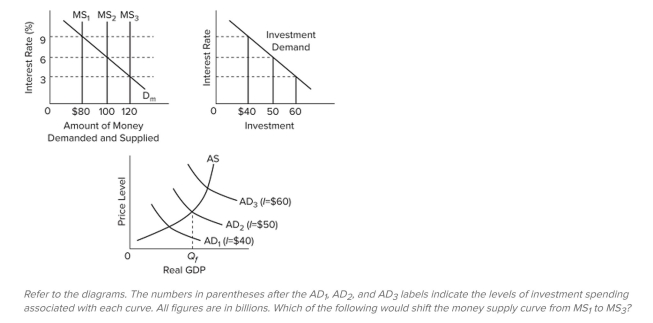
(97) 

Filters
- Essay(0)
- Multiple Choice(0)
- Short Answer(0)
- True False(0)
- Matching(0)