



 Chat with AI
Exam 16: Interest Rates and Monetary Policy

Exam 2: The Market System and the Circular Flow274 Questions
Exam 3: Demand, Supply, and Market Equilibrium357 Questions
Exam 4: Market Failures Caused by Externalities Asymmetric Information222 Questions
Exam 5: Public Goods, Public Choice, and Government Failure242 Questions
Exam 6: An Introduction to Macroeconomics243 Questions
Exam 7: Measuring Domestic Output and National Income238 Questions
Exam 8: Economic Growth274 Questions
Exam 9: Business Cycles, Unemployment, and Inflation298 Questions
Exam 10: Basic Macroeconomic Relationships233 Questions
Exam 11: The Aggregate Expenditures Model126 Questions
Exam 12: Aggregate Demand and Aggregate Supply320 Questions
Exam 13: Fiscal Policy, Deficits, and Debt401 Questions
Exam 14: Money, Banking, and Financial Institutions265 Questions
Exam 15: Money Creation285 Questions
Exam 16: Interest Rates and Monetary Policy405 Questions
Exam 17: Financial Economics356 Questions
Exam 18: Extending the Analysis of Aggregate Supply268 Questions
Exam 19: Current Issues in Macro Theory and Policy279 Questions
Exam 20: International Trade339 Questions
Exam 21: The Balance of Payments, Exchange Rates, and Trade Deficits315 Questions
Exam 22: The Economics of Developing Countries269 Questions
Select questions type


Disequilibrium in the money market is mainly corrected via a change in
(Multiple Choice)
5.0/5  (86)
(86) If the Fed wants to discourage commercial bank lending, it will
(Multiple Choice)
4.8/5 (88)
(88) If there is a 2 percent unemployment gap and the inflation rate is 1 percent, then according to the Taylor rule, the Fed should make their targeted interest rate
(Multiple Choice)
4.8/5 (90)
(90) Which of the following tools of monetary policy is considered the most important on a day-to-day basis?
(Multiple Choice)
4.9/5 (96)
(96) If the Fed reduces the interest paid on banks' reserves, it is trying to make banks hold
(Multiple Choice)
4.7/5 (81)
(81) The main tools that the Fed can use to alter the reserves of commercial banks are the required-reserve ratio and all of the following, except
(Multiple Choice)
4.9/5 (84)
(84) Trace the cause-effect chain that results from an expansionary monetary policy.
(Essay)
4.9/5 (71)
(71) Which of the following is considered a limitation of monetary policy?
(Multiple Choice)
4.9/5 (76)
(76) According to the Taylor rule, if there is no unemployment gap and
(Multiple Choice)
4.9/5 (74)
(74) If the economy is operating in the relatively steep (upper) portion of its aggregate supply curve, a reduction in the money supply will
(Multiple Choice)
4.7/5 (81)
(81) As expansionary monetary policy tools, quantitative easing (QE) and traditional open-market purchases differ in all of the following, except
(Multiple Choice)
4.9/5 (75)
(75) Quantitative easing (QE) differs from open-market purchases in that QE shrinks the assets of the Fed, whereas open market purchases
expand the Fed's assets.
(True/False)
5.0/5 (76)
(76) Which of the following is not a result of policy actions taken by the Fed since the financial crisis in 2008?
(Multiple Choice)
4.9/5 (82)
(82)  Refer to the given market-for-money diagrams. Curve represents the
 (Multiple Choice)
4.8/5 (83)
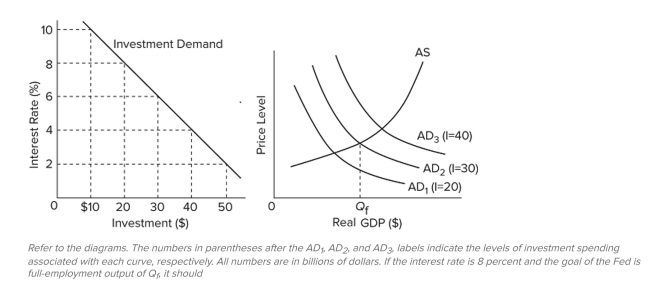
(83) 

Filters
- Essay(0)
- Multiple Choice(0)
- Short Answer(0)
- True False(0)
- Matching(0)