



 Chat with AI
Exam 4: The Market Forces of Supply and Demand

Exam 1: Ten Lessons From Economics146 Questions
Exam 2: Thinking Like an Economist133 Questions
Exam 3: Interdependence and the Gains From Trade139 Questions
Exam 4: The Market Forces of Supply and Demand215 Questions
Exam 5: Elasticity and Its Application178 Questions
Exam 6: Supply, Demand and Government Policies145 Questions
Exam 7: Consumers, Producers and the Efficiency of Markets171 Questions
Exam 8: Application: the Costs of Taxation135 Questions
Exam 9: Application: International Trade151 Questions
Exam 10: Externalities199 Questions
Exam 11: Public Goods and Common Resources178 Questions
Exam 12: The Design of the Tax System154 Questions
Exam 13: The Costs of Production191 Questions
Exam 14: Firms in Competitive Markets198 Questions
Exam 15: Monopoly212 Questions
Exam 16: Monopolistic Competition212 Questions
Exam 17: Business Strategy and Oligopoly179 Questions
Exam 18: Competition Policy103 Questions
Exam 19: The Markets for the Factors of Production214 Questions
Exam 20: Earnings, Unions and Discrimination201 Questions
Exam 21: Income Inequity and Poverty111 Questions
Exam 22: The Theory of Consumer Choice158 Questions
Exam 23: Frontiers of Microeconomics111 Questions
Exam 24: Measuring a Nations Income51 Questions
Exam 25: Measuring the Cost of Living55 Questions
Exam 26: Production and Growth62 Questions
Exam 27: Saving, Investment and the Financial System62 Questions
Exam 28: The Natural Rate of Unemployment58 Questions
Exam 29: The Monetary System66 Questions
Exam 30: Inflation: Its Causes and Costs74 Questions
Exam 31: Open-Economy Macroeconomics: Basic Concepts68 Questions
Exam 32: A Macroeconomic Theory of the Open Economy61 Questions
Exam 33: Aggregate Demand and Aggregate Supply81 Questions
Exam 34: The Influence of Monetary and Fiscal Policy on Aggregate Demand73 Questions
Exam 35: The Short-Run Trade-Off Between Inflation and Unemployment57 Questions
Exam 36: Global Financial Crisis of 2008 and Beyond37 Questions
Exam 37: Five Debates Over Macroeconomic Policy38 Questions
Select questions type


It is not possible for demand and supply to shift at the same time.
(True/False)
4.9/5  (74)
(74) Table 4-2
-Refer to Table 4-2.In the table shown, if the price were $10:
(Multiple Choice)
4.9/5 (101)
(101) In a market economy, prices determine who produces each good and how much is produced.
(True/False)
4.8/5 (89)
(89) A competitive market is one in which sellers and buyers can choose the price at which they wish to buy or sell goods.
(True/False)
4.7/5 (85)
(85) Given the following supply schedule, graph Lee's supply of croissants.
(Essay)
4.8/5 (90)
(90) If a tupperware company discovers that the price of plastic has risen by 10%, the company will decide to supply more tupperware to the market.
(True/False)
4.8/5 (90)
(90) Holding all else constant, a decrease in the price of mobile phones will:
(Multiple Choice)
4.9/5 (90)
(90) Table 4-1
A market is represented by the table below:
Quantities demanded:
Price of the good John Lee Amy Jean \ 0.50 36 25 12 5 1.00 30 22 8 4 2.00 25 20 3 3 3.00 20 19 1 2 4.00 10 18 0 1 5.00 5 17 0 0
-Refer to Table 4-1.If the price of the good is $4, the quantity demanded in this market would be:
(Multiple Choice)
4.9/5 (84)
(84) Whenever the price of a good changes in a competitive market it is NOT a result of:
(Multiple Choice)
4.8/5 (94)
(94) The quantity supplied of a good or service is the amount that sellers are willing and able to sell at a particular price.
(True/False)
4.9/5 (79)
(79) What must happen to cause a movement along the demand curve? How does this differ from what causes a shift in the demand curve?
(Essay)
4.8/5 (78)
(78) If there is a shift of the demand curve, this is known as:
(Multiple Choice)
4.9/5 (82)
(82) Graph 4-6 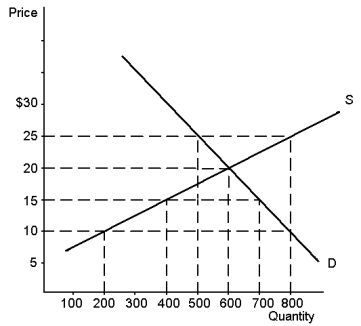 -Refer to the Graph 4-6.If the price were $10 there would be a:
 (Multiple Choice)
4.9/5 (76)
(76) If there is an improvement in the technology of producing a product, the supply curve for that product will shift to the left.
(True/False)
4.9/5 (77)
(77) 
Filters
- Essay(0)
- Multiple Choice(0)
- Short Answer(0)
- True False(0)
- Matching(0)