



 Chat with AI
Exam 4: The Market Forces of Supply and Demand

Exam 1: Ten Lessons From Economics146 Questions
Exam 2: Thinking Like an Economist133 Questions
Exam 3: Interdependence and the Gains From Trade139 Questions
Exam 4: The Market Forces of Supply and Demand215 Questions
Exam 5: Elasticity and Its Application178 Questions
Exam 6: Supply, Demand and Government Policies145 Questions
Exam 7: Consumers, Producers and the Efficiency of Markets171 Questions
Exam 8: Application: the Costs of Taxation135 Questions
Exam 9: Application: International Trade151 Questions
Exam 10: Externalities199 Questions
Exam 11: Public Goods and Common Resources178 Questions
Exam 12: The Design of the Tax System154 Questions
Exam 13: The Costs of Production191 Questions
Exam 14: Firms in Competitive Markets198 Questions
Exam 15: Monopoly212 Questions
Exam 16: Monopolistic Competition212 Questions
Exam 17: Business Strategy and Oligopoly179 Questions
Exam 18: Competition Policy103 Questions
Exam 19: The Markets for the Factors of Production214 Questions
Exam 20: Earnings, Unions and Discrimination201 Questions
Exam 21: Income Inequity and Poverty111 Questions
Exam 22: The Theory of Consumer Choice158 Questions
Exam 23: Frontiers of Microeconomics111 Questions
Exam 24: Measuring a Nations Income51 Questions
Exam 25: Measuring the Cost of Living55 Questions
Exam 26: Production and Growth62 Questions
Exam 27: Saving, Investment and the Financial System62 Questions
Exam 28: The Natural Rate of Unemployment58 Questions
Exam 29: The Monetary System66 Questions
Exam 30: Inflation: Its Causes and Costs74 Questions
Exam 31: Open-Economy Macroeconomics: Basic Concepts68 Questions
Exam 32: A Macroeconomic Theory of the Open Economy61 Questions
Exam 33: Aggregate Demand and Aggregate Supply81 Questions
Exam 34: The Influence of Monetary and Fiscal Policy on Aggregate Demand73 Questions
Exam 35: The Short-Run Trade-Off Between Inflation and Unemployment57 Questions
Exam 36: Global Financial Crisis of 2008 and Beyond37 Questions
Exam 37: Five Debates Over Macroeconomic Policy38 Questions
Select questions type


All else being constant, an increase in the number of cattle delivered to an auction to be marketed would:
(Multiple Choice)
5.0/5  (74)
(74) Graph 4-5 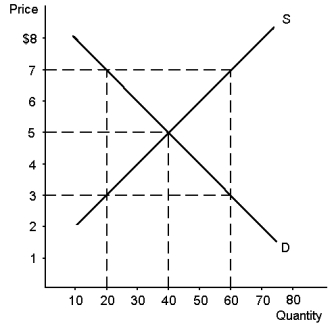 -Refer to Graph 4-5.According to the graph, at a price of $3:
 (Multiple Choice)
4.9/5 (85)
(85) Doug likes tomatoes today more than he did yesterday.Ceteris paribus, which of the following statements is correct?
(Multiple Choice)
4.9/5 (70)
(70) If good Z is 'inferior', then an increase in income will cause:
(Multiple Choice)
5.0/5 (65)
(65) The price of any good adjusts until quantity demanded equals quantity supplied.
(True/False)
4.9/5 (71)
(71) Graph 4-6 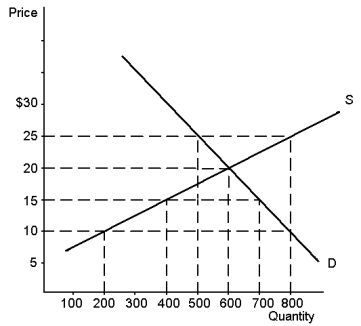 -Refer to the Graph 4-6.If price were $15, quantity supplied would be:
 (Multiple Choice)
4.8/5 (78)
(78) As a seller, you would be considered part of a perfectly competitive market if:
(Multiple Choice)
4.9/5 (73)
(73) Suppose that demand decreases AND supply decreases.What would you expect to occur in the market for the good?
(Multiple Choice)
5.0/5 (79)
(79) Market demand is obtained by adding individual demand curves vertically.
(True/False)
4.8/5 (88)
(88) A market supply curve is found by summing vertically all of the individual supply curves.
(True/False)
4.9/5 (81)
(81) When analysing how some event affects a market, we check whether the price is the same as the quantity demanded.
(True/False)
4.8/5 (69)
(69) What is the difference between a change in demand and a change in quantity demanded? Graph your answer.
(Essay)
4.9/5 (83)
(83) If a seller in a competitive market chooses to charge more than the market price, then:
(Multiple Choice)
4.8/5 (85)
(85) The side of the market that deals with the willingness and ability to produce and sell is:
(Multiple Choice)
4.8/5 (85)
(85) Graph 4-1 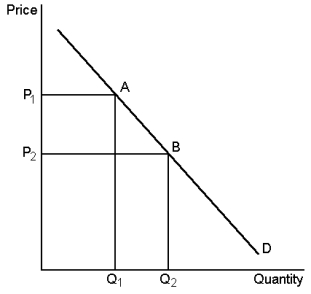 -Refer to Graph 4-1.The movement from point A to point B on the graph would be caused by:
 (Multiple Choice)
4.9/5 (72)
(72) At the equilibrium price, quantity demanded is equal to quantity supplied.
(True/False)
4.9/5 (77)
(77) 'Because of unseasonably cold weather, the supply of oranges has substantially decreased'.This statement indicates that:
(Multiple Choice)
4.7/5 (81)
(81) Which one of the following is not a determinant of demand?
(Multiple Choice)
4.8/5 (75)
(75) 
Filters
- Essay(0)
- Multiple Choice(0)
- Short Answer(0)
- True False(0)
- Matching(0)