



 Chat with AI
Exam 4: The Market Forces of Supply and Demand

Exam 1: Ten Lessons From Economics146 Questions
Exam 2: Thinking Like an Economist133 Questions
Exam 3: Interdependence and the Gains From Trade139 Questions
Exam 4: The Market Forces of Supply and Demand215 Questions
Exam 5: Elasticity and Its Application178 Questions
Exam 6: Supply, Demand and Government Policies145 Questions
Exam 7: Consumers, Producers and the Efficiency of Markets171 Questions
Exam 8: Application: the Costs of Taxation135 Questions
Exam 9: Application: International Trade151 Questions
Exam 10: Externalities199 Questions
Exam 11: Public Goods and Common Resources178 Questions
Exam 12: The Design of the Tax System154 Questions
Exam 13: The Costs of Production191 Questions
Exam 14: Firms in Competitive Markets198 Questions
Exam 15: Monopoly212 Questions
Exam 16: Monopolistic Competition212 Questions
Exam 17: Business Strategy and Oligopoly179 Questions
Exam 18: Competition Policy103 Questions
Exam 19: The Markets for the Factors of Production214 Questions
Exam 20: Earnings, Unions and Discrimination201 Questions
Exam 21: Income Inequity and Poverty111 Questions
Exam 22: The Theory of Consumer Choice158 Questions
Exam 23: Frontiers of Microeconomics111 Questions
Exam 24: Measuring a Nations Income51 Questions
Exam 25: Measuring the Cost of Living55 Questions
Exam 26: Production and Growth62 Questions
Exam 27: Saving, Investment and the Financial System62 Questions
Exam 28: The Natural Rate of Unemployment58 Questions
Exam 29: The Monetary System66 Questions
Exam 30: Inflation: Its Causes and Costs74 Questions
Exam 31: Open-Economy Macroeconomics: Basic Concepts68 Questions
Exam 32: A Macroeconomic Theory of the Open Economy61 Questions
Exam 33: Aggregate Demand and Aggregate Supply81 Questions
Exam 34: The Influence of Monetary and Fiscal Policy on Aggregate Demand73 Questions
Exam 35: The Short-Run Trade-Off Between Inflation and Unemployment57 Questions
Exam 36: Global Financial Crisis of 2008 and Beyond37 Questions
Exam 37: Five Debates Over Macroeconomic Policy38 Questions
Select questions type


If demand and supply both increase, quantity demanded will always increase, no matter how big the changes in supply and demand.
(True/False)
4.9/5  (84)
(84) 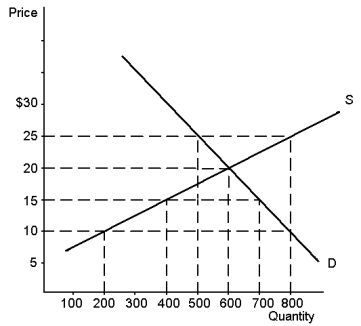 -Refer to the Graph 4-6.At a price of $20:
Jack usually eats a lot of noodles.He reads an article saying that rice has twice the health benefits of noodles.His demand curve for noodles is likely to shift right.
(True/False)
4.9/5 (74)
(74) Supply and demand are the concepts that economists use most often.
(True/False)
4.8/5 (84)
(84) Increasing the number of sellers in a market is demonstrated by a movement along the supply curve.
(True/False)
4.8/5 (81)
(81) A table showing how the quantity supplied of a product varies with its price, other things being equal, is a supply schedule and the graph of the supply schedule is called a supply curve.
(True/False)
4.9/5 (78)
(78) Suppose that scientists find evidence that proves that chocolate pudding increases hair growth in men who are balding.We would expect to see:
(Multiple Choice)
4.8/5 (94)
(94) Suppose that the price of shaving cream rises.We could expect the:
(Multiple Choice)
4.8/5 (72)
(72) Graph 4-1 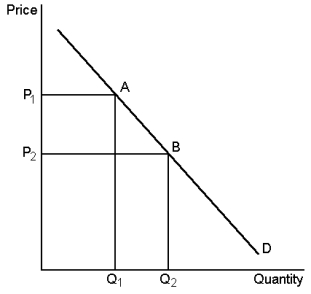 -Refer to Graph 4-1.The movement from point B to point A on the graph shows:
 (Multiple Choice)
4.8/5 (70)
(70) A demand schedule shows how much will be demanded of a good in the future.
(True/False)
4.8/5 (83)
(83) If the number of buyers of DVD movies increases, other things being equal, there will be an increase in the equilibrium price of DVD movies and a decrease in the equilibrium quantity sold.
(True/False)
4.7/5 (75)
(75) If crocodile leather handbags are a normal good, then consumers will buy less of them as their incomes rise.
(True/False)
4.8/5 (84)
(84) For each of the following situations in the Australian crocodile market, determine whether the quantity supplied changes, or whether the supply curve shifts and determine the direction of the change.
a.the number of crocodile farms and ranches closes, ceteris paribus
b.Professor Webb develops an antibiotic that ensures more hatchlings survive on ranches
c.the cost of meat to feed crocodiles rises
d.Thailand announces it is going to increase the number of crocodile farms in the next five years
(Essay)
4.8/5 (90)
(90) Holding the non-price determinants of supply constant, a change in price would:
(Multiple Choice)
4.9/5 (73)
(73) Individual demand curves are summed horizontally to obtain the market demand curve.
(True/False)
4.8/5 (85)
(85) Suppose an outbreak of Varroa kills off many beehives.Which of the following would not occur as a direct result of this event?
(Multiple Choice)
4.7/5 (77)
(77) There are thousands of wheat farmers who produce and sell wheat, and there are millions of consumers who use wheat and wheat products.The market for wheat would be considered:
(Multiple Choice)
4.8/5 (79)
(79) 
Filters
- Essay(0)
- Multiple Choice(0)
- Short Answer(0)
- True False(0)
- Matching(0)