



 Chat with AI
Exam 14: Infection, Infectious Diseases, and Epidemiology

Exam 1: A Brief History of Microbiology73 Questions
Exam 2: The Chemistry of Microbiology76 Questions
Exam 3: Cell Structure and Function80 Questions
Exam 4: Microscopy, Staining, and Classification80 Questions
Exam 5: Microbial Metabolism77 Questions
Exam 6: Microbial Nutrition and Growth75 Questions
Exam 7: Microbial Genetics75 Questions
Exam 8: Recombinant DNA Technology75 Questions
Exam 9: Controlling Microbial Growth in the Environment75 Questions
Exam 10:Controlling Microbial Growth in the Body: Antimicrobial Drugs75 Questions
Exam 11: Characterizing and Classifying Prokaryotes75 Questions
Exam 12: Characterizing and Classifying Eukaryotes75 Questions
Exam 13: Characterizing and Classifying Viruses, Viroids, and Prions75 Questions
Exam 14: Infection, Infectious Diseases, and Epidemiology76 Questions
Exam 15: Innate Immunity75 Questions
Exam 16: Adaptive Immunity75 Questions
Exam 17: Immunization and Immune Testing75 Questions
Exam 18: Immune Disorders75 Questions
Exam 19: Microbial Diseases of the Skin and Wounds72 Questions
Exam 20: Microbial Diseases of the Nervous System and Eyes71 Questions
Exam 21: Microbial Cardiovascular and Systemic Diseases71 Questions
Exam 22: Microbial Diseases of the Respiratory System70 Questions
Exam 23: Microbial Diseases of the Digestive System70 Questions
Exam 24: Microbial Diseases of the Urinary and Reproductive Systems65 Questions
Exam 25: Applied and Industrial Microbiology73 Questions
Exam 26: Microbial Ecology and Microbiomes73 Questions
Select questions type


Pathogens in droplets of body fluids are spread by (contact/indirect/vehicle) transmission.
(Short Answer)
4.8/5  (73)
(73) In early 2014, West African countries began diagnosing and reporting cases of Ebola for the first time in their history. This is an example of a(n) (endemic/epidemic/sporadic) disease.
(Short Answer)
4.8/5 (75)
(75) The bacterium that causes cholera is capable of living independently in freshwater. As a consequence, cholera epidemics primarily involve (animal/nonliving/zoonotic) reservoirs.
(Short Answer)
4.9/5 (70)
(70) A syndrome is a group of symptoms and signs that collectively characterize a particular disease.
(True/False)
4.8/5 (82)
(82) Diseases that are induced by modern medical procedures are referred to as ________ infections.
(Multiple Choice)
4.9/5 (71)
(71) Which of the following is NOT considered a member of the normal human microbiota?
(Multiple Choice)
4.7/5 (74)
(74) In 2012, a new kind of fungal meningitis (infection of the nervous system) was discovered. Disease occurred among patients who had received steroid injections in the spine. Discuss whether these were healthcare-associated infections (HAIs): defend your answer. Discuss the route of transmission and what measures public health agencies could take to reduce disease.
(Essay)
4.8/5 (77)
(77) People in the asymptomatic incubation stage of a disease may be a reservoir of the agent.
(True/False)
5.0/5 (80)
(80) Which of the following situations is NOT a way in which a baby acquires normal microbiota?
(Multiple Choice)
4.8/5 (79)
(79) Lipid A is a(n) (cytotoxin/endotoxin/exotoxin) that stimulates the body to release chemicals that cause fever, inflammation, diarrhea, hemorrhaging, shock, and blood coagulation.
(Short Answer)
4.9/5 (85)
(85) In which of the following do the mucous membranes serve as a portal of entry for disease?
(Multiple Choice)
4.8/5 (83)
(83) The condition known as microbial antagonism may be defined as
(Multiple Choice)
4.7/5 (74)
(74) 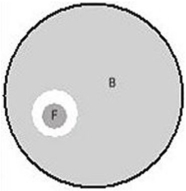 Figure 14.1 represents a Petri dish with a fungus (F), shown in darker gray, growing in the midst of bacterial lawn (B), shown in light gray. The relationship between the fungus and the bacteria would best be described as
 (Multiple Choice)
4.9/5 (78)
(78) A strain of Neisseria gonorrhea has a mutation which has caused it to lose the ability to produce fimbriae and become less virulent as a consequence. What function has this pathogen lost?
(Multiple Choice)
4.8/5 (90)
(90) 
Filters
- Essay(0)
- Multiple Choice(0)
- Short Answer(0)
- True False(0)
- Matching(0)