



 Chat with AI
Exam 10:Controlling Microbial Growth in the Body: Antimicrobial Drugs

Exam 1: A Brief History of Microbiology73 Questions
Exam 2: The Chemistry of Microbiology76 Questions
Exam 3: Cell Structure and Function80 Questions
Exam 4: Microscopy, Staining, and Classification80 Questions
Exam 5: Microbial Metabolism77 Questions
Exam 6: Microbial Nutrition and Growth75 Questions
Exam 7: Microbial Genetics75 Questions
Exam 8: Recombinant DNA Technology75 Questions
Exam 9: Controlling Microbial Growth in the Environment75 Questions
Exam 10:Controlling Microbial Growth in the Body: Antimicrobial Drugs75 Questions
Exam 11: Characterizing and Classifying Prokaryotes75 Questions
Exam 12: Characterizing and Classifying Eukaryotes75 Questions
Exam 13: Characterizing and Classifying Viruses, Viroids, and Prions75 Questions
Exam 14: Infection, Infectious Diseases, and Epidemiology76 Questions
Exam 15: Innate Immunity75 Questions
Exam 16: Adaptive Immunity75 Questions
Exam 17: Immunization and Immune Testing75 Questions
Exam 18: Immune Disorders75 Questions
Exam 19: Microbial Diseases of the Skin and Wounds72 Questions
Exam 20: Microbial Diseases of the Nervous System and Eyes71 Questions
Exam 21: Microbial Cardiovascular and Systemic Diseases71 Questions
Exam 22: Microbial Diseases of the Respiratory System70 Questions
Exam 23: Microbial Diseases of the Digestive System70 Questions
Exam 24: Microbial Diseases of the Urinary and Reproductive Systems65 Questions
Exam 25: Applied and Industrial Microbiology73 Questions
Exam 26: Microbial Ecology and Microbiomes73 Questions
Select questions type


Which of the following is NOT a target of drugs that inhibit protein synthesis?
(Multiple Choice)
5.0/5  (73)
(73) Which of the following groups of drugs can become incorporated into the bones and teeth of a fetus?
(Multiple Choice)
4.8/5 (72)
(72) Which of the following statements is true of selective toxicity?
(Multiple Choice)
4.8/5 (90)
(90)  Figure 10.1 represents a Petri plate. The gray area is where bacteria A is growing, the black area is where bacteria B is growing. The white area is a zone where neither organism is growing. What is the best interpretation of what is observed on the plate?
 (Multiple Choice)
5.0/5 (100)
(100) Which of the following steps in the folic acid synthesis pathway is specifically inhibited by sulfonamides?
(Multiple Choice)
4.7/5 (73)
(73) There are relatively few antifungal medications available compared to antibacterial drugs.
(True/False)
4.8/5 (87)
(87) Which of the following is a primary advantage of semisynthetic drugs?
(Multiple Choice)
4.8/5 (76)
(76) It is inappropriate to prescribe antibacterial agents to treat colds or flu because
(Multiple Choice)
4.9/5 (81)
(81) The ratio of a medication's dose that can be tolerated to its effective dose is the therapeutic (MIC/index/range) of the medication.
(Short Answer)
5.0/5 (79)
(79) The drug metronidazole is effective on both bacteria and some protozoa. It can therefore be described as a ________ drug.
(Multiple Choice)
4.9/5 (67)
(67) Amoxicillin is very effective for treating infections with Gram-positive bacteria but rarely causes side effects in humans. This is an example of
(Multiple Choice)
4.9/5 (82)
(82) A drug is structurally similar to PABA and inhibits folic acid synthesis. It is most likely a(n)
(Multiple Choice)
4.8/5 (73)
(73) Selective (action/toxicity/treatment) means that a given antimicrobial agent is more toxic to a pathogen than to the host being treated.
(Short Answer)
4.9/5 (92)
(92) A microbe resistant to a variety of different antimicrobials is said to have (cross/drug/multiple) resistance.
(Short Answer)
4.8/5 (76)
(76) An antimicrobial that inhibits bacterial cell wall synthesis will result in which of the following?
(Multiple Choice)
4.7/5 (86)
(86) 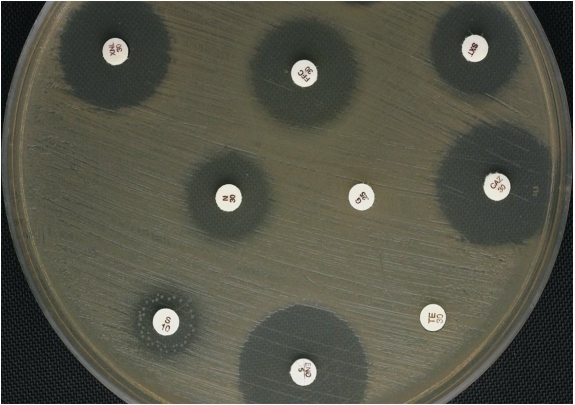 Examine the diffusion susceptibility plate results shown in Figure 10.2. Propose an explanation for the appearance of the zone around the S/10 disk, and discuss the implications for therapeutic use of this antibiotic for the pathogen tested.
 (Essay)
4.9/5 (88)
(88) 
Filters
- Essay(0)
- Multiple Choice(0)
- Short Answer(0)
- True False(0)
- Matching(0)