



 Chat with AI
Exam 2: The Chemistry of Microbiology

Exam 1: A Brief History of Microbiology73 Questions
Exam 2: The Chemistry of Microbiology76 Questions
Exam 3: Cell Structure and Function80 Questions
Exam 4: Microscopy, Staining, and Classification80 Questions
Exam 5: Microbial Metabolism77 Questions
Exam 6: Microbial Nutrition and Growth75 Questions
Exam 7: Microbial Genetics75 Questions
Exam 8: Recombinant DNA Technology75 Questions
Exam 9: Controlling Microbial Growth in the Environment75 Questions
Exam 10:Controlling Microbial Growth in the Body: Antimicrobial Drugs75 Questions
Exam 11: Characterizing and Classifying Prokaryotes75 Questions
Exam 12: Characterizing and Classifying Eukaryotes75 Questions
Exam 13: Characterizing and Classifying Viruses, Viroids, and Prions75 Questions
Exam 14: Infection, Infectious Diseases, and Epidemiology76 Questions
Exam 15: Innate Immunity75 Questions
Exam 16: Adaptive Immunity75 Questions
Exam 17: Immunization and Immune Testing75 Questions
Exam 18: Immune Disorders75 Questions
Exam 19: Microbial Diseases of the Skin and Wounds72 Questions
Exam 20: Microbial Diseases of the Nervous System and Eyes71 Questions
Exam 21: Microbial Cardiovascular and Systemic Diseases71 Questions
Exam 22: Microbial Diseases of the Respiratory System70 Questions
Exam 23: Microbial Diseases of the Digestive System70 Questions
Exam 24: Microbial Diseases of the Urinary and Reproductive Systems65 Questions
Exam 25: Applied and Industrial Microbiology73 Questions
Exam 26: Microbial Ecology and Microbiomes73 Questions
Select questions type


Organisms use carbohydrates in all of the following ways EXCEPT
(Multiple Choice)
4.8/5  (79)
(79) The monomer of a nucleic acid is called a (nucleoside/nucleotide/base).
(Short Answer)
4.7/5 (78)
(78) Which of the following would NOT normally be found as a component of a cell's nucleic acids?
(Multiple Choice)
4.9/5 (86)
(86) The folding of a polypeptide into a three-dimensional shape is its (secondary/tertiary/quaternary) structure.
(Short Answer)
4.8/5 (83)
(83) An atom or molecule becomes a(n) (anion/ion/cation) when it loses an electron to a more electronegative molecule.
(Short Answer)
4.8/5 (70)
(70) 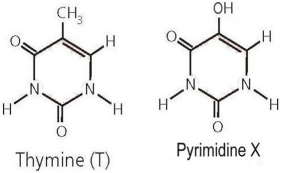 Consider the structure of thymine, shown on the left in Figure 2.3 above, and compare to the structure of pyrimidine X on the right. What would be the impact if X is incorporated into the structure of a DNA strand in place of thymine?
 (Essay)
4.9/5 (74)
(74) DNA is composed of repeating units of sugars, phosphates, and nucleic acids. This is an example of a
(Multiple Choice)
4.8/5 (86)
(86) Proteins contain both acidic and basic R groups and can, therefore, function as
(Multiple Choice)
4.8/5 (94)
(94) Nucleic acids, proteins, and complex carbohydrates are all produced by
(Multiple Choice)
4.9/5 (81)
(81) Describe the chemical properties of phospholipids that account for their behavior in water.
(Essay)
4.7/5 (76)
(76) Which of the following is an atomic particle that has no electrical charge?
(Multiple Choice)
4.9/5 (84)
(84) The type(s) of bond(s) produced when atoms with somewhat different electronegativities share electrons is/are
(Multiple Choice)
4.7/5 (75)
(75) 
Filters
- Essay(0)
- Multiple Choice(0)
- Short Answer(0)
- True False(0)
- Matching(0)