



 Chat with AI
Exam 9: Muscular System: Histology and Physiology

Exam 1: The Human Organism120 Questions
Exam 2: The Chemical Basis of Life168 Questions
Exam 3: Cell Biology227 Questions
Exam 4: Tissues174 Questions
Exam 5: Integumentary System152 Questions
Exam 6: Skeletal System: Bones and Bone Tissue176 Questions
Exam 7: Skeletal System: Gross Anatomy173 Questions
Exam 8: Joints and Movement126 Questions
Exam 9: Muscular System: Histology and Physiology200 Questions
Exam 10: Muscular System: Gross Anatomy140 Questions
Exam 11: Functional Organization of Nervous Tissue171 Questions
Exam 12: Spinal Cord and Spinal Nerves124 Questions
Exam 13: Brain and Cranial Nerves158 Questions
Exam 14: Integration of Nervous System Functions142 Questions
Exam 15: The Special Senses198 Questions
Exam 16: Autonomic Nervous System109 Questions
Exam 17: Functional Organization of the Endocrine System83 Questions
Exam 18: Endocrine Glands167 Questions
Exam 19: Cardiovascular System: Blood148 Questions
Exam 20: Cardiovascular System: the Heart139 Questions
Exam 21: Cardiovascular System: Blood Vessels and Circulation234 Questions
Exam 22: Lymphatic System and Immunity174 Questions
Exam 23: Respiratory System175 Questions
Exam 24: Digestive System253 Questions
Exam 25: Nutrition, Metabolism, and Temperature Regulation168 Questions
Exam 26: Urinary System159 Questions
Exam 27: Water, Electrolyte, and Acid-Based Balance108 Questions
Exam 28: Reproductive System160 Questions
Exam 29: Development, Growth, Aging, and Genetics187 Questions
Select questions type


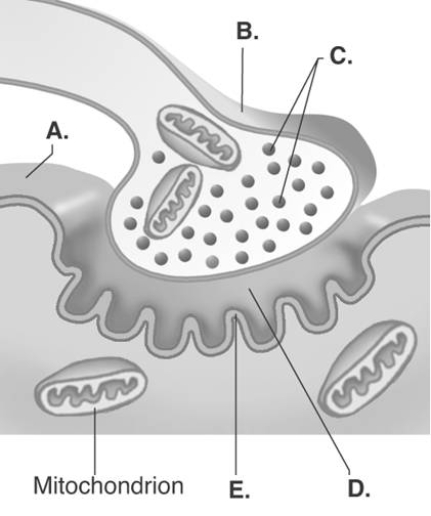 -The figure illustrates a detailed drawing of the neuromuscular junction. What does "C" represent?
 (Multiple Choice)
4.8/5  (83)
(83) Which of the following statements concerning types of muscle contractions is false?
(Multiple Choice)
4.8/5 (76)
(76) You are hired to work in a laboratory to measure the rate of human muscle contraction. Which of the following might decrease in quantity in muscle cells undergoing contractions?
(Multiple Choice)
4.9/5 (83)
(83) Consider a chemical that blocks the action of acetylcholinesterase. What effect does this have on muscles?
(Multiple Choice)
4.8/5 (89)
(89) Arrange the following list of biochemical events in the correct sequence. (1) An action potential is conducted deep into the muscle fiber by the T tubule.
(2) Calcium ions bind to troponin.
(3) The membranes of the sarcoplasmic reticulum become more permeable to calcium ions.
(4) Calcium ions diffuse into the sarcoplasm around the myofibril.
(5) The troponin-tropomyosin complex moves exposing active sites.
(Multiple Choice)
4.8/5 (75)
(75) The diffusion of calcium ions into a smooth muscle cell does not depolarize the membrane so no action potential occurs.
(True/False)
4.9/5 (84)
(84) Heather is watching a movie. What type of chemical pathway do her muscles depend upon at this time?
(Multiple Choice)
4.7/5 (72)
(72) When an action potential reaches the presynaptic terminal,
(Multiple Choice)
5.0/5 (82)
(82) Which of the following would contribute to muscular fatigue in the muscle fiber?
(Multiple Choice)
5.0/5 (83)
(83) 
Filters
- Essay(0)
- Multiple Choice(0)
- Short Answer(0)
- True False(0)
- Matching(0)