



 Chat with AI
Exam 9: Muscular System: Histology and Physiology

Exam 1: The Human Organism120 Questions
Exam 2: The Chemical Basis of Life168 Questions
Exam 3: Cell Biology227 Questions
Exam 4: Tissues174 Questions
Exam 5: Integumentary System152 Questions
Exam 6: Skeletal System: Bones and Bone Tissue176 Questions
Exam 7: Skeletal System: Gross Anatomy173 Questions
Exam 8: Joints and Movement126 Questions
Exam 9: Muscular System: Histology and Physiology200 Questions
Exam 10: Muscular System: Gross Anatomy140 Questions
Exam 11: Functional Organization of Nervous Tissue171 Questions
Exam 12: Spinal Cord and Spinal Nerves124 Questions
Exam 13: Brain and Cranial Nerves158 Questions
Exam 14: Integration of Nervous System Functions142 Questions
Exam 15: The Special Senses198 Questions
Exam 16: Autonomic Nervous System109 Questions
Exam 17: Functional Organization of the Endocrine System83 Questions
Exam 18: Endocrine Glands167 Questions
Exam 19: Cardiovascular System: Blood148 Questions
Exam 20: Cardiovascular System: the Heart139 Questions
Exam 21: Cardiovascular System: Blood Vessels and Circulation234 Questions
Exam 22: Lymphatic System and Immunity174 Questions
Exam 23: Respiratory System175 Questions
Exam 24: Digestive System253 Questions
Exam 25: Nutrition, Metabolism, and Temperature Regulation168 Questions
Exam 26: Urinary System159 Questions
Exam 27: Water, Electrolyte, and Acid-Based Balance108 Questions
Exam 28: Reproductive System160 Questions
Exam 29: Development, Growth, Aging, and Genetics187 Questions
Select questions type


If sodium ions cannot enter a muscle fiber in response to a stimulus,
(Multiple Choice)
4.8/5  (73)
(73) Inflammation of the fibrous connective tissue resulting in stiffness and soreness is
(Multiple Choice)
4.9/5 (78)
(78) Which of the following is NOT an age related change in skeletal muscle?
(Multiple Choice)
4.9/5 (87)
(87) A condition in which stimuli occur so rapidly that there are no intervening relaxations between contractions is called
(Multiple Choice)
4.9/5 (74)
(74) Hypertrophy of skeletal muscles from weight lifting is caused by an increase in the
(Multiple Choice)
4.8/5 (76)
(76) When skeletal muscle is producing carbon dioxide and water while making ATP, which chemical processes could be active at this time?
(Multiple Choice)
4.9/5 (71)
(71) A waste product of anaerobic respiration in muscle cells is
(Multiple Choice)
4.8/5 (78)
(78) A lack of glycolytic enzymes within skeletal muscle cells would impair which type of ATP-yielding process?
(Multiple Choice)
5.0/5 (73)
(73) 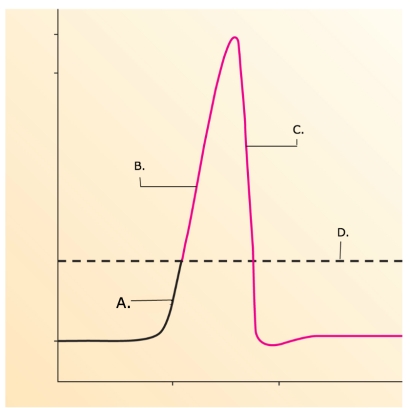 -What does "B" represent on the diagram?

Filters
- Essay(0)
- Multiple Choice(0)
- Short Answer(0)
- True False(0)
- Matching(0)