



 Chat with AI
Exam 13: Monopoly

Exam 1: What Is Economics483 Questions
Exam 2: The Economic Problem440 Questions
Exam 3: Demand and Supply515 Questions
Exam 4: Elasticity530 Questions
Exam 5: Efficiency and Equity450 Questions
Exam 6: Government Actions in Markets412 Questions
Exam 7: Global Markets in Action205 Questions
Exam 8: Utility and Demand366 Questions
Exam 10: Organizing Production385 Questions
Exam 11: Output and Costs493 Questions
Exam 12: Perfect Competition487 Questions
Exam 13: Monopoly599 Questions
Exam 14: Monopolistic Competition318 Questions
Exam 15: Oligopoly276 Questions
Exam 16: Public Choices, Public Goods, and Healthcare205 Questions
Exam 17: Externalities437 Questions
Exam 18: Markets for Factors of Production382 Questions
Exam 19: Economic Inequality351 Questions
Exam 20: Uncertainty and Information233 Questions
Select questions type


A single-price monopoly is characterized by a marginal revenue curve that is
(Multiple Choice)
4.9/5  (70)
(70) In the case of a perfectly price-discriminating monopoly, there is no
(Multiple Choice)
4.8/5 (80)
(80) 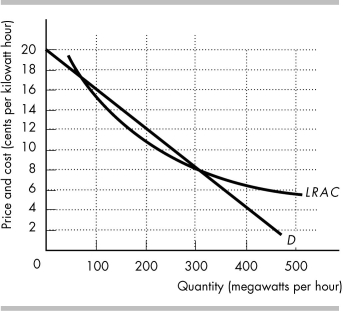 -In the figure above, complete the graph of the electric utility company by adding the marginal revenue and marginal cost curves. Assume the marginal cost is constant at 4¢ per kilowatt-hour. Now discuss the two options regulators have in trying to regulate the firm. Be sure to state the price and quantity that are selected for each option. Also, what price and quantity does the firm select if it is not regulated?
 (Essay)
4.8/5 (87)
(87) 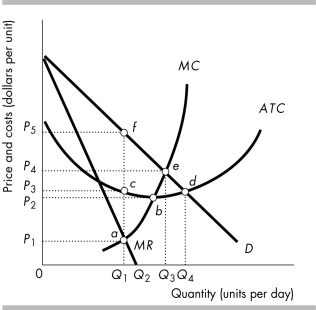 -In the above figure, what quantity will a single-price monopolist produce?
 (Multiple Choice)
4.9/5 (71)
(71) Compared to a single-price monopoly, the price charged by a perfectly competitive market with the same costs
(Multiple Choice)
4.9/5 (74)
(74) 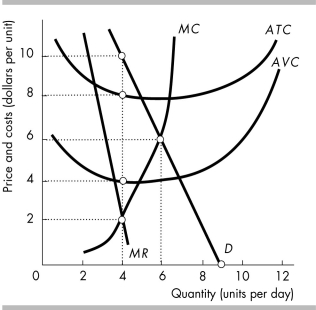 -The unregulated, single-price monopolist illustrated in the figure above makes an economic profit of
 (Multiple Choice)
4.9/5 (76)
(76) There is a deadweight loss if a natural monopoly is regulated to use
(Multiple Choice)
4.9/5 (87)
(87) A monopoly that sells every unit of its output at the same price is a
(Multiple Choice)
4.9/5 (88)
(88) 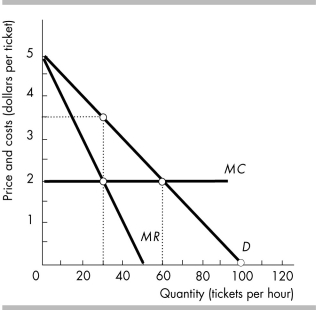 -An unregulated, single-price monopoly is shown in the figure above. If its fixed cost is $20, the monopoly's total economic profit when it is maximizing its profit will be
 (Multiple Choice)
4.9/5 (70)
(70) Which of the following is a barrier to entry for a monopoly?
(Multiple Choice)
4.9/5 (70)
(70) Demand Schedule Facing a
Perfectly Price Discriminating Firm
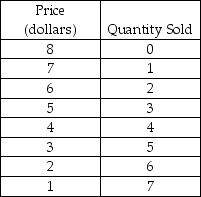 -Using the demand schedule in the table above, the total revenue a perfectly price discriminating monopolist receives from selling 5 units of output is
 (Multiple Choice)
4.7/5 (76)
(76) 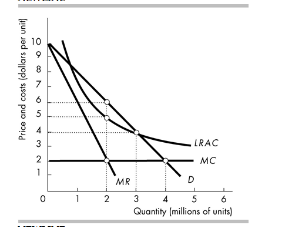 -If the natural monopoly shown in the figure above is unregulated, then the deadweight loss will be
 (Multiple Choice)
4.8/5 (73)
(73) Compared to a single-price monopolist, a price-discriminating monopolist
(Multiple Choice)
4.8/5 (91)
(91) A natural monopoly that charges the profit-maximizing price will produce ________ amount of output than a ________.
(Multiple Choice)
4.8/5 (68)
(68) 
Filters
- Essay(0)
- Multiple Choice(0)
- Short Answer(0)
- True False(0)
- Matching(0)