



 Chat with AI
Exam 13: Monopoly

Exam 1: What Is Economics483 Questions
Exam 2: The Economic Problem440 Questions
Exam 3: Demand and Supply515 Questions
Exam 4: Elasticity530 Questions
Exam 5: Efficiency and Equity450 Questions
Exam 6: Government Actions in Markets412 Questions
Exam 7: Global Markets in Action205 Questions
Exam 8: Utility and Demand366 Questions
Exam 10: Organizing Production385 Questions
Exam 11: Output and Costs493 Questions
Exam 12: Perfect Competition487 Questions
Exam 13: Monopoly599 Questions
Exam 14: Monopolistic Competition318 Questions
Exam 15: Oligopoly276 Questions
Exam 16: Public Choices, Public Goods, and Healthcare205 Questions
Exam 17: Externalities437 Questions
Exam 18: Markets for Factors of Production382 Questions
Exam 19: Economic Inequality351 Questions
Exam 20: Uncertainty and Information233 Questions
Select questions type


Demand Schedule Facing a
Perfectly Price Discriminating Firm
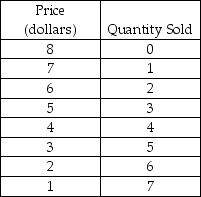 -Using the demand schedule in the above table, the marginal revenue for a perfectly price discriminating monopolist from the sale of the third unit of output is
 (Multiple Choice)
4.8/5  (72)
(72) In the monopoly, the firm's marginal revenue curve is ________, while in a perfectly competitive market, each firm's marginal revenue curve is ________.
(Multiple Choice)
5.0/5 (78)
(78) When a natural monopoly is regulated using a marginal cost pricing rule, what can you say about the firm's profit and the market's efficiency?
(Essay)
4.9/5 (78)
(78) The WaveHouse on Mission Beach in San Diego features the Bruticus Maximus, a ten foot wave, which tests the skills of even the most talented surf and wake board riders on the planet. WaveHouse is the only place in San Diego where this service is offered. You can ride B. Max for $40 for the first hour, $33 for the second hour, and $26 for the third hour. Why would WaveHouse charge different prices for each subsequent hour of riding?
(Multiple Choice)
4.8/5 (83)
(83) Single-price monopolies maximize profit by producing the amount of output at which
(Multiple Choice)
4.9/5 (81)
(81) A perfect price discriminating monopoly produces the same quantity of output as a
(Multiple Choice)
4.7/5 (81)
(81) A natural monopoly regulated with a marginal cost pricing rule results in
(Multiple Choice)
4.8/5 (81)
(81) The iconic American drink-maker, Coca-Cola, announced plans in 2008 to buy the dominant Chinese fruit juice company for $2.5 billion. But China just rolled out a new law to guard against business monopolies. How would this rent-seeking behavior by Coca-Cola most likely affect efficiency in the drink market?
(Multiple Choice)
4.8/5 (89)
(89) 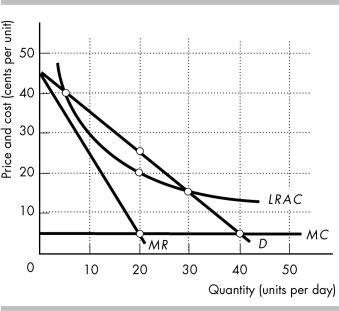 -If the firm in the figure above is unregulated, it will charge a price of
 (Multiple Choice)
4.9/5 (83)
(83) 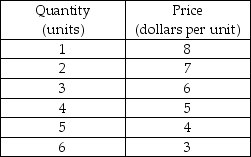 -The table above gives the demand for a monopolist's output. Between which two quantities is demand elastic?
 (Multiple Choice)
4.9/5 (58)
(58) A single-price monopolist will find when it produces its profit-maximizing amount of output that
(Multiple Choice)
4.8/5 (79)
(79)
-If the firm in the figure above is unregulated, it will produce
-If the firm in the figure above is unregulated, it will produce (Multiple Choice)
4.8/5 (83)
(83) 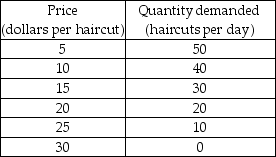 -Christy's Haircuts, the sole supplier of haircuts in a small town, faces the demand schedule shown in the table above. What is Christy's marginal revenue from the 25th haircut?
 (Multiple Choice)
4.8/5 (85)
(85) If a monopolist lowers its price and its demand is inelastic, then its
(Multiple Choice)
5.0/5 (86)
(86) What is price discrimination? Can a perfectly competitive firm price discriminate? Explain you answer.
(Essay)
4.9/5 (83)
(83) The United States Mint is the only legal entity to produce circulating coinage for the United States. What are the barriers to entry, if any, that protect this firm from competition?
(Multiple Choice)
4.8/5 (80)
(80) 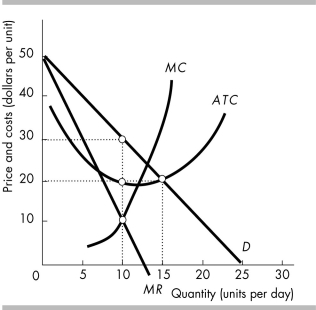 -The figure above shows the demand and cost curves for a single-price monopoly. Which of the following statements is FALSE?
 (Multiple Choice)
4.8/5 (63)
(63) 
Filters
- Essay(0)
- Multiple Choice(0)
- Short Answer(0)
- True False(0)
- Matching(0)