



 Chat with AI
Exam 13: Monopoly

Exam 1: What Is Economics483 Questions
Exam 2: The Economic Problem440 Questions
Exam 3: Demand and Supply515 Questions
Exam 4: Elasticity530 Questions
Exam 5: Efficiency and Equity450 Questions
Exam 6: Government Actions in Markets412 Questions
Exam 7: Global Markets in Action205 Questions
Exam 8: Utility and Demand366 Questions
Exam 10: Organizing Production385 Questions
Exam 11: Output and Costs493 Questions
Exam 12: Perfect Competition487 Questions
Exam 13: Monopoly599 Questions
Exam 14: Monopolistic Competition318 Questions
Exam 15: Oligopoly276 Questions
Exam 16: Public Choices, Public Goods, and Healthcare205 Questions
Exam 17: Externalities437 Questions
Exam 18: Markets for Factors of Production382 Questions
Exam 19: Economic Inequality351 Questions
Exam 20: Uncertainty and Information233 Questions
Select questions type


Which of the following cannot be an effective entry barrier?
(Multiple Choice)
4.9/5  (89)
(89) 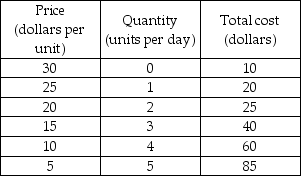 -The table above shows the demand and costs for a single-price monopolist. The firm will
 (Multiple Choice)
4.9/5 (79)
(79) 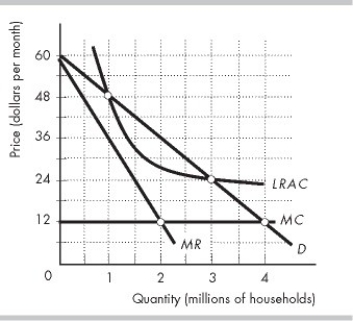 -The figure above shows the demand curve (D) faced by Visual, Inc., a cable TV company, and the firm's marginal revenue (MR), marginal cost (MC), and average cost (LRAC) curves. If Visual is regulated using rate of return regulation, and the regulator knows the firm's costs curves, the company will serve ________ million households and set a price of ________ per household per month.
 (Multiple Choice)
4.8/5 (77)
(77) Firms that can price discriminate between customers do so to
(Multiple Choice)
4.8/5 (72)
(72) 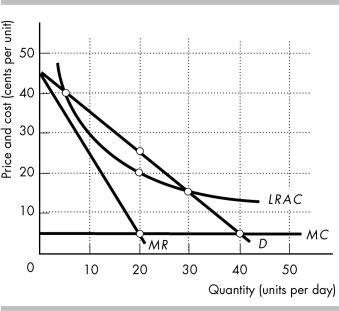 -If the firm in the figure above is unregulated, the deadweight loss will be
 (Multiple Choice)
4.9/5 (87)
(87) What is a natural monopoly and what problem does natural monopoly pose for regulators?
(Essay)
4.9/5 (78)
(78) Which of the following is TRUE for a perfect price-discriminating monopoly?
(Multiple Choice)
5.0/5 (67)
(67) 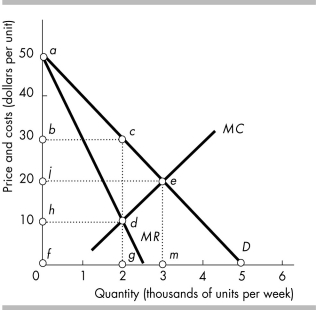 -In the above figure, if a single-price monopolist charges the profit-maximizing price, the triangle dce represents
 (Multiple Choice)
4.7/5 (94)
(94) In the case of a perfectly price-discriminating monopoly, there is no
(Multiple Choice)
5.0/5 (62)
(62) Activity aimed at creating artificial barriers to entry into a particular market
(Multiple Choice)
4.7/5 (72)
(72) 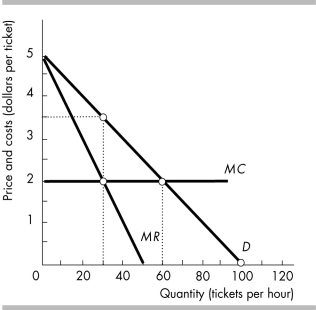 -In the figure above, what is the loss of consumer surplus if the firm is a perfectly price-discriminating monopoly instead of a perfectly competitive industry?
 (Multiple Choice)
5.0/5 (89)
(89) 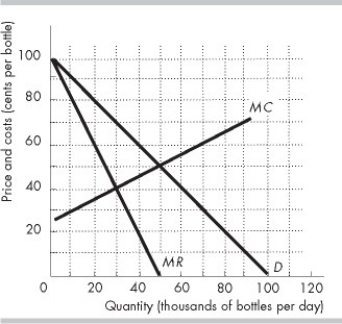 -Interlace, Inc. produces and a unique soda. The company cannot price discriminate. The figure above shows Interlace's demand curve, marginal revenue curve, and marginal cost curve. When Interlace maximizes its profit, the deadweight loss is
 (Multiple Choice)
4.8/5 (84)
(84) Joe, a hair dresser, offers students a discount price on haircuts. This form of pricing is an example of
(Multiple Choice)
4.8/5 (85)
(85) 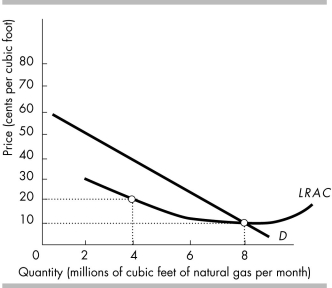 -Given the market demand and cost data in the above figure, the existence of two firms equal sized firms producing a total of 8 million cubic feet of natural gas means that the long-run average cost of producing natural gas is
 (Multiple Choice)
5.0/5 (84)
(84) A market in which competition and entry are restricted by the granting of a public franchise, government license, patent, or copyright is called a
(Multiple Choice)
4.9/5 (80)
(80) Suppose a firm is a natural monopoly. Then, until the long-run average cost curve crosses the demand curve, as the quantity increases the long-run average costs
(Multiple Choice)
4.9/5 (71)
(71) 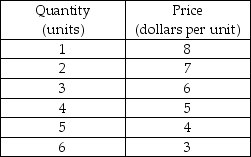 -The table above gives the demand for a monopolist's output. What is the marginal revenue when output is increased from 5 to 6 units?
 (Multiple Choice)
4.8/5 (70)
(70) 
Filters
- Essay(0)
- Multiple Choice(0)
- Short Answer(0)
- True False(0)
- Matching(0)