



 Chat with AI
Exam 13: Monopoly

Exam 1: What Is Economics483 Questions
Exam 2: The Economic Problem440 Questions
Exam 3: Demand and Supply515 Questions
Exam 4: Elasticity530 Questions
Exam 5: Efficiency and Equity450 Questions
Exam 6: Government Actions in Markets412 Questions
Exam 7: Global Markets in Action205 Questions
Exam 8: Utility and Demand366 Questions
Exam 10: Organizing Production385 Questions
Exam 11: Output and Costs493 Questions
Exam 12: Perfect Competition487 Questions
Exam 13: Monopoly599 Questions
Exam 14: Monopolistic Competition318 Questions
Exam 15: Oligopoly276 Questions
Exam 16: Public Choices, Public Goods, and Healthcare205 Questions
Exam 17: Externalities437 Questions
Exam 18: Markets for Factors of Production382 Questions
Exam 19: Economic Inequality351 Questions
Exam 20: Uncertainty and Information233 Questions
Select questions type


Demand Schedule Facing a
Perfectly Price Discriminating Firm
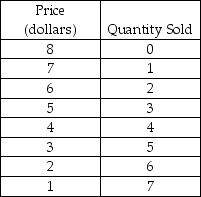 -Using the demand schedule in the above table, if the firm's marginal cost is constant at $3.00, output for a perfectly price discriminating monopolist is
 (Multiple Choice)
4.8/5  (82)
(82) Suppose the government breaks up a single-price monopoly and turns it into a perfectly competitive industry. What will happen to price and the quantity produced? What will happen to the monopoly's economic profit and the deadweight loss associated with the monopoly?
(Essay)
4.9/5 (79)
(79) 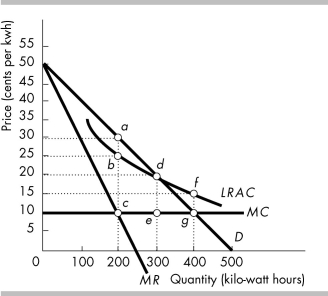 -The figure above provides information about Light-U-Up Utilities, which is a natural monopoly that provides electricity. If Light-U-Up is regulated and must follow an average cost pricing rule, it will produce ________ and sell at a price of ________.
 (Multiple Choice)
4.8/5 (86)
(86) 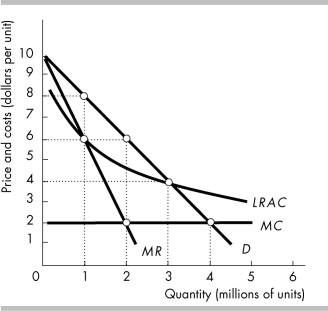 -The figure above shows the costs and demand curves for the Bigshow Cable Company. If the firm is required to set its price according to an average cost pricing rule, the price is ________ and the quantity produced is ________ million.
 (Multiple Choice)
4.9/5 (83)
(83) 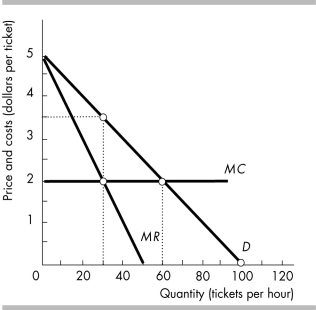 -If the monopoly illustrated in the figure above could engage in perfect price discrimination, then it would sell
 (Multiple Choice)
4.8/5 (78)
(78) Which of the following statements applies to a single-price monopolist?
(Multiple Choice)
4.8/5 (76)
(76) 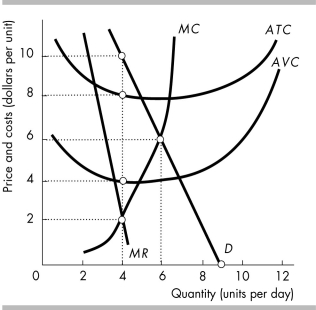 -The unregulated, single-price monopolist illustrated in the figure above has a total revenue of
 (Multiple Choice)
4.8/5 (91)
(91) 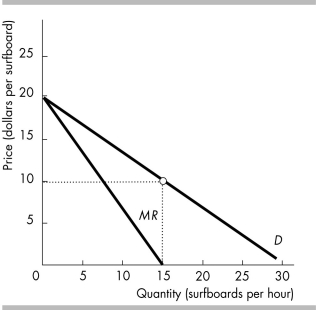 -The figure above shows the demand and marginal revenue curves facing Sue's Surfboards, the sole renter of surfboards on Big Wave Island. If Sue is renting 25 surfboards an hour so that the marginal revenue is negative, then Sue's Surfboards
 (Multiple Choice)
4.9/5 (90)
(90) 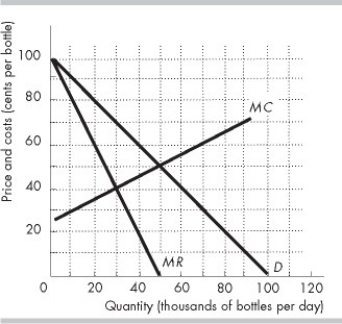 -Interlace, Inc. produces and a unique soda. The company cannot price discriminate. The figure above shows Interlace's demand curve, marginal revenue curve, and marginal cost curve. Interlace, Inc. is definitely
 (Multiple Choice)
4.9/5 (75)
(75) For a monopoly able to perfectly price discriminate, the marginal revenue curve coincides with the demand curve.
(True/False)
4.8/5 (83)
(83) A rule that specifies the highest price that a regulated firm is permitted to set is called
(Multiple Choice)
4.9/5 (95)
(95) 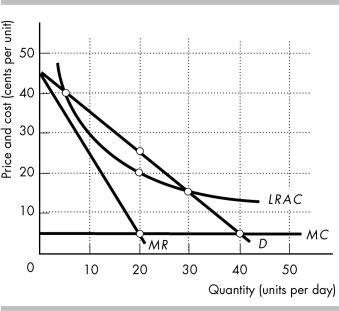 -The firm shown in the figure above is
For a monopoly able to practice perfect price discrimination, the market
(Multiple Choice)
4.9/5 (83)
(83) Donna owns the only dog grooming salon on Lonely Island. If Donna can price discriminate between dog owners who are seniors and those who are not, her economic profit will be ________ than if she does not price discriminate and the number of dog groomings will be ________ than if she does not price discriminate.
(Multiple Choice)
4.9/5 (84)
(84) 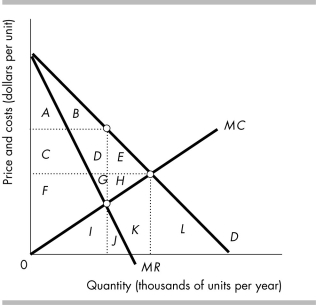 -Which area in the above figure equals the producer surplus under perfect price discrimination?
 (Multiple Choice)
4.8/5 (71)
(71) Which of the following will result in the most deadweight loss?
(Multiple Choice)
4.8/5 (95)
(95) Which of the following is NOT a barrier to entry for a monopoly?
(Multiple Choice)
4.9/5 (86)
(86) Why will a profit-maximizing, single-price monopolist NOT produce the amount of output that maximizes its total revenue?
(Essay)
5.0/5 (72)
(72) 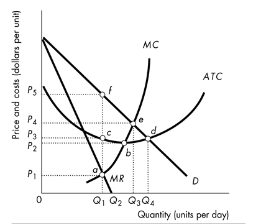 -If the market illustrated in the above figure was a perfectly competitive market with the MC curve being the sum of all individual firms' marginal costs, then the perfectly competitive price and quantity would be
 (Multiple Choice)
5.0/5 (81)
(81) 
Filters
- Essay(0)
- Multiple Choice(0)
- Short Answer(0)
- True False(0)
- Matching(0)