



 Chat with AI
Exam 13: Monopoly

Exam 1: What Is Economics483 Questions
Exam 2: The Economic Problem440 Questions
Exam 3: Demand and Supply515 Questions
Exam 4: Elasticity530 Questions
Exam 5: Efficiency and Equity450 Questions
Exam 6: Government Actions in Markets412 Questions
Exam 7: Global Markets in Action205 Questions
Exam 8: Utility and Demand366 Questions
Exam 10: Organizing Production385 Questions
Exam 11: Output and Costs493 Questions
Exam 12: Perfect Competition487 Questions
Exam 13: Monopoly599 Questions
Exam 14: Monopolistic Competition318 Questions
Exam 15: Oligopoly276 Questions
Exam 16: Public Choices, Public Goods, and Healthcare205 Questions
Exam 17: Externalities437 Questions
Exam 18: Markets for Factors of Production382 Questions
Exam 19: Economic Inequality351 Questions
Exam 20: Uncertainty and Information233 Questions
Select questions type


A key difference between a monopoly and a perfectly competitive firm is that the monopolist
(Multiple Choice)
4.7/5  (95)
(95) 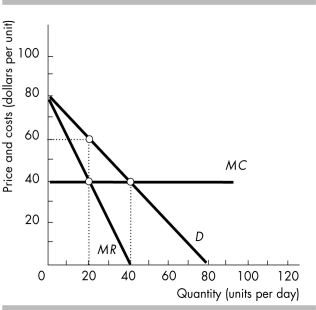 -In the figure above, the efficient amount of output is
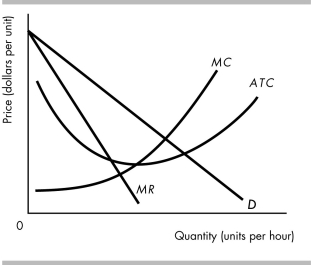 -The above figure represents the cost, demand, and marginal revenue curves for a monopolist.
a) Indicate the price and quantity a single-price monopolist selects by labeling the price Pm and the quantity Qm.
b) In the figure, lightly shade in the area that represents the single-price monopoly's economic profit.
c) Indicate the quantity a perfectly price-discriminating monopolist selects by labeling it Qppd.
d) In the figure, more darkly shade the area that represents the additional economic profit the monopoly earns as a result of the perfect price discrimination.
-The above figure represents the cost, demand, and marginal revenue curves for a monopolist.
a) Indicate the price and quantity a single-price monopolist selects by labeling the price Pm and the quantity Qm.
b) In the figure, lightly shade in the area that represents the single-price monopoly's economic profit.
c) Indicate the quantity a perfectly price-discriminating monopolist selects by labeling it Qppd.
d) In the figure, more darkly shade the area that represents the additional economic profit the monopoly earns as a result of the perfect price discrimination. (Essay)
4.7/5 (97)
(97) If a marginal cost pricing rule is imposed on the firm in the figure above, the total surplus will be
(Multiple Choice)
4.9/5 (73)
(73) 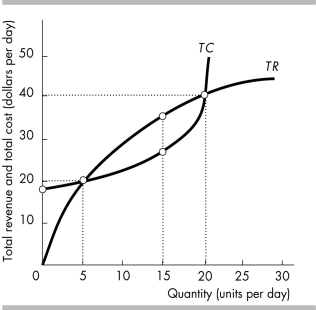 -The figure above shows a monopoly's total revenue and total cost curves. The monopoly's marginal revenue equals its marginal cost when it produces
 (Multiple Choice)
4.8/5 (73)
(73) 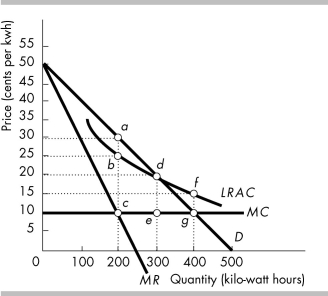 -The figure above provides information about Light-U-Up Utilities, which is a natural monopoly that provides electricity. At the unregulated price and quantity, Light-U-Up's economic profit is equal to
 (Multiple Choice)
4.7/5 (73)
(73) 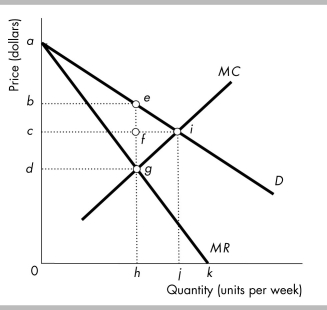 -In the figure above, the elasticity of demand facing the monopoly equals one when it produces ________ units of output.
 (Multiple Choice)
4.7/5 (70)
(70) 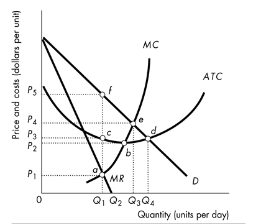 -The deadweight loss incurred when the market in the above figure is a single-price monopoly rather than perfectly competitive is the area
 (Multiple Choice)
4.9/5 (85)
(85) "A single-price monopolist will always charge a price that is on the elastic range of its demand." Explain why the previous statement is correct or incorrect.
(Essay)
4.8/5 (71)
(71) If a marginal cost pricing rule is imposed on the firm in the figure above, the consumer surplus will be
(Multiple Choice)
4.9/5 (75)
(75) 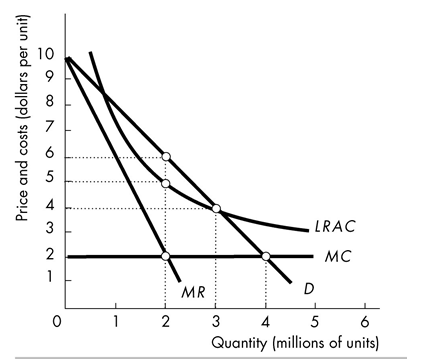 -If an average cost pricing rule is imposed on the natural monopoly shown in the figure above, then consumer surplus will be
 (Multiple Choice)
4.9/5 (69)
(69) 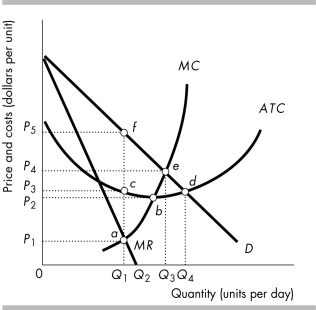 -In the above figure, the total revenue for a single-price monopolist is shown by the area
 (Multiple Choice)
4.8/5 (91)
(91) 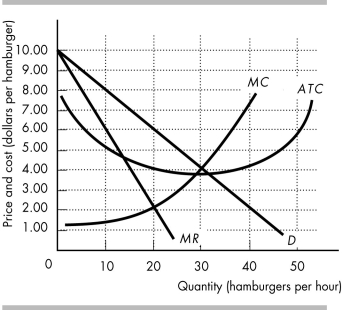 -Ron's Hamburger Joint is the only restaurant in town. The above figure represents Ron's cost, demand, and marginal revenue curves. Ron operates as a single-price monopoly.
a) How many hamburgers does Ron produce?
b) What price does Ron charge for a hamburger?
c) What is Ron's total revenue?
d) What is his total cost?
e) What is Ron's economic profit?
-Ron's Hamburger Joint is the only restaurant in town. The above figure represents Ron's cost, demand, and marginal revenue curves. Ron operates as a single-price monopoly.
a) How many hamburgers does Ron produce?
b) What price does Ron charge for a hamburger?
c) What is Ron's total revenue?
d) What is his total cost?
e) What is Ron's economic profit? (Essay)
4.8/5 (85)
(85) 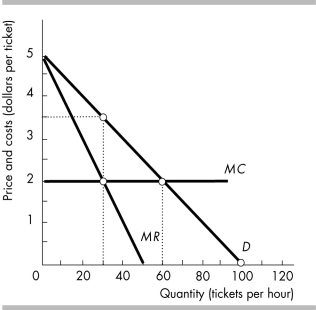 -If the monopoly illustrated in the figure above could engage in perfect price discrimination, then each buyer would pay
 (Multiple Choice)
4.8/5 (88)
(88) While smoking is on the decline in the United States, China is still puffing away madly. That's not because the government is eager to protect its citizens from the hazards of smoking. It's because China is eager to protect its own tobacco industry which is a state monopoly. How would entry of foreign companies into the tobacco market affect the economic profit of the state monopoly?
(Multiple Choice)
4.8/5 (82)
(82) Why do some utilities have an incentive to exaggerate their costs of production?
(Essay)
4.9/5 (90)
(90) 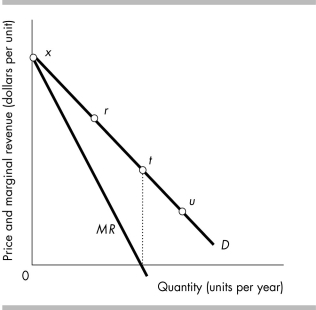 -The figure above shows a monopoly firm's demand curve. If the price and quantity of haircuts move from point t to point u, the monopoly's
 (Multiple Choice)
4.9/5 (71)
(71) 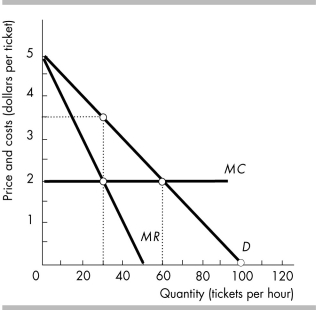 -The monopoly illustrated in the figure above is unregulated and charges a single price. The deadweight loss created by the monopoly is
 (Multiple Choice)
4.8/5 (72)
(72) 
Filters
- Essay(0)
- Multiple Choice(0)
- Short Answer(0)
- True False(0)
- Matching(0)