



 Chat with AI
Exam 13: Monopoly

Exam 1: What Is Economics483 Questions
Exam 2: The Economic Problem440 Questions
Exam 3: Demand and Supply515 Questions
Exam 4: Elasticity530 Questions
Exam 5: Efficiency and Equity450 Questions
Exam 6: Government Actions in Markets412 Questions
Exam 7: Global Markets in Action205 Questions
Exam 8: Utility and Demand366 Questions
Exam 10: Organizing Production385 Questions
Exam 11: Output and Costs493 Questions
Exam 12: Perfect Competition487 Questions
Exam 13: Monopoly599 Questions
Exam 14: Monopolistic Competition318 Questions
Exam 15: Oligopoly276 Questions
Exam 16: Public Choices, Public Goods, and Healthcare205 Questions
Exam 17: Externalities437 Questions
Exam 18: Markets for Factors of Production382 Questions
Exam 19: Economic Inequality351 Questions
Exam 20: Uncertainty and Information233 Questions
Select questions type


Which of the following is TRUE for a single-price monopolist?
(Multiple Choice)
4.7/5  (70)
(70) 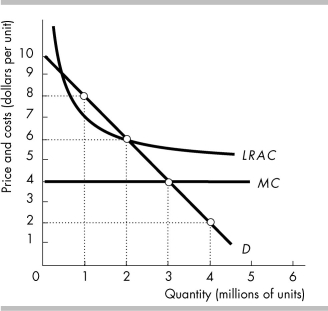 -The figure above shows the costs and demand curves for the Bigshow Cable Company. If the regulator wants to set the price so that Bigshow earns the same normal profit as a perfectly competitive firm, what price should be set?
 (Multiple Choice)
4.9/5 (71)
(71) 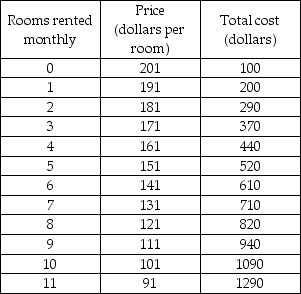 -The table above shows the demand and total cost schedule for a monopolist hotel. What is the marginal revenue from renting out the fifth room each night?
 (Multiple Choice)
4.8/5 (95)
(95) 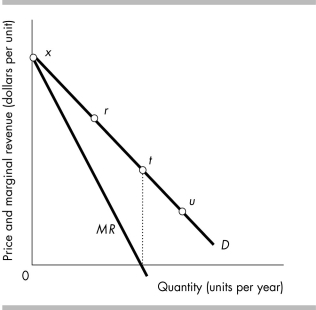 -The figure above shows a monopoly firm's demand curve. At point t
 (Multiple Choice)
4.8/5 (76)
(76) When an average cost pricing rule is imposed on a natural monopoly
(Multiple Choice)
4.9/5 (80)
(80) 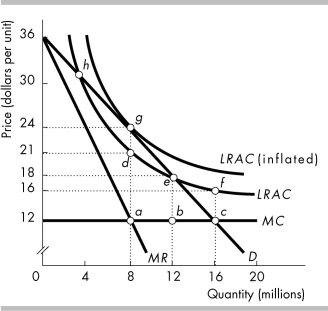 -In the above figure, if this natural monopoly is NOT regulated the deadweight loss to society is
 (Multiple Choice)
4.8/5 (82)
(82) Electric utilities are often considered natural monopolies and are regulated. When would the price be highest: when the utility is not regulated, when it is regulated using an average cost pricing rule, or when it is regulated using a marginal cost pricing rule? When would its price be lowest?
(Essay)
4.9/5 (87)
(87) 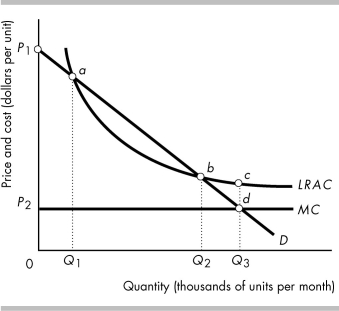 -The above figure represents the cost and demand curves for a natural monopoly that is regulated using a marginal cost pricing rule.
a) What is the quantity?
b) What price is charged?
c) What area represents the consumer surplus when the firm is regulated using a marginal cost pricing rule?
d) What distance represents the firm's loss per unit when the firm is regulated using a marginal cost pricing rule?
-The above figure represents the cost and demand curves for a natural monopoly that is regulated using a marginal cost pricing rule.
a) What is the quantity?
b) What price is charged?
c) What area represents the consumer surplus when the firm is regulated using a marginal cost pricing rule?
d) What distance represents the firm's loss per unit when the firm is regulated using a marginal cost pricing rule? (Essay)
4.7/5 (72)
(72) 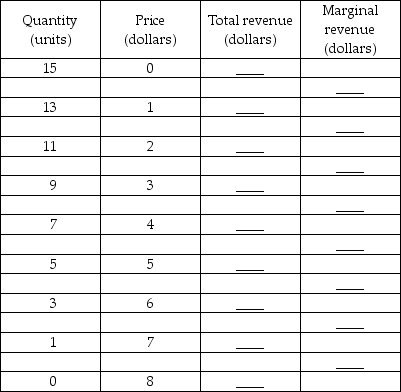 -The above table gives a monopolist's demand schedule. Complete the table by calculating the total revenue and the marginal revenue.
 (Essay)
4.9/5 (89)
(89) Monopolies can make an economic profit in the long run because of
(Multiple Choice)
4.9/5 (85)
(85) 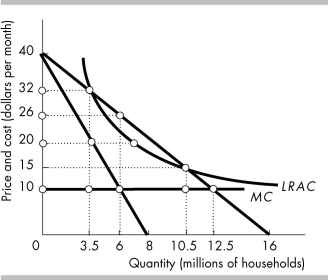 -Consider the market for cable television, a natural monopoly, shown in the figure above. If the regulator imposes an average cost pricing rule, deadweight loss is equal to
 (Multiple Choice)
4.9/5 (75)
(75) 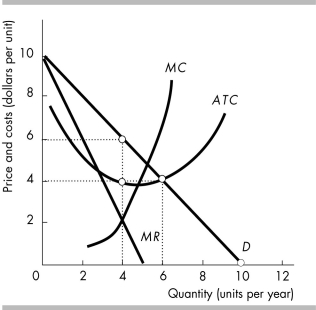 -The unregulated, single-price monopoly shown in the figure above will produce where its demand
 (Multiple Choice)
4.9/5 (89)
(89) Why do perfectly competitive firms maximize their profits by producing so that the price is equal to marginal cost, but monopolists maximize their profits by setting a price that is greater than marginal cost?
(Essay)
4.9/5 (91)
(91) 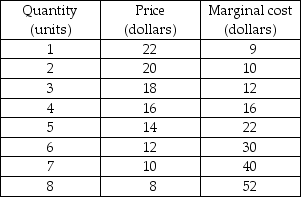 -A monopolist has the demand and marginal cost schedules given in the above table. If the monopoly can perfectly price discriminate, what is the profit-maximizing level of output and price?
 (Essay)
4.7/5 (90)
(90) What is rent seeking? How does rent seeking affect the deadweight loss from monopoly?
(Essay)
4.9/5 (83)
(83) 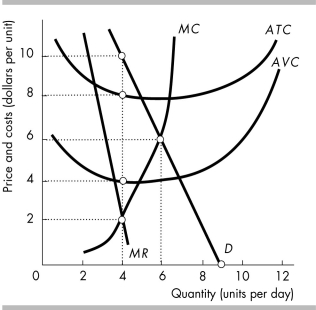 -The unregulated, single-price monopolist illustrated in the figure above has a total cost of
 (Multiple Choice)
4.7/5 (76)
(76) 
Filters
- Essay(0)
- Multiple Choice(0)
- Short Answer(0)
- True False(0)
- Matching(0)