



 Chat with AI
Exam 13: Monopoly

Exam 1: What Is Economics483 Questions
Exam 2: The Economic Problem440 Questions
Exam 3: Demand and Supply515 Questions
Exam 4: Elasticity530 Questions
Exam 5: Efficiency and Equity450 Questions
Exam 6: Government Actions in Markets412 Questions
Exam 7: Global Markets in Action205 Questions
Exam 8: Utility and Demand366 Questions
Exam 10: Organizing Production385 Questions
Exam 11: Output and Costs493 Questions
Exam 12: Perfect Competition487 Questions
Exam 13: Monopoly599 Questions
Exam 14: Monopolistic Competition318 Questions
Exam 15: Oligopoly276 Questions
Exam 16: Public Choices, Public Goods, and Healthcare205 Questions
Exam 17: Externalities437 Questions
Exam 18: Markets for Factors of Production382 Questions
Exam 19: Economic Inequality351 Questions
Exam 20: Uncertainty and Information233 Questions
Select questions type


A monopolist is the sole supplier of a good or service for which there are no close substitutes.
(True/False)
4.8/5  (81)
(81) The WaveHouse on Mission Beach in San Diego features the Bruticus Maximus, a ten foot wave, which tests the skills of even the most talented surf and wake board riders on the planet. WaveHouse is the only place in San Diego where this service is offered. You can ride B. Max for $40 for the first hour, $33 for the second hour, and $26 for the third hour. An effect of this price discrimination is that
(Multiple Choice)
4.7/5 (76)
(76) A natural monopoly that is regulated to set its price equal to its marginal cost
(Multiple Choice)
4.7/5 (86)
(86) 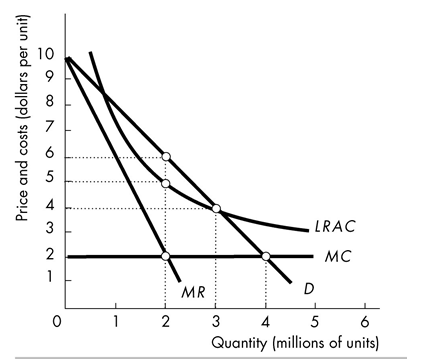 -If a marginal cost pricing rule is imposed on the natural monopoly shown in the figure above, then it will produce
 (Multiple Choice)
4.9/5 (75)
(75) What is the relationship between the marginal revenue curve and the demand curve for a single-price monopolist?
(Essay)
4.9/5 (73)
(73) Price discrimination by a monopolist is less effective if the
(Multiple Choice)
4.9/5 (90)
(90) Patents are ________ barriers to entry and public franchises are ________ barriers to entry.
(Multiple Choice)
4.8/5 (81)
(81) If a decrease in price decreases a monopolist's total revenue, then
(Multiple Choice)
4.8/5 (85)
(85) 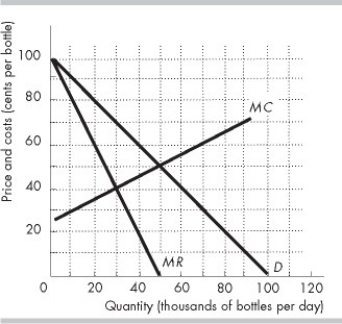 -Interlace, Inc. produces and a unique soda. The company cannot price discriminate. The figure above shows Interlace's demand curve, marginal revenue curve, and marginal cost curve. Interlace's profit maximizing level of output is
 (Multiple Choice)
4.9/5 (91)
(91) A major difference between a single-price monopolist and a perfectly competitive firm is that the
(Multiple Choice)
4.8/5 (84)
(84) 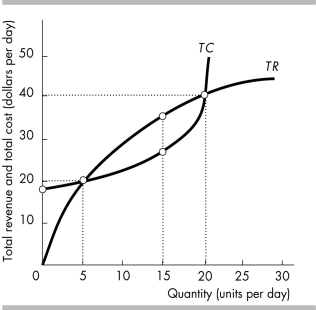 -The figure above shows a monopoly's total revenue and total cost curves. The monopoly's economic profit is positive if it produces between
 (Multiple Choice)
4.7/5 (73)
(73) 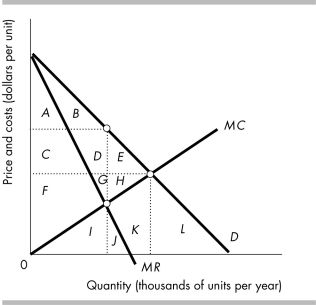 -Which area in the above figure shows the producer surplus at the price and quantity that would be set by a single-price monopoly?
 (Multiple Choice)
4.8/5 (85)
(85) 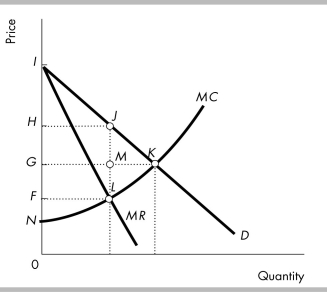 -In the market depicted in the above figure, if a single-price monopoly maximizes its profit, which area shows the deadweight loss?
 (Multiple Choice)
4.9/5 (75)
(75) 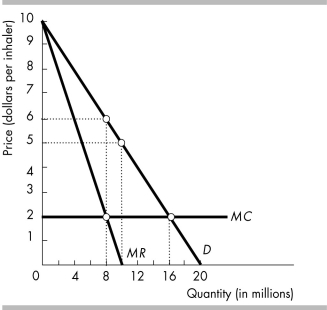 -Prime Pharmaceuticals has developed a new asthma medicine, for which it has a patent. An inhaler can be produced at a constant marginal cost of $2/inhaler. The demand curve, marginal revenue curve, and marginal cost curve for this new asthma inhaler are in the figure above. With its patent giving it a monopoly for its new inhaler, if Prime Pharmaceuticals operates as a single-price monopoly, then there will be a deadweight loss equal to
 (Multiple Choice)
5.0/5 (71)
(71) 
Filters
- Essay(0)
- Multiple Choice(0)
- Short Answer(0)
- True False(0)
- Matching(0)