



 Chat with AI
Exam 13: Monopoly

Exam 1: What Is Economics483 Questions
Exam 2: The Economic Problem440 Questions
Exam 3: Demand and Supply515 Questions
Exam 4: Elasticity530 Questions
Exam 5: Efficiency and Equity450 Questions
Exam 6: Government Actions in Markets412 Questions
Exam 7: Global Markets in Action205 Questions
Exam 8: Utility and Demand366 Questions
Exam 10: Organizing Production385 Questions
Exam 11: Output and Costs493 Questions
Exam 12: Perfect Competition487 Questions
Exam 13: Monopoly599 Questions
Exam 14: Monopolistic Competition318 Questions
Exam 15: Oligopoly276 Questions
Exam 16: Public Choices, Public Goods, and Healthcare205 Questions
Exam 17: Externalities437 Questions
Exam 18: Markets for Factors of Production382 Questions
Exam 19: Economic Inequality351 Questions
Exam 20: Uncertainty and Information233 Questions
Select questions type


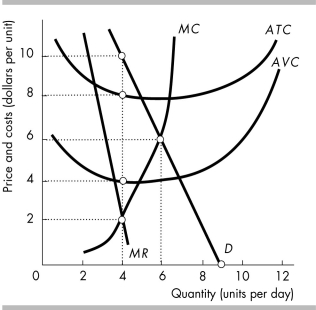 -The unregulated, single-price monopolist illustrated in the figure above will produce
 (Multiple Choice)
4.9/5  (77)
(77)
-In the figure above, compared to a perfectly competitive industry with the same costs, a single-price, unregulated monopoly will raise the price by
-In the figure above, compared to a perfectly competitive industry with the same costs, a single-price, unregulated monopoly will raise the price by (Multiple Choice)
4.8/5 (83)
(83) When an average total cost pricing rule is enforced, average total cost equals
(Multiple Choice)
4.8/5 (68)
(68) 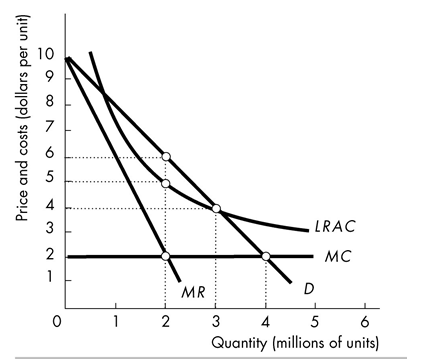 -If an average cost pricing rule is imposed on the natural monopoly shown in the figure above, then it will produce
 (Multiple Choice)
4.7/5 (74)
(74) What does the marginal revenue equal when a monopoly's total revenue is maximized? What is the elasticity of demand when the total revenue is maximized?
(Essay)
5.0/5 (81)
(81) 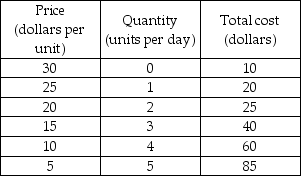 -The table above shows the demand and costs for a single-price monopolist. When it maximizes its profit, the firm makes an economic profit of
 (Multiple Choice)
4.8/5 (89)
(89) A regulated monopoly facing average cost pricing rule will make the same profit as a firm in ________ market does in the long run.
(Multiple Choice)
4.9/5 (78)
(78) 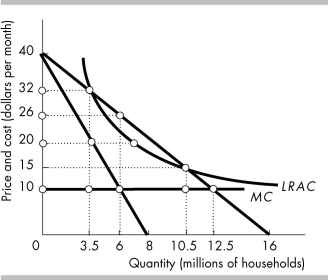 -Consider the market for cable television, a natural monopoly, shown in the figure above. If the regulator imposes an average cost pricing rule, the firm provides service to
 (Multiple Choice)
4.7/5 (93)
(93) Which creates a larger deadweight loss, perfect competition or a single-price monopoly?
(Essay)
4.8/5 (73)
(73) Which of the following statements regarding an average-cost pricing rule for a natural monopoly is WRONG?
(Multiple Choice)
4.8/5 (88)
(88) If economies of scale allow one cable TV firm to supply the entire market at the lowest possible cost, then this company is
(Multiple Choice)
4.9/5 (77)
(77) 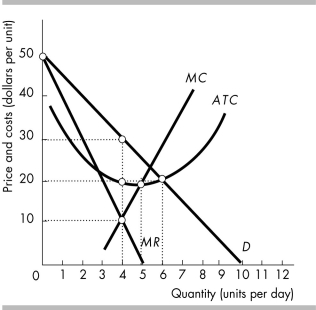 -For the monopoly shown in the figure above, the profit maximizing price is ________ per unit.
 (Multiple Choice)
4.9/5 (80)
(80) 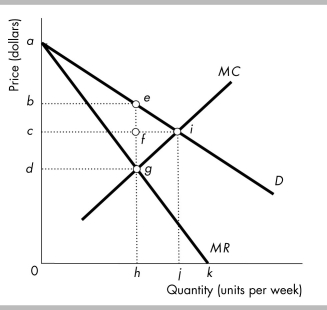 -In the figure above, if the market is a single-price monopoly rather than a perfectly competitive industry, the transfer of consumer surplus from consumers to the producer is the area of
 (Multiple Choice)
4.8/5 (71)
(71) 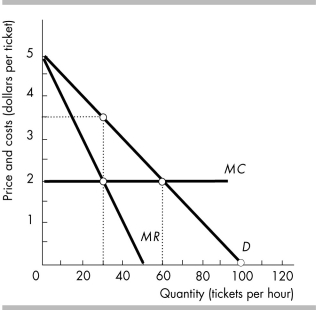 -The unregulated, single-price monopoly shown in the figure above will sell
 (Multiple Choice)
4.9/5 (84)
(84)
-An unregulated, single-price monopoly is shown in the figure above. If fixed cost is $20, the monopoly's total costs when it is maximizing its profit will be
-An unregulated, single-price monopoly is shown in the figure above. If fixed cost is $20, the monopoly's total costs when it is maximizing its profit will be (Multiple Choice)
4.8/5 (89)
(89)
-Consider the market for cable television in the figure above. This graph depicts a natural monopoly because the
-Consider the market for cable television in the figure above. This graph depicts a natural monopoly because the (Multiple Choice)
4.8/5 (88)
(88) 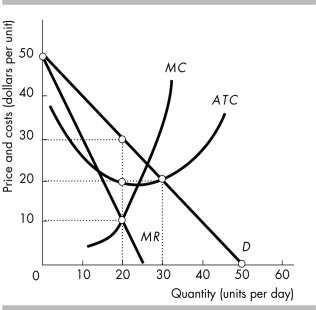 -The figure above shows the demand and cost curves for a single-price monopoly. What economic profit does this firm make?
 (Multiple Choice)
4.7/5 (72)
(72) 
Filters
- Essay(0)
- Multiple Choice(0)
- Short Answer(0)
- True False(0)
- Matching(0)