



 Chat with AI
Exam 13: Monopoly

Exam 1: What Is Economics483 Questions
Exam 2: The Economic Problem440 Questions
Exam 3: Demand and Supply515 Questions
Exam 4: Elasticity530 Questions
Exam 5: Efficiency and Equity450 Questions
Exam 6: Government Actions in Markets412 Questions
Exam 7: Global Markets in Action205 Questions
Exam 8: Utility and Demand366 Questions
Exam 10: Organizing Production385 Questions
Exam 11: Output and Costs493 Questions
Exam 12: Perfect Competition487 Questions
Exam 13: Monopoly599 Questions
Exam 14: Monopolistic Competition318 Questions
Exam 15: Oligopoly276 Questions
Exam 16: Public Choices, Public Goods, and Healthcare205 Questions
Exam 17: Externalities437 Questions
Exam 18: Markets for Factors of Production382 Questions
Exam 19: Economic Inequality351 Questions
Exam 20: Uncertainty and Information233 Questions
Select questions type


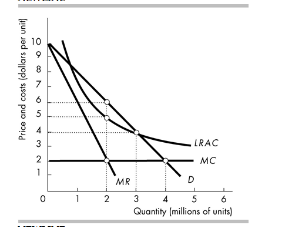 -If the natural monopoly shown in the figure above is unregulated, it will sell
Free
(Multiple Choice)
4.9/5  (82)
(82) Correct Answer: Verified
A
Monopolists can make an economic profit in the long-run because of barriers to entry.
Free
(True/False)
4.8/5 (83)
(83) Correct Answer:Verified
VerifiedTrue
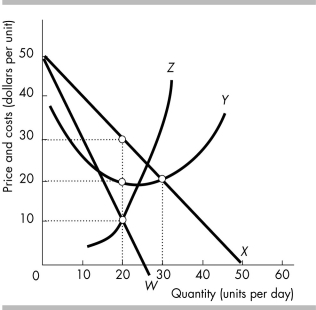 -In the figure above, the curve labeled "X" can be a
If an average cost pricing rule is imposed on the firm in the figure above, the deadweight loss will be
(Multiple Choice)
4.7/5 (74)
(74) 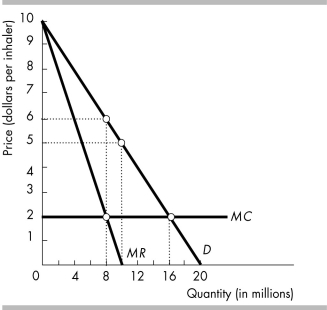 -Prime Pharmaceuticals has developed a new asthma medicine, for it has a patent. An inhaler can be produced at a constant marginal cost of $2/inhaler. The demand curve, marginal revenue curve, and marginal cost curve for this new asthma inhaler are in the figure above. With its patent giving it a monopoly for its new inhaler, if it is a single-price monopoly, Prime Pharmaceuticals will produce ________ inhalers and set a price of ________ for each inhaler.
 (Multiple Choice)
4.8/5 (96)
(96) 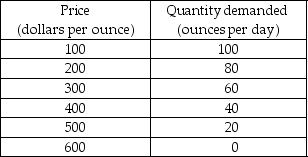
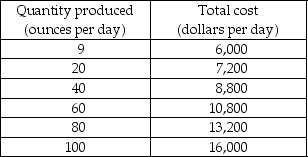 -Anastasia's Gold Mines, a single-price monopoly, faces the demand schedule shown in the first table above and has the cost schedule shown in the second table above.
a) Calculate Anastasia's marginal revenue schedule. In a figure, draw the demand curve and the marginal revenue curve.
b) Calculate Anastasia's marginal cost and average total cost schedules. In the same figure that you drew the demand and marginal revenue curves, draw the marginal and the average total cost curves.
c) What are Anastasia's profit-maximizing output and price? What is Anastasia's economic profit? Explain your answer.
d) Does Anastasia's Gold Mines use resources efficiently? Explain your answer.
-Anastasia's Gold Mines, a single-price monopoly, faces the demand schedule shown in the first table above and has the cost schedule shown in the second table above.
a) Calculate Anastasia's marginal revenue schedule. In a figure, draw the demand curve and the marginal revenue curve.
b) Calculate Anastasia's marginal cost and average total cost schedules. In the same figure that you drew the demand and marginal revenue curves, draw the marginal and the average total cost curves.
c) What are Anastasia's profit-maximizing output and price? What is Anastasia's economic profit? Explain your answer.
d) Does Anastasia's Gold Mines use resources efficiently? Explain your answer. (Essay)
4.9/5 (72)
(72) If an average cost pricing rule is imposed on the firm in the figure above, the price will be
(Multiple Choice)
4.8/5 (79)
(79) 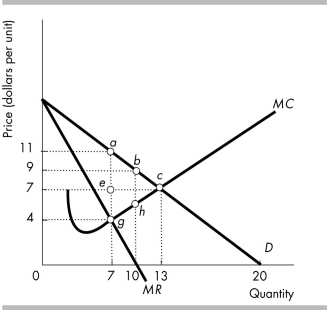 -Consider the monopolist depicted in the figure above. When it maximizes its profit, a single-price monopolist sets a price of ________ per unit.
 (Multiple Choice)
4.9/5 (66)
(66) 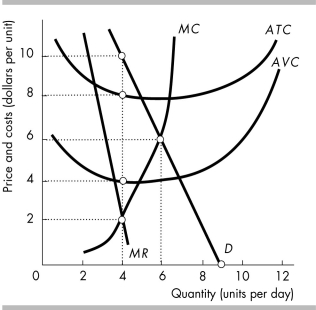 -In the figure above, the deadweight loss created if the industry changes from perfectly competitive to a single-price, unregulated monopoly is
 (Multiple Choice)
4.8/5 (82)
(82) 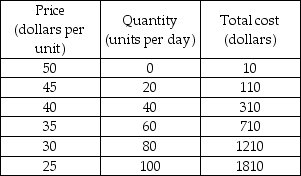 -The table above shows the demand and costs for a single-price monopolist. The firm can maximize its profit by selling
 (Multiple Choice)
4.8/5 (84)
(84) The WaveHouse on Mission Beach in San Diego features the Bruticus Maximus, a ten foot wave, which tests the skills of even the most talented surf and wake board riders on the planet. WaveHouse is the only place in San Diego where this service is offered. If you are a member of WaveHouse, you can ride for half the price that a non-member pays. This is an example of
(Multiple Choice)
4.9/5 (76)
(76) A profit maximizing single-price monopolist charges a price equal to
(Multiple Choice)
4.8/5 (76)
(76) 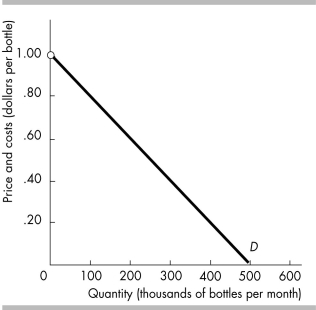 -Mountain Water is a natural monopoly. The government decides to regulate Mountain Water by imposing a marginal cost pricing rule. The figure above shows the demand for Mountain Water. Marginal cost is $0.20 per bottle. The price of a bottle of Mountain Water is ________, and ________ thousand bottles are sold per month.
 (Multiple Choice)
4.8/5 (97)
(97) 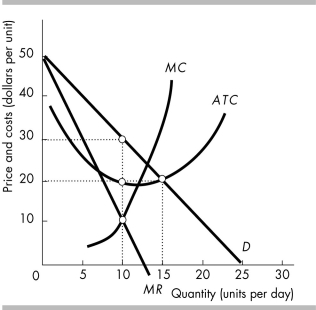 -The figure above shows the demand and cost curves for a single-price monopoly. The firm will produce ________ units and set a price of ________ per unit.
 (Multiple Choice)
4.9/5 (72)
(72) A natural monopoly regulated with an average cost pricing rule is
(Multiple Choice)
4.9/5 (70)
(70) Which of the following types of economic regulation is most likely to encourage a natural monopoly to NOT inflate its costs?
(Multiple Choice)
4.9/5 (86)
(86) Which of the following is ALWAYS true for a profit-maximizing single-price monopolist?
(Multiple Choice)
4.9/5 (80)
(80) 
Filters
- Essay(0)
- Multiple Choice(0)
- Short Answer(0)
- True False(0)
- Matching(0)