



 Chat with AI
Exam 13: Monopoly

Exam 1: What Is Economics483 Questions
Exam 2: The Economic Problem440 Questions
Exam 3: Demand and Supply515 Questions
Exam 4: Elasticity530 Questions
Exam 5: Efficiency and Equity450 Questions
Exam 6: Government Actions in Markets412 Questions
Exam 7: Global Markets in Action205 Questions
Exam 8: Utility and Demand366 Questions
Exam 10: Organizing Production385 Questions
Exam 11: Output and Costs493 Questions
Exam 12: Perfect Competition487 Questions
Exam 13: Monopoly599 Questions
Exam 14: Monopolistic Competition318 Questions
Exam 15: Oligopoly276 Questions
Exam 16: Public Choices, Public Goods, and Healthcare205 Questions
Exam 17: Externalities437 Questions
Exam 18: Markets for Factors of Production382 Questions
Exam 19: Economic Inequality351 Questions
Exam 20: Uncertainty and Information233 Questions
Select questions type


"Because of rent seeking, a monopoly may end up making zero economic profit." Is the previous statement correct or incorrect? Why?
(Essay)
4.8/5  (80)
(80) 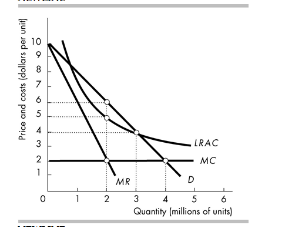 -If the natural monopoly shown in the figure above is unregulated, then consumer surplus will be
 (Multiple Choice)
4.8/5 (69)
(69) Unregulated monopolies can often make an economic profit in the long run because
(Multiple Choice)
4.8/5 (68)
(68) "Price discriminators lose money by being nice to their customers." Is the previous statement correct or incorrect?
(Essay)
4.8/5 (82)
(82)
-If a marginal cost pricing rule is imposed on the natural monopoly in the figure above, then the consumer surplus will be
-If a marginal cost pricing rule is imposed on the natural monopoly in the figure above, then the consumer surplus will be (Multiple Choice)
4.9/5 (83)
(83) If a monopolist was operating in a price range where marginal revenue was negative, it would be
(Multiple Choice)
4.7/5 (85)
(85) Attempts to create a monopoly by having favorable laws passed are examples of rent seeking.
(True/False)
4.9/5 (67)
(67) 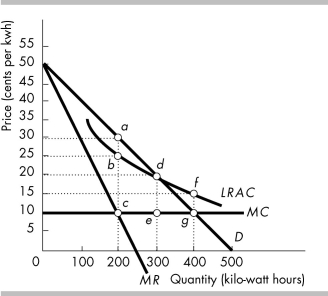 -The figure above provides information about Light-U-Up Utilities, which is a natural monopoly that provides electricity. If Light-U-Up is regulated, what is its economic profit if it must follow a marginal cost pricing rule?
 (Multiple Choice)
4.9/5 (79)
(79) Which of the following statements is TRUE for both a competitive market and a single-price monopoly?
(Multiple Choice)
5.0/5 (77)
(77) 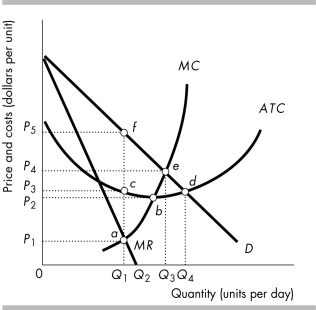 -In the above figure, for a single-price monopolist producing at its profit-maximizing equilibrium price and quantity, the price elasticity of demand at this equilibrium will be
 (Multiple Choice)
4.9/5 (86)
(86) For a monopoly, the demand for its product is perfectly elastic at the market price.
(True/False)
4.9/5 (96)
(96) If a marginal cost pricing rule is imposed on the firm in the figure above, the price will be
(Multiple Choice)
4.9/5 (92)
(92) A monopoly that can perfectly price discriminate creates no deadweight loss.
(True/False)
4.8/5 (77)
(77)
-The figure above provides information about Light-U-Up Utilities, which is a natural monopoly that provides electricity. If Light-U-Up is unregulated, it will produce ________ and sell at a price of ________.
-The figure above provides information about Light-U-Up Utilities, which is a natural monopoly that provides electricity. If Light-U-Up is unregulated, it will produce ________ and sell at a price of ________. (Multiple Choice)
5.0/5 (72)
(72) Compare and contrast the effect of perfect competition to the effect of perfect price discrimination on:
a) efficiency.
b) consumer surplus.
c) economic profit in the long run.
(Essay)
4.7/5 (87)
(87)
-If a marginal cost pricing rule is imposed on the natural monopoly in the figure above, then the price will be
-If a marginal cost pricing rule is imposed on the natural monopoly in the figure above, then the price will be (Multiple Choice)
4.9/5 (71)
(71) A single-price monopolist will produce the output at which
(Multiple Choice)
4.8/5 (74)
(74) 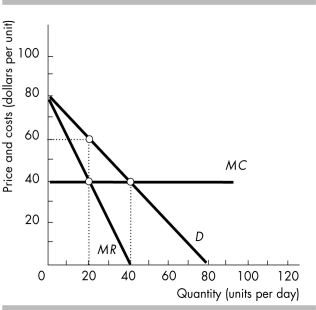 -The output produced by the single-price, unregulated monopoly in the above figure is
 (Multiple Choice)
4.7/5 (89)
(89) A monopoly is a firm that produces a good or service for which no close substitute exists.
(True/False)
4.8/5 (80)
(80) 
Filters
- Essay(0)
- Multiple Choice(0)
- Short Answer(0)
- True False(0)
- Matching(0)