



 Chat with AI
Exam 13: Monopoly

Exam 1: What Is Economics483 Questions
Exam 2: The Economic Problem440 Questions
Exam 3: Demand and Supply515 Questions
Exam 4: Elasticity530 Questions
Exam 5: Efficiency and Equity450 Questions
Exam 6: Government Actions in Markets412 Questions
Exam 7: Global Markets in Action205 Questions
Exam 8: Utility and Demand366 Questions
Exam 10: Organizing Production385 Questions
Exam 11: Output and Costs493 Questions
Exam 12: Perfect Competition487 Questions
Exam 13: Monopoly599 Questions
Exam 14: Monopolistic Competition318 Questions
Exam 15: Oligopoly276 Questions
Exam 16: Public Choices, Public Goods, and Healthcare205 Questions
Exam 17: Externalities437 Questions
Exam 18: Markets for Factors of Production382 Questions
Exam 19: Economic Inequality351 Questions
Exam 20: Uncertainty and Information233 Questions
Select questions type


Define price discrimination. What factors must be present in order for a monopolist to price discriminate? Why do firms price discriminate?
(Essay)
4.9/5  (83)
(83) The Public Service Company of Colorado is a natural monopoly in the transmission and distribution of electric power. As such, it will incur an economic loss if it
(Multiple Choice)
4.9/5 (81)
(81) 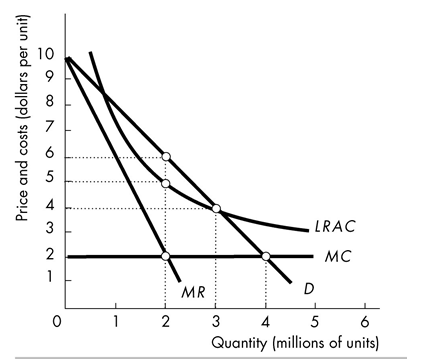 -If an average cost pricing rule is imposed on the natural monopoly shown in the figure above, then the price will be
 (Multiple Choice)
4.9/5 (80)
(80) Under rate of return regulation, a regulated firm has an incentive to
(Multiple Choice)
4.9/5 (86)
(86) A monopolist can make an economic profit in the long run because of
(Multiple Choice)
4.8/5 (91)
(91) 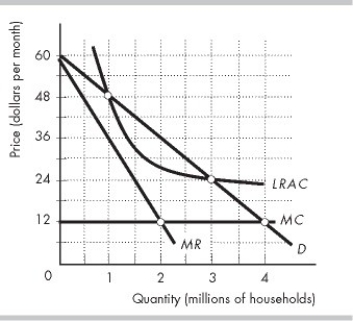 -The figure above shows the demand curve (D) faced by Visual, Inc., a cable TV company, and the firm's marginal revenue (MR), marginal cost (MC), and average cost (LRAC) curves. If Visual is regulated according to an average cost pricing rule, there will be
 (Multiple Choice)
4.8/5 (94)
(94) 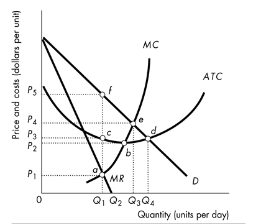 -The area of economic profit shown in the above figure for the single-price monopolist is
 (Multiple Choice)
4.8/5 (78)
(78) There is no deadweight loss if the regulatory rule for a natural monopoly
(Multiple Choice)
4.8/5 (76)
(76) 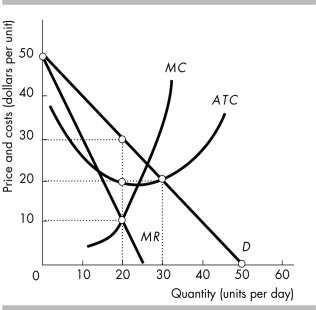 -The figure above shows the demand and cost curves for a single-price monopoly. What price will the firm charge?
 (Multiple Choice)
4.8/5 (75)
(75) When comparing perfect competition to a single-price monopoly with the same costs
(Multiple Choice)
4.9/5 (72)
(72) If a natural monopoly does NOT inflate its costs, the output it produces is the smallest when the monopoly is
(Multiple Choice)
4.9/5 (73)
(73) Price discrimination, where different units of a good are sold for different prices
(Multiple Choice)
4.9/5 (70)
(70) An industry in which economies of scale allow one firm to supply the entire market at the lowest possible cost is called a
(Multiple Choice)
4.7/5 (74)
(74) Which of the following is a characteristic of monopoly in the long run?
(Multiple Choice)
4.7/5 (83)
(83) The social interest theory of regulation suggests that the political process and regulations will ________ and the capture theory of regulation suggests that the political process and regulations will ________.
(Multiple Choice)
4.7/5 (82)
(82) 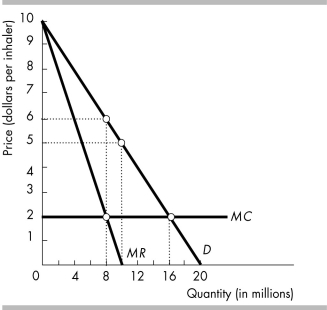 -Prime Pharmaceuticals has developed a new asthma medicine, for which it has a patent. An inhaler can be produced at a constant marginal cost of $2/inhaler. The demand curve, marginal revenue curve, and marginal cost curve for this new asthma inhaler are in the figure above. With its patent giving it a monopoly for its new inhaler, if Prime Pharmaceuticals could perfectly price discriminate, then consumer surplus would equal
 (Multiple Choice)
4.8/5 (73)
(73) 
Filters
- Essay(0)
- Multiple Choice(0)
- Short Answer(0)
- True False(0)
- Matching(0)