



 Chat with AI
Exam 10: Gases

Exam 1: Chemistry: the Central Science133 Questions
Exam 2: Atoms, Molecules, and Ions124 Questions
Exam 3: Stoichiometry: Ratios of Combination137 Questions
Exam 4: Reactions in Aqueous Solutions146 Questions
Exam 5: Thermochemistry141 Questions
Exam 6: Quantum Theory and the Electronic Structure of Atoms135 Questions
Exam 7: Electron Configuration and the Periodic Table120 Questions
Exam 8: Chemical Bonding I: Basic Concepts102 Questions
Exam 9: Chemical Bonding II: Molecular Geometry and Bonding Theories139 Questions
Exam 10: Gases137 Questions
Exam 11: Intermolecular Forces and the Physical Properties of Liquids and Solids137 Questions
Exam 12: Modern Materials108 Questions
Exam 13: Physical Properties of Solutions151 Questions
Exam 14: Chemical Kinetics132 Questions
Exam 15: Chemical Equilibrium146 Questions
Exam 16: Acids and Bases137 Questions
Exam 17: Acid-Base Equilibria and Solubility Equilibria133 Questions
Exam 18: Entropy, Free Energy, and Equilibrium107 Questions
Exam 19: Electrochemistry122 Questions
Exam 20: Nuclear Chemistry127 Questions
Exam 21: Environmental Chemistry135 Questions
Exam 22: Coordination Chemistry132 Questions
Exam 23: Metallurgy and the Chemistry of Metals152 Questions
Exam 24: Nonmetallic Elements and Their Compounds117 Questions
Exam 25: Organic Chemistry121 Questions
Select questions type


When active metals such as magnesium are immersed in acid solution, hydrogen gas is evolved. Calculate the volume of H2(g) at 30.1°C and 0.85 atm that can be formed when 275 mL of 0.725 M HCl solution reacts with excess Mg to give hydrogen gas and aqueous magnesium chloride. Mg(s) + 2HCl(aq) → MgCl2(aq) + H2(g)
(R = 0.08206 L • atm/K • mol)
(Multiple Choice)
4.9/5  (84)
(84) Suppose a sample of gas is composed of 100 molecules, with speeds given below. 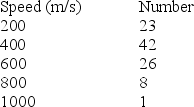 According to the kinetic molecular theory, if the absolute temperature of the gas is halved, what is a reasonable estimation of the new distribution of speeds of the molecules?
 (Multiple Choice)
4.8/5 (76)
(76) Magnesium metal (0.100 mol) and hydrochloric acid (0.500 mol HCl) are combined and react to completion. What volume of hydrogen gas, measured at STP, is produced? Mg(s) + 2HCl(aq) → MgCl2(aq) + H2(g)
(R = 0.08206 L • atm/K • mol)
(Multiple Choice)
4.8/5 (74)
(74) Choose all answers that apply. Which of the following is/are characteristic(s) of gases?
(Multiple Choice)
4.9/5 (69)
(69) Arrange the following gases in order of increasing rate of effusion: C2H6, Ar, HCl, and PH3.
(Multiple Choice)
4.9/5 (83)
(83) What is the mass, in grams, of 2.74 L of CO gas measured at 33°C and 945 mmHg? (R = 0.08206 L • atm/mol • K, 1 atm = 760 mmHg)
(Multiple Choice)
4.9/5 (75)
(75) A block of dry ice (solid CO2, density = 1.56 g/mL) of dimensions 25.0 cm × 25.0 cm × 25.0 cm is left to sublime (i.e., to pass from the solid phase to the gas phase) in a closed chamber of dimensions 4.00 m × 5.00 m × 3.00 m. Once the sublimation is complete, what is the partial pressure of carbon dioxide in the chamber at 25°C? (R = 0.08206 L • atm/K • mol, 1 atm = 760 mmHg)
(Multiple Choice)
4.8/5 (76)
(76) According to the postulates of kinetic molecular theory, the molecules of all gases at a given temperature have the same average speed.
(True/False)
4.8/5 (83)
(83) The pressure of hydrogen sulfide gas in a container is 3.565 ×10⁴ Pa. What is this pressure in torr? (1 atm = 101,325 Pa = 760 torr)?
(Multiple Choice)
4.9/5 (80)
(80) What is the final temperature of a gas that expands from a volume of 22.4 L at 278 K to a volume of 38.3 L at constant pressure?
(Multiple Choice)
4.8/5 (95)
(95) If equal masses of O2(g) and HBr(g) are in separate containers of equal volume and temperature, which one of the following statements is true?
(Multiple Choice)
4.8/5 (73)
(73) Select the gas with the highest average kinetic energy per mole at 298 K.
(Multiple Choice)
4.9/5 (74)
(74) A gaseous compound is 30.4% nitrogen and 69.6% oxygen by mass. A 5.25-g sample of the gas occupies a volume of 1.00 L and exerts a pressure of 1.26 atm at -4.0°C. What is its molecular formula? (R = 0.08206 L • atm/K • mol)
(Multiple Choice)
5.0/5 (84)
(84) Packaged cake mixes usually contain baking powder, a mixture of sodium hydrogen carbonate and calcium hydrogen phosphate that react to produce carbon dioxide gas when they come into contact with water. Many such mixes have special instructions for use at high altitudes. Why?
(Essay)
5.0/5 (81)
(81) 
Filters
- Essay(0)
- Multiple Choice(0)
- Short Answer(0)
- True False(0)
- Matching(0)