



 Chat with AI
Exam 10: Gases

Exam 1: Chemistry: the Central Science133 Questions
Exam 2: Atoms, Molecules, and Ions124 Questions
Exam 3: Stoichiometry: Ratios of Combination137 Questions
Exam 4: Reactions in Aqueous Solutions146 Questions
Exam 5: Thermochemistry141 Questions
Exam 6: Quantum Theory and the Electronic Structure of Atoms135 Questions
Exam 7: Electron Configuration and the Periodic Table120 Questions
Exam 8: Chemical Bonding I: Basic Concepts102 Questions
Exam 9: Chemical Bonding II: Molecular Geometry and Bonding Theories139 Questions
Exam 10: Gases137 Questions
Exam 11: Intermolecular Forces and the Physical Properties of Liquids and Solids137 Questions
Exam 12: Modern Materials108 Questions
Exam 13: Physical Properties of Solutions151 Questions
Exam 14: Chemical Kinetics132 Questions
Exam 15: Chemical Equilibrium146 Questions
Exam 16: Acids and Bases137 Questions
Exam 17: Acid-Base Equilibria and Solubility Equilibria133 Questions
Exam 18: Entropy, Free Energy, and Equilibrium107 Questions
Exam 19: Electrochemistry122 Questions
Exam 20: Nuclear Chemistry127 Questions
Exam 21: Environmental Chemistry135 Questions
Exam 22: Coordination Chemistry132 Questions
Exam 23: Metallurgy and the Chemistry of Metals152 Questions
Exam 24: Nonmetallic Elements and Their Compounds117 Questions
Exam 25: Organic Chemistry121 Questions
Select questions type


The rate of diffusion of a gas is inversely proportional to its molar mass.
(True/False)
4.7/5  (76)
(76) Gases are sold in large cylinders for laboratory use. What pressure is exerted by 2.500 kg of oxygen gas (O2) stored at 22°C in a 40.0-L cylinder? (R = 0.08206 L • atm/K • mol)
(Multiple Choice)
4.9/5 (73)
(73) What is the initial pressure of a gas having an initial temperature of 905 K, an initial volume of 14.3 L, a final pressure of 0.83 atm, a final temperature of 154 K and a final volume of 2.7 L?
(Multiple Choice)
4.8/5 (83)
(83) A sample of a gas occupies 1.40 L at 25°C and 760 mmHg. What volume will it occupy at the same temperature and 380 mmHg?
(Multiple Choice)
4.9/5 (72)
(72) Give five examples of compounds that exist as gases at room temperature and atmospheric pressure.
(Short Answer)
4.9/5 (77)
(77) 1.000 atm of oxygen gas, placed in a container having a pinhole opening in its side, leaks from the container 2.14 times faster than does 1.000 atm of an unknown gas placed in this same apparatus. Which of the following species could be the unknown gas?
(Multiple Choice)
5.0/5 (82)
(82) A compound composed of carbon, hydrogen, and chlorine effuses through a pinhole 0.411 times as fast as neon. What is the molecular formula of the compound?
(Multiple Choice)
5.0/5 (87)
(87) "The pressure of an ideal gas is inversely proportional to its volume at constant temperature and number of moles" is a statement of ________ law.
(Multiple Choice)
4.8/5 (78)
(78) Consider the following reaction. H2(g) + I2(s) → 2 HI(g)
If the cylinder with a movable piston below contains 1 mol H2(g) and 1 mol I2(s), which represents the cylinder after the reaction is complete? 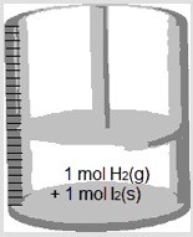
(Multiple Choice)
5.0/5 (92)
(92) The air pressure in a volleyball is 75 psi. What is this pressure in torr? (1 atm = 14.7 psi = 101,325 Pa = 760 torr)?
(Multiple Choice)
4.8/5 (86)
(86) What is the pressure in atmospheres exerted by a column of mercury that is 100. m high? (density of mercury = 13.5951 g/cm3, gravitational constant = 9.80665 m/s2, 1 atm = 101,325 Pa = 760 torr = 760 mmHg)
(Multiple Choice)
4.8/5 (74)
(74) What is the volume of NH3 produced in the following reaction when 3.0 L of N2 reacts with 4.0 L of H2 ? N2(g) + 3H2(g) → 2NH3(g)
(Multiple Choice)
4.8/5 (70)
(70) A(n) ________ is a device used to measure the pressure of gases other than the atmosphere.
(Short Answer)
4.8/5 (76)
(76) A 0.271-g sample of an unknown vapor occupies 294 mL at 140°C and 847 mmHg. The empirical formula of the compound is CH2. What is the molecular formula of the compound? (R = 0.08206 L • atm/K • mol)
(Multiple Choice)
4.9/5 (81)
(81) A sample of nitrogen gas has a volume of 32.4 L at 20°C. The gas is heated to 220ºC at constant pressure. What is the final volume of the nitrogen gas?
(Multiple Choice)
4.9/5 (75)
(75) A gas evolved during the fermentation of sugar was collected at 22.5°C and 702 mmHg. After purification its volume was found to be 25.0 L. How many moles of gas were collected? (R = 0.08206 L • atm/K • mol, 1 atm = 760 mmHg)
(Multiple Choice)
4.9/5 (79)
(79) In the van der Waals equation, the constant b is a constant that is part of a correction factor for ________.
(Multiple Choice)
4.7/5 (81)
(81) The mole fraction of oxygen molecules in dry air is 0.2095. What volume of dry air at 1.00 atm and 25°C is required for burning completely 1.00 L of octane (C8H18, density = 0.7025 g/mL), yielding carbon dioxide and water? (R = 0.08206 L • atm/K • mol)
(Multiple Choice)
4.8/5 (67)
(67) 
Filters
- Essay(0)
- Multiple Choice(0)
- Short Answer(0)
- True False(0)
- Matching(0)