



 Chat with AI
Exam 10: Gases

Exam 1: Chemistry: the Central Science133 Questions
Exam 2: Atoms, Molecules, and Ions124 Questions
Exam 3: Stoichiometry: Ratios of Combination137 Questions
Exam 4: Reactions in Aqueous Solutions146 Questions
Exam 5: Thermochemistry141 Questions
Exam 6: Quantum Theory and the Electronic Structure of Atoms135 Questions
Exam 7: Electron Configuration and the Periodic Table120 Questions
Exam 8: Chemical Bonding I: Basic Concepts102 Questions
Exam 9: Chemical Bonding II: Molecular Geometry and Bonding Theories139 Questions
Exam 10: Gases137 Questions
Exam 11: Intermolecular Forces and the Physical Properties of Liquids and Solids137 Questions
Exam 12: Modern Materials108 Questions
Exam 13: Physical Properties of Solutions151 Questions
Exam 14: Chemical Kinetics132 Questions
Exam 15: Chemical Equilibrium146 Questions
Exam 16: Acids and Bases137 Questions
Exam 17: Acid-Base Equilibria and Solubility Equilibria133 Questions
Exam 18: Entropy, Free Energy, and Equilibrium107 Questions
Exam 19: Electrochemistry122 Questions
Exam 20: Nuclear Chemistry127 Questions
Exam 21: Environmental Chemistry135 Questions
Exam 22: Coordination Chemistry132 Questions
Exam 23: Metallurgy and the Chemistry of Metals152 Questions
Exam 24: Nonmetallic Elements and Their Compounds117 Questions
Exam 25: Organic Chemistry121 Questions
Select questions type


What is the formula which describes the relationship between the volume and number of moles in the sample at constant pressure and constant temperature?
(Multiple Choice)
4.9/5  (95)
(95) A sample of hydrogen gas exerts a pressure of 466 torr in a container. What is this pressure in atmospheres? (1 atm = 1.01325 ×10⁵ Pa = 760 torr)
(Multiple Choice)
4.7/5 (73)
(73) A fixed quantity of gas, initially at 600ºC, undergoes a temperature change at constant pressure in a cylinder with a movable piston. What final temperature of the gas can result in the change of state depicted below? 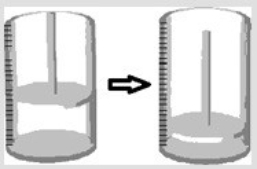
(Multiple Choice)
4.7/5 (71)
(71) In the van der Waals equation, the constant a is a constant that is part of a correction factor for ________.
(Multiple Choice)
4.8/5 (74)
(74) If 2.38 mol of a gas has a volume of 120.0 mL, what is the volume of 1.97 mol of the gas at the same temperature and pressure?
(Multiple Choice)
5.0/5 (84)
(84) ________ is the formula to determine the amount of a reactant or product in units of moles using the ideal gas law.
(Short Answer)
5.0/5 (77)
(77) What is the volume occupied by 25.2 g of CO2 at 0.840 atm and 25°C? (R = 0.08206 L • atm/K • mol)
(Multiple Choice)
4.8/5 (85)
(85) At -3°C, 2.5 moles of a gas in a 0.50-L container exert a pressure of 135 atm. Under these conditions, is the gas behaving like an ideal gas?
(Short Answer)
4.9/5 (90)
(90) If a liquid boils at -75°C then what is the temperature in kelvins?
(Short Answer)
4.9/5 (80)
(80) What is the mole fraction of NO in a 55.0-L gas cylinder at 30°C which comes from a mixture of N2 and NO if the cylinder contains 3.238 mol of N2 at a total pressure of 2.14 atm?
(Short Answer)
4.8/5 (80)
(80) A gas sample occupies 8.76 L at a temperature of 37°C. What is the volume if the temperature is lowered to 0°C at constant pressure?
(Multiple Choice)
4.9/5 (71)
(71) The molecules of different samples of an ideal gas have the same average kinetic energies at the same ________.
(Multiple Choice)
4.9/5 (79)
(79) If 2.3 mol of a gas occupies 50.5 mL, how many moles of the gas will occupy 85.5 mL at the same temperature and pressure?
(Multiple Choice)
4.8/5 (84)
(84) The pressure of sulfur dioxide in a container is 159 kPa. What is this pressure in atmospheres? (1 atm = 101,325 Pa = 760 torr)?
(Multiple Choice)
4.7/5 (71)
(71) Which of the following gas molecules have the highest average kinetic energy at 25°C?
(Multiple Choice)
4.9/5 (83)
(83) 
Filters
- Essay(0)
- Multiple Choice(0)
- Short Answer(0)
- True False(0)
- Matching(0)