



 Chat with AI
Exam 17: Acid-Base Equilibria and Solubility Equilibria

Exam 1: Chemistry: the Central Science133 Questions
Exam 2: Atoms, Molecules, and Ions124 Questions
Exam 3: Stoichiometry: Ratios of Combination137 Questions
Exam 4: Reactions in Aqueous Solutions146 Questions
Exam 5: Thermochemistry141 Questions
Exam 6: Quantum Theory and the Electronic Structure of Atoms135 Questions
Exam 7: Electron Configuration and the Periodic Table120 Questions
Exam 8: Chemical Bonding I: Basic Concepts102 Questions
Exam 9: Chemical Bonding II: Molecular Geometry and Bonding Theories139 Questions
Exam 10: Gases137 Questions
Exam 11: Intermolecular Forces and the Physical Properties of Liquids and Solids137 Questions
Exam 12: Modern Materials108 Questions
Exam 13: Physical Properties of Solutions151 Questions
Exam 14: Chemical Kinetics132 Questions
Exam 15: Chemical Equilibrium146 Questions
Exam 16: Acids and Bases137 Questions
Exam 17: Acid-Base Equilibria and Solubility Equilibria133 Questions
Exam 18: Entropy, Free Energy, and Equilibrium107 Questions
Exam 19: Electrochemistry122 Questions
Exam 20: Nuclear Chemistry127 Questions
Exam 21: Environmental Chemistry135 Questions
Exam 22: Coordination Chemistry132 Questions
Exam 23: Metallurgy and the Chemistry of Metals152 Questions
Exam 24: Nonmetallic Elements and Their Compounds117 Questions
Exam 25: Organic Chemistry121 Questions
Select questions type


The amount of strong acid added to a buffer solution cannot exceed the original amount of conjugate base present in order for the buffer to still work.
(True/False)
4.9/5  (83)
(83) Which is more soluble in a basic solution than in pure water?
(Multiple Choice)
4.8/5 (78)
(78) pH = pKa + log [conjugate base]/[weak acid] is the ________-________ equation.
(Short Answer)
4.8/5 (81)
(81) When an acid, HA, is titrated with 0.1 M NaOH, the pH at the half equivalence point of the titration is 4.5. What is the Ka of the acid?
(Multiple Choice)
4.8/5 (73)
(73) Calculate the pH at the equivalence point for the titration of 50.0 mL of 0.20 M NH3 with 0.20 M HCl. [Kb(NH3) = 1.8 × 10⁻⁵]
(Multiple Choice)
4.8/5 (72)
(72) When the concentration of the conjugate base of a weak acid is less than the concentration of the weak acid in a buffer solution, the pH of the solution is
(Multiple Choice)
5.0/5 (83)
(83) After 50.0 mL of a 0.100 M solution of NaOH is added to 50.0 mL of a 0.100 M solution of an unknown acid, the equilibrium pH is basic. What may be concluded about the identity of the acid?
(Multiple Choice)
4.9/5 (86)
(86) Below is a titration curve for the titration of 50.0 mL of a 0.100 M solution of the weak acid HA with a 0.100 M solution of NaOH. 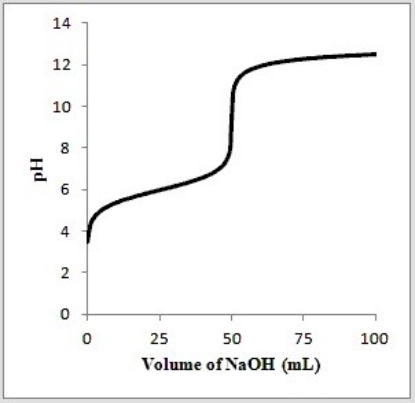 What is the approximate pKa of HA?
 (Multiple Choice)
4.8/5 (90)
(90) A buffer is prepared by adding 300.0 mL of 2.0 M NaOH to 500.0 mL of 2.0 M CH3COOH. What is the pH of this buffer? [Ka(CH3COOH) = 1.8 × 10⁻⁵]
(Multiple Choice)
5.0/5 (89)
(89) A 20.00-mL sample of 0.3000 M HBr is titrated with 0.15 M NaOH. What is the pH of the solution after 40.3 mL of NaOH have been added to the acid?
(Multiple Choice)
4.9/5 (84)
(84) Write the ion product expression for calcium phosphate, Ca3(PO4)2.
(Multiple Choice)
4.9/5 (73)
(73) Describe how to make a sodium formate (HCOONa)/formic acid (HCOOH) buffer that has a pH of 4.77. Ka = 1.7 × 10⁻⁴
(Essay)
4.9/5 (89)
(89) Will a precipitate (ppt) form when 20.0 mL of 1.1 × 10⁻³ M Ba(NO3)2 are added to 80.0 mL of 8.4 × 10⁻⁴M Na2CO3?
(Multiple Choice)
4.9/5 (92)
(92) The "p" of the pH equation and pKa equation represents ________.
(Short Answer)
4.9/5 (81)
(81) What is the name used to describe the situation when a compound containing an ion in common with a dissolved substance is added to a solution at equilibrium which shifts the equilibrium?
(Multiple Choice)
4.8/5 (75)
(75) Suppose 50.0 mL of a 0.100 M solution of the weak acid HA is titrated with a 0.100 M solution of NaOH. Which diagram best represents the equilibrium composition of the solution at point X on the titration curve below? (Solvent water molecules are omitted for clarity.) 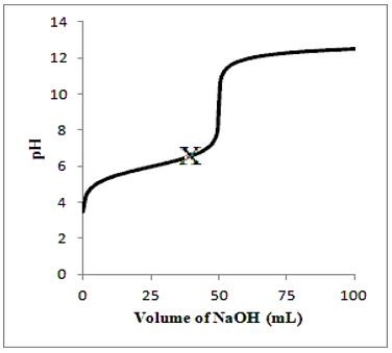
(Multiple Choice)
4.9/5 (80)
(80) You have 500.0 mL of a buffer solution containing 0.30 M acetic acid (CH3COOH) and 0.20 M sodium acetate (CH3COONa). What will the pH of this solution be after the addition of 20.0 mL of 1.00 M NaOH solution? [Ka(CH3COOH) = 1.8 × 10⁻⁵]
(Multiple Choice)
4.8/5 (84)
(84) NaCl is added slowly to a solution that is 0.010 M each in Cu+, Ag+, and Au+. The Ksp for CuCl, AgCl, and AuCl are 1.9 × 10⁻⁷, 1.8 × 10⁻¹⁰, and 2.0 × 10⁻¹³, respectively. Which compound will precipitate first?
(Short Answer)
4.7/5 (83)
(83) What name is given to a solution that contains a weak acid and its conjugate base?
(Short Answer)
4.7/5 (82)
(82) 
Filters
- Essay(0)
- Multiple Choice(0)
- Short Answer(0)
- True False(0)
- Matching(0)