



 Chat with AI
Exam 12: Airway Clearance Techniques and Hyperinflation Therapy

Exam 1: Fetal Lung Development8 Questions
Exam 2: Fetal Gas Exchange and Circulation9 Questions
Exam 3: Antenatal Assessment and High-Risk Delivery23 Questions
Exam 4: Examination and Assessment of the Neonatal and Pediatric Patient33 Questions
Exam 5: Pulmonary Function Testing and Bedside Pulmonary Mechanics19 Questions
Exam 6: Radiographic Assessment20 Questions
Exam 7: Pediatric Flexible Bronchoscopy20 Questions
Exam 8: Invasive Blood Gas Analysis and Cardiovascular Monitoring21 Questions
Exam 9: Noninvasive Monitoring in Neonatal and Pediatric Care16 Questions
Exam 10: Oxygen Administration17 Questions
Exam 11: Aerosols and Administration of Inhaled Medications23 Questions
Exam 12: Airway Clearance Techniques and Hyperinflation Therapy18 Questions
Exam 13: Airway Management26 Questions
Exam 14: Surfactant Replacement Therapy14 Questions
Exam 15: Noninvasive Mechanical Ventilation and Continuous Positive Pressure of the Neonate20 Questions
Exam 16: Noninvasive Mechanical Ventilation of the Infant and Child21 Questions
Exam 17: Invasive Mechanical Ventilation of the Neonate and Pediatric Patient28 Questions
Exam 18: Administration of Gas Mixtures22 Questions
Exam 19: Extracorporeal Membrane Oxygenation26 Questions
Exam 20: Pharmacology20 Questions
Exam 21: Thoracic Organ Transplantation18 Questions
Exam 22: Neonatal Pulmonary Disorders28 Questions
Exam 23: Surgical Disorders in Childhood That Affect Respiratory Care20 Questions
Exam 24: Congenital Cardiac Defects24 Questions
Exam 25: Pediatric Sleep-Disordered Breathing17 Questions
Exam 26: Pediatric Airway Disorders and Parenchymal Lung Diseases25 Questions
Exam 27: Asthma22 Questions
Exam 28: Cystic Fibrosis19 Questions
Exam 29: Acute Respiratory Distress Syndrome19 Questions
Exam 30: Shock20 Questions
Exam 31: Pediatric Trauma33 Questions
Exam 32: Disorders of the Pleura14 Questions
Exam 33: Neurological and Neuromuscular Disorders16 Questions
Exam 34: Transport of Infants and Children14 Questions
Exam 35: Home Care16 Questions
Exam 36: Quality and Safety12 Questions
Select questions type


On the basis of the following diagram, which of the following lung segments is being drained? 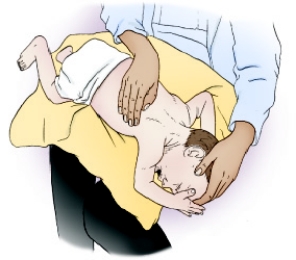

Free
(Multiple Choice)
5.0/5  (68)
(68) Correct Answer: Verified
C
A patient with an excessive amount of secretions and atelectasis has been receiving ACT. The most commonly cited complication is _____________________________.
Free
(Multiple Choice)
4.8/5 (79)
(79) Correct Answer:Verified
VerifiedA
A respiratory therapist has been assigned to administer CPT to a patient with cystic fibrosis. What areas of the body should the RT avoid when percussing the patient?
Free
(Multiple Choice)
4.9/5 (74)
(74) Correct Answer:Verified
VerifiedB
On the basis of the following diagram, which of the following lung segments is being drained? 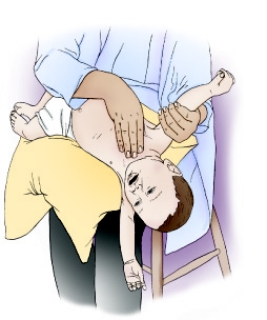
(Multiple Choice)
4.9/5 (83)
(83) During autogenic drainage, at which of the following levels does the patient begin breathing?
(Multiple Choice)
4.8/5 (74)
(74) Which of the following maneuvers is characterized by having a patient forcibly exhale, from a middle to low lung volume, through an open glottis?
(Multiple Choice)
4.8/5 (76)
(76) The following postural drainage positions are shown for an infant patient. 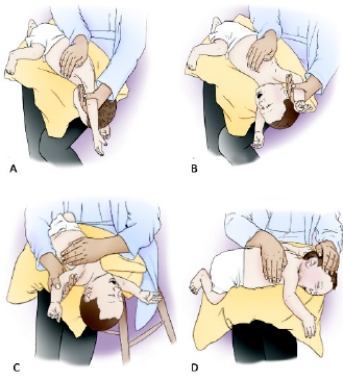 Which of the diagrams demonstrates the postural drainage position for draining the lingular segments of the left upper lobe in an infant?
 (Multiple Choice)
4.7/5 (74)
(74) By which of the following mechanisms are high-frequency chest compressions purported to mobilize tracheobronchial secretions?
(Multiple Choice)
4.7/5 (76)
(76) Which of the following clinical parameters are important to determine a positive response to ACT?
I. Changes in sputum color
II. Breath sounds
III. Vital signs
IV. Lung mechanics
(Multiple Choice)
4.9/5 (83)
(83) What is the most important variable used to assess the efficacy of CPT?
(Multiple Choice)
4.7/5 (74)
(74) A respiratory therapist has been assigned to administer ACT to a patient with acute lobar atelectasis. What should the RT consider to determine the length and frequency of the treatment?
I. Most pediatric patients require ACTs for at least 60 minutes.
II. ACT is rarely needed more than every 4 hours.
III. ACT orders should be evaluated at least every 48 hours for patients in the ICU.
IV. ACT for patients with atelectasis due to CF requires at least 30 to 45 minutes.
(Multiple Choice)
4.8/5 (82)
(82) What do postural drainage, positive expiratory pressure therapy, autogenic drainage, forced expiration techniques, and high-frequency chest compressions have in common?
(Multiple Choice)
4.8/5 (83)
(83) What are the main components of the traditional airway clearance techniques?
I. Palpation of the chest wall
II. Postural drainage
III. Percussion
IV. Coughing
(Multiple Choice)
4.8/5 (70)
(70) Which of the following is the best explanation of why the therapist should routinely avoid advancing the catheter tip beyond the distal end of the endotracheal tube when performing endotracheal suctioning on a neonate?
(Multiple Choice)
4.8/5 (77)
(77) The following postural drainage positions are shown for a pediatric patient. 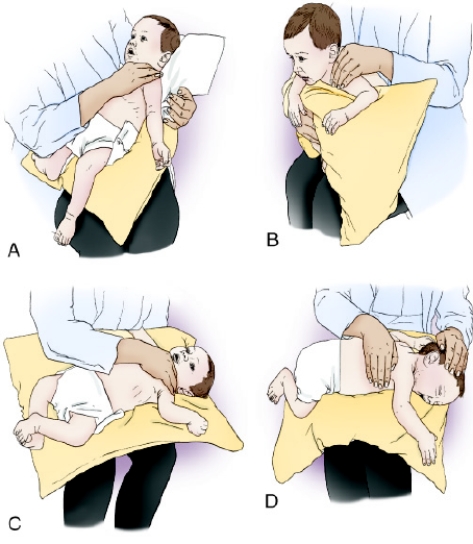 Which of the diagrams demonstrates the postural drainage position for draining the posterior subsegment of the apical-posterior segment of the left upper lobe?
 (Multiple Choice)
4.8/5 (74)
(74) A respiratory therapist has been assigned to administer ACT to a number of patients on the ward. In which of the following conditions may ACT be beneficial?
(Multiple Choice)
4.9/5 (70)
(70) A respiratory therapist has been assigned to administer ACT to a number of patients on the ward. In which of the following conditions may ACT be contraindicated?
I. Bronchial secretions
II. Frank hemoptysis
III. Empyema
IV. Untreated pneumothorax
(Multiple Choice)
4.9/5 (87)
(87) A respiratory therapist has been assigned to administer FET to a 5-year-old patient. Since small children are typically unable to perform such a maneuver, what should the RT do at this time?
(Multiple Choice)
4.7/5 (84)
(84) 
Filters
- Essay(0)
- Multiple Choice(0)
- Short Answer(0)
- True False(0)
- Matching(0)