



 Chat with AI
Exam 26: Pediatric Airway Disorders and Parenchymal Lung Diseases

Exam 1: Fetal Lung Development8 Questions
Exam 2: Fetal Gas Exchange and Circulation9 Questions
Exam 3: Antenatal Assessment and High-Risk Delivery23 Questions
Exam 4: Examination and Assessment of the Neonatal and Pediatric Patient33 Questions
Exam 5: Pulmonary Function Testing and Bedside Pulmonary Mechanics19 Questions
Exam 6: Radiographic Assessment20 Questions
Exam 7: Pediatric Flexible Bronchoscopy20 Questions
Exam 8: Invasive Blood Gas Analysis and Cardiovascular Monitoring21 Questions
Exam 9: Noninvasive Monitoring in Neonatal and Pediatric Care16 Questions
Exam 10: Oxygen Administration17 Questions
Exam 11: Aerosols and Administration of Inhaled Medications23 Questions
Exam 12: Airway Clearance Techniques and Hyperinflation Therapy18 Questions
Exam 13: Airway Management26 Questions
Exam 14: Surfactant Replacement Therapy14 Questions
Exam 15: Noninvasive Mechanical Ventilation and Continuous Positive Pressure of the Neonate20 Questions
Exam 16: Noninvasive Mechanical Ventilation of the Infant and Child21 Questions
Exam 17: Invasive Mechanical Ventilation of the Neonate and Pediatric Patient28 Questions
Exam 18: Administration of Gas Mixtures22 Questions
Exam 19: Extracorporeal Membrane Oxygenation26 Questions
Exam 20: Pharmacology20 Questions
Exam 21: Thoracic Organ Transplantation18 Questions
Exam 22: Neonatal Pulmonary Disorders28 Questions
Exam 23: Surgical Disorders in Childhood That Affect Respiratory Care20 Questions
Exam 24: Congenital Cardiac Defects24 Questions
Exam 25: Pediatric Sleep-Disordered Breathing17 Questions
Exam 26: Pediatric Airway Disorders and Parenchymal Lung Diseases25 Questions
Exam 27: Asthma22 Questions
Exam 28: Cystic Fibrosis19 Questions
Exam 29: Acute Respiratory Distress Syndrome19 Questions
Exam 30: Shock20 Questions
Exam 31: Pediatric Trauma33 Questions
Exam 32: Disorders of the Pleura14 Questions
Exam 33: Neurological and Neuromuscular Disorders16 Questions
Exam 34: Transport of Infants and Children14 Questions
Exam 35: Home Care16 Questions
Exam 36: Quality and Safety12 Questions
Select questions type


A 30-month-old child is brought to the emergency room (ER) by the parents. The child appears to have a sore throat along with dysphagia, fever, and voice changes. The child exhibits a "hot potato voice." Visualization of the posterior pharynx reveals a displaced retropharynx. What condition does this child likely have?

Free
(Multiple Choice)
4.9/5  (68)
(68) Correct Answer: Verified
B
A 10-month-old child has been brought into the emergency room (ER) by his or her parents, who state that after few days with low-grade fever, malaise, and rhinorrhea, their child presented with a "barking" cough and increased work of breathing. What condition is this child likely exhibiting?
Free
(Multiple Choice)
4.7/5 (83)
(83) Correct Answer:Verified
VerifiedB
A therapist has been asked to evaluate a child suspected of having foreign body aspiration. Which of the following clinical conditions would guide the therapist to the diagnosis?
Free
(Multiple Choice)
4.8/5 (75)
(75) Correct Answer:Verified
VerifiedC
Which of the following radiographic techniques is best for determining the presence of a ball-valve type obstruction?
(Multiple Choice)
4.7/5 (87)
(87) The therapist has been asked to evaluate the chest radiograph of a 3-month-old boy with atelectasis. Which pulmonary lobe has the greatest tendency to collapse in young infants?
(Multiple Choice)
4.7/5 (77)
(77) While performing auscultation on a 2-month-old child, the therapist hears wheezes equal in pitch across all regions of the chest; however, they seem loudest in the vicinity of the sternum. From which of the following anatomic structures is the wheezing likely originating?
(Multiple Choice)
4.9/5 (78)
(78) Which of the following lateral neck radiographic presentations is characteristic of laryngotracheobronchitis? 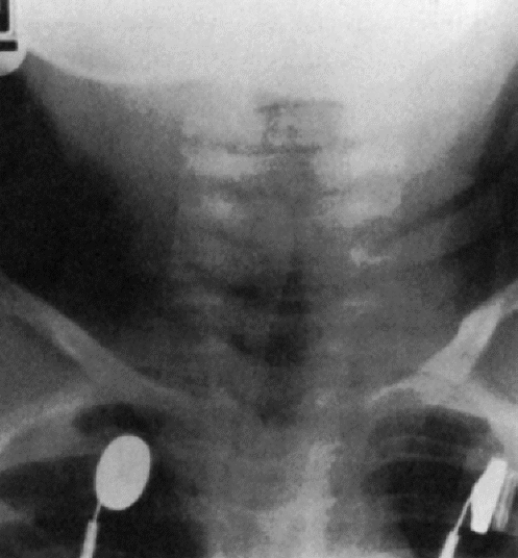
(Multiple Choice)
4.8/5 (97)
(97) An 18-month-old child has been admitted with a diagnosis of bronchiolitis due to RSV. The therapist has administered a single dose of albuterol and racemic epinephrine, but the child shows no signs of improvement. What should the therapist suggest at this time?
(Multiple Choice)
4.9/5 (77)
(77) Relative to an adult's larynx, where is an infant's larynx situated?
(Multiple Choice)
4.8/5 (79)
(79) As the therapist auscultates over an infant's larynx, he hears a very low-pitched sound. On the basis of this finding, what impression is he or she likely to have regarding the nature of the upper airway obstruction?
(Multiple Choice)
4.8/5 (77)
(77) Diagnosis of TB in children requires which of the following special considerations?
(Multiple Choice)
4.9/5 (80)
(80) The therapist is evaluating a child in the emergency department who displays the following signs: inability to cry, ineffective cough, high-pitched inspiratory sound, and cyanosis. What should the therapist suspect?
(Multiple Choice)
4.7/5 (87)
(87) A 4-year-old child is brought into the emergency room (ER) by her parents, who state that an abrupt high fever developed along with a severe sore throat, dysphagia with drooling, and cough. In the ER, the girl exhibits stridor, muffled voice without hoarseness, air hunger, and cyanosis. She also has suprasternal, substernal, and intercostal retractions, with nasal flaring, bradypnea, and dyspnea. The child is sitting upright with her chin thrust forward and her neck hyperextended in a tripod position. What condition is she likely exhibiting?
(Multiple Choice)
4.9/5 (69)
(69) A 3-year-old child has been diagnosed with epiglottitis and was intubated due to severe respiratory distress. After 24 hours of antibiotics, the therapist is considering extubation. What will be an acceptable leak before considering extubation?
(Multiple Choice)
4.9/5 (82)
(82) A child presents to the emergency department with fever, tachypnea, nasal flaring, and shallow breathing. The physical exam of the chest reveals the presence of crackles, increased tactile fremitus, and dullness to percussion. What should the therapist suspect the diagnosis is?
(Multiple Choice)
5.0/5 (84)
(84) An 11-month-old child has been treated with bronchodilators for persistent wheezing without a positive clinical response. Which of the following conditions should the therapist suspect?
(Multiple Choice)
4.8/5 (76)
(76) Bronchoalveolar lavage fluid is considered positive for VAP when which of the following conditions occur?
I. Polymorphonuclear neutrophils are greater than 25 per optic field at a magnification *100.
II. Squamous epithelial cells are less than 1%.
III. Axilary temperature of greater than 37°C.
IV. One or more microorganisms are seen per optic field at a magnification of 1:1000.
(Multiple Choice)
4.9/5 (94)
(94) A 3-year-old child has the following clinical presentations in the ER:
Profound nasal congestion and productive cough
Chest auscultation revealing diffuse coarse, "sticky" crackles (sounding like Velcro)
Chest radiograph revealing lung hyperinflation with flattened hemidiaphragms
What pulmonary condition does this infant likely have?
(Multiple Choice)
4.8/5 (95)
(95) Tracheomalacia is a condition of dynamic tracheal collapse. Which of the following injurious events can be associated with this condition?
(Multiple Choice)
4.8/5 (82)
(82) Which of the following medications should be administered to a 4-year-old child with symptomatic LTB and respiratory compromise?
(Multiple Choice)
4.9/5 (66)
(66) 
Filters
- Essay(0)
- Multiple Choice(0)
- Short Answer(0)
- True False(0)
- Matching(0)