



 Chat with AI
Exam 8: Invasive Blood Gas Analysis and Cardiovascular Monitoring

Exam 1: Fetal Lung Development8 Questions
Exam 2: Fetal Gas Exchange and Circulation9 Questions
Exam 3: Antenatal Assessment and High-Risk Delivery23 Questions
Exam 4: Examination and Assessment of the Neonatal and Pediatric Patient33 Questions
Exam 5: Pulmonary Function Testing and Bedside Pulmonary Mechanics19 Questions
Exam 6: Radiographic Assessment20 Questions
Exam 7: Pediatric Flexible Bronchoscopy20 Questions
Exam 8: Invasive Blood Gas Analysis and Cardiovascular Monitoring21 Questions
Exam 9: Noninvasive Monitoring in Neonatal and Pediatric Care16 Questions
Exam 10: Oxygen Administration17 Questions
Exam 11: Aerosols and Administration of Inhaled Medications23 Questions
Exam 12: Airway Clearance Techniques and Hyperinflation Therapy18 Questions
Exam 13: Airway Management26 Questions
Exam 14: Surfactant Replacement Therapy14 Questions
Exam 15: Noninvasive Mechanical Ventilation and Continuous Positive Pressure of the Neonate20 Questions
Exam 16: Noninvasive Mechanical Ventilation of the Infant and Child21 Questions
Exam 17: Invasive Mechanical Ventilation of the Neonate and Pediatric Patient28 Questions
Exam 18: Administration of Gas Mixtures22 Questions
Exam 19: Extracorporeal Membrane Oxygenation26 Questions
Exam 20: Pharmacology20 Questions
Exam 21: Thoracic Organ Transplantation18 Questions
Exam 22: Neonatal Pulmonary Disorders28 Questions
Exam 23: Surgical Disorders in Childhood That Affect Respiratory Care20 Questions
Exam 24: Congenital Cardiac Defects24 Questions
Exam 25: Pediatric Sleep-Disordered Breathing17 Questions
Exam 26: Pediatric Airway Disorders and Parenchymal Lung Diseases25 Questions
Exam 27: Asthma22 Questions
Exam 28: Cystic Fibrosis19 Questions
Exam 29: Acute Respiratory Distress Syndrome19 Questions
Exam 30: Shock20 Questions
Exam 31: Pediatric Trauma33 Questions
Exam 32: Disorders of the Pleura14 Questions
Exam 33: Neurological and Neuromuscular Disorders16 Questions
Exam 34: Transport of Infants and Children14 Questions
Exam 35: Home Care16 Questions
Exam 36: Quality and Safety12 Questions
Select questions type


A 12-hour-old infant is experiencing respiratory distress, and the neonatologist orders a heel stick to assess the infant's oxygenation status. What action should the therapist take at this time?

Free
(Multiple Choice)
4.8/5  (81)
(81) Correct Answer: Verified
C
Which of the following will cause a right shift in the oxyhemoglobin dissociation curve?
Free
(Multiple Choice)
4.7/5 (76)
(76) Correct Answer:Verified
VerifiedD
Which of the following arteries is considered the optimal puncture site for obtaining arterial blood samples from a pediatric patients? 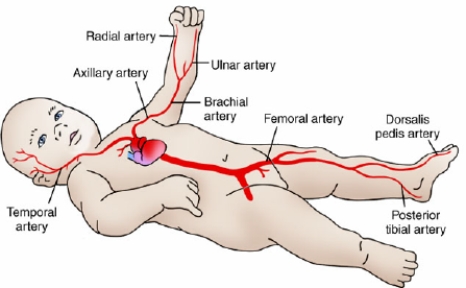
Free
(Multiple Choice)
4.9/5 (82)
(82) Correct Answer:Verified
VerifiedA
Which of the following is one of the most common arrhythmias observed as a complication from the insertion of a pulmonary artery catheter?
(Multiple Choice)
4.9/5 (89)
(89) On the basis of the position of the three-way stopcock shown here, identify which of the following activities related to arterial lineblood sampling is occurring. 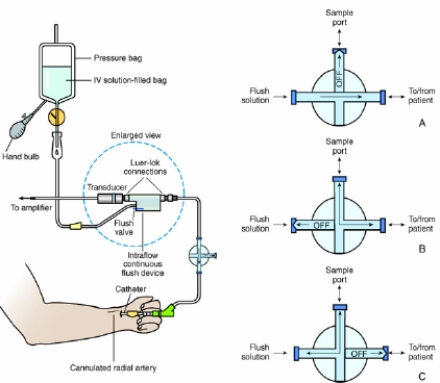
(Multiple Choice)
4.7/5 (81)
(81) Which of the following pulmonary artery catheter waveforms represents the catheter's normal location? 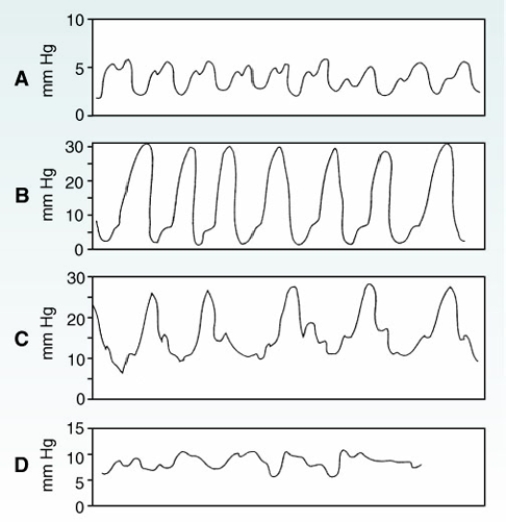
(Multiple Choice)
4.9/5 (78)
(78) On the basis of the following waveform, in which of the following anatomic locations is the distal tip of the pulmonary artery catheter located? 
(Multiple Choice)
4.7/5 (77)
(77) A 3-kg neonate has lost 30% of his circulating blood volume. Approximately how much fluid should be infused to compensate for this loss?
(Multiple Choice)
4.8/5 (70)
(70) On the basis of the following waveform, in which of the following anatomic locations is the distal tip of the pulmonary artery catheter located? 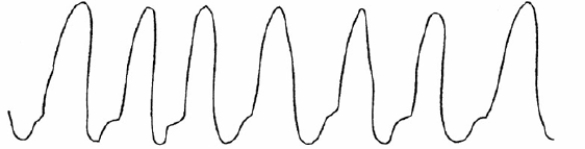
(Multiple Choice)
4.9/5 (78)
(78) With an umbilical artery catheter (UAC) in the "low position," which of the following blood vessels should be avoided?
(Multiple Choice)
4.8/5 (77)
(77) Which of the following conditions can cause methemoglobinemia?
(Multiple Choice)
4.7/5 (72)
(72) On the basis of the following waveform, in which of the following anatomic locations is the distal tip of the pulmonary artery catheter located? 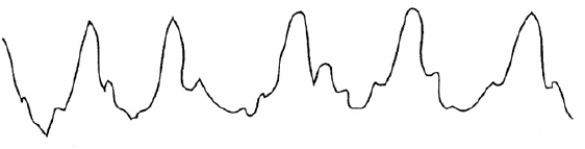
(Multiple Choice)
4.8/5 (89)
(89) In addition to the dorsalis pedis, which of the following arteries is involved when the modified Allen's test is performed using a foot as the potential arterial puncture site?
(Multiple Choice)
4.9/5 (81)
(81) A patient has a systolic blood pressure of 100 mm Hg and a diastolic pressure of 75 mm Hg. What is this patient's mean arterial pressure?
(Multiple Choice)
4.8/5 (69)
(69) Which of the following factors would adversely affect the correlation between arterial puncture measurements and those from a capillary sample?
(Multiple Choice)
4.9/5 (86)
(86) Which of the following factors influence the central venous pressure (CVP) measurement?
I. Bicuspid valve function
II. Right ventricular pressure
III. Intravascular volume
IV. Systemic venous return
(Multiple Choice)
4.8/5 (87)
(87) How would tricuspid stenosis be expected to influence a patient's CVP value?
(Multiple Choice)
4.9/5 (92)
(92) A respiratory therapist has been ordered to obtain a blood gas sample from a nonintubated premature baby. After selecting the best site to obtain the sample, what should the RT suggest to ameliorate the pain associated with the procedure?
(Multiple Choice)
5.0/5 (79)
(79) If a blood gas sample is not obtained from an arterial stick in a premature baby without central access, which of the following sites should be considered because this blood vessel is larger than the radial artery at this age?
(Multiple Choice)
4.9/5 (84)
(84) Calculate a patient's total arterial oxygen content given the following data:
Arterial oxygen tension (PaO2), 100 mm Hg
Arterial carbon dioxide tension (PaCO2), 45 mm Hg
Arterial oxygen saturation (SaO2), 97.5%
Hemoglobin concentration ([Hb]), 15 g/dL
Cardiac output, 4.5 L/minute
Stroke volume, 55 mL/beat
(Multiple Choice)
4.8/5 (98)
(98) 
Filters
- Essay(0)
- Multiple Choice(0)
- Short Answer(0)
- True False(0)
- Matching(0)