



 Chat with AI
Exam 24: Congenital Cardiac Defects

Exam 1: Fetal Lung Development8 Questions
Exam 2: Fetal Gas Exchange and Circulation9 Questions
Exam 3: Antenatal Assessment and High-Risk Delivery23 Questions
Exam 4: Examination and Assessment of the Neonatal and Pediatric Patient33 Questions
Exam 5: Pulmonary Function Testing and Bedside Pulmonary Mechanics19 Questions
Exam 6: Radiographic Assessment20 Questions
Exam 7: Pediatric Flexible Bronchoscopy20 Questions
Exam 8: Invasive Blood Gas Analysis and Cardiovascular Monitoring21 Questions
Exam 9: Noninvasive Monitoring in Neonatal and Pediatric Care16 Questions
Exam 10: Oxygen Administration17 Questions
Exam 11: Aerosols and Administration of Inhaled Medications23 Questions
Exam 12: Airway Clearance Techniques and Hyperinflation Therapy18 Questions
Exam 13: Airway Management26 Questions
Exam 14: Surfactant Replacement Therapy14 Questions
Exam 15: Noninvasive Mechanical Ventilation and Continuous Positive Pressure of the Neonate20 Questions
Exam 16: Noninvasive Mechanical Ventilation of the Infant and Child21 Questions
Exam 17: Invasive Mechanical Ventilation of the Neonate and Pediatric Patient28 Questions
Exam 18: Administration of Gas Mixtures22 Questions
Exam 19: Extracorporeal Membrane Oxygenation26 Questions
Exam 20: Pharmacology20 Questions
Exam 21: Thoracic Organ Transplantation18 Questions
Exam 22: Neonatal Pulmonary Disorders28 Questions
Exam 23: Surgical Disorders in Childhood That Affect Respiratory Care20 Questions
Exam 24: Congenital Cardiac Defects24 Questions
Exam 25: Pediatric Sleep-Disordered Breathing17 Questions
Exam 26: Pediatric Airway Disorders and Parenchymal Lung Diseases25 Questions
Exam 27: Asthma22 Questions
Exam 28: Cystic Fibrosis19 Questions
Exam 29: Acute Respiratory Distress Syndrome19 Questions
Exam 30: Shock20 Questions
Exam 31: Pediatric Trauma33 Questions
Exam 32: Disorders of the Pleura14 Questions
Exam 33: Neurological and Neuromuscular Disorders16 Questions
Exam 34: Transport of Infants and Children14 Questions
Exam 35: Home Care16 Questions
Exam 36: Quality and Safety12 Questions
Select questions type


Which of the following clinical pathophysiologic manifestations are consistent with a large ventricular septal defect (VSD)?
I. The majority of the blood flow are shunted from left right to right left.
II. Shunting typically occurs during ventricular diastole, which causes left atrial enlargement.
III. Chest radiography reveals an enlarged cardiac silhouette and increased pulmonary vascular markings, increasing pulmonary blood flow.
IV. Thickening and fibrosing of the pulmonary veins develop, decreasing pulmonary artery pressure.

Free
(Multiple Choice)
4.9/5  (86)
(86) Correct Answer: Verified
A
At birth, what factor causes dilation of the pulmonary vascular bed and a decrease in the pulmonary vascular resistance?
Free
(Multiple Choice)
4.9/5 (65)
(65) Correct Answer:Verified
VerifiedA
Which of the following clinical manifestations is consistent with an atrial septal defect (ASD)?
Free
(Multiple Choice)
4.8/5 (78)
(78) Correct Answer:Verified
VerifiedB
A therapist monitoring an infant after a Blalock-Tausig shunt placement notices a significant drop in the end-tidal carbon dioxide (ETCO2) despite no changes in the infant's respiratory rate. How should the therapist interpret this change?
(Multiple Choice)
4.9/5 (85)
(85) A condition in which blood flow out of the right ventricle is obstructed because of atresia of the pulmonary valve is more consistent with which of the following defects?
(Multiple Choice)
4.8/5 (68)
(68) Which of the following vessels return blood to the right ventricle?
I.. Pulmonary vein
II. Inferior vena cava
III. Superior vena cava
IV. Coronary sinus
(Multiple Choice)
5.0/5 (78)
(78) Low signal strength on a plethysmogram may indicate which of the following?
(Multiple Choice)
4.9/5 (90)
(90) Identify the congenital cardiac defect depicted in the following illustration: 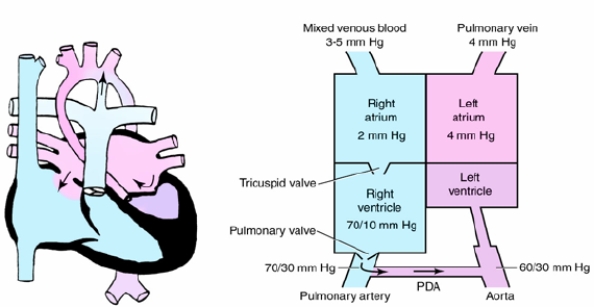
(Multiple Choice)
4.8/5 (71)
(71) How should the therapist interpret a preductal-to-postductal PaO2 difference of 8 mm Hg in a neonate?
(Multiple Choice)
4.8/5 (62)
(62) Which of the following is a risk if PVR decreases in the first days of life in infants with HLHS?
(Multiple Choice)
5.0/5 (70)
(70) Which of the following methods is involved in the management of a PDA?
(Multiple Choice)
4.9/5 (77)
(77) What factor is responsible for closure of the foramen ovale?
(Multiple Choice)
4.9/5 (76)
(76) 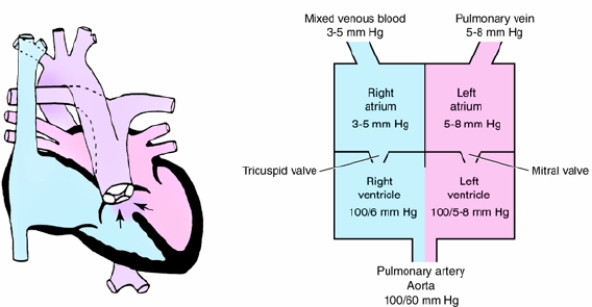
The therapist is monitoring a patient in the CICU with a cardiac abnormality. They notice a narrowing pulse pressure. Which of the following could result?
I. A low stroke volume
II. Increased cardiac output
III. Poor ventricular function
IV. Impaired venous return
(Multiple Choice)
4.9/5 (78)
(78) Which of the following is the correct statement regarding the path of blood as it travels through the heart?
(Multiple Choice)
4.8/5 (78)
(78) Which of the following statements describe truncus arteriosus?
I. It is a rare defect in which a single great artery arises from the ventricles of the heart.
II. If PVR increases relative to systemic vascular resistance (SVR), more blood flows to the lungs through the truncus, decreasing systemic cardiac output.
III. Oxygen should be avoided in almost all circumstances in the preoperative setting.
IV. Patients may undergo complete biventricular repair in the newborn period.
(Multiple Choice)
4.7/5 (86)
(86) The therapist is treating a child with TOF who appears to be having a "spell." What should the therapist suggest to treat this event?
I. Prone positioning
II. Knee-chest position to increase SVR
III. Morphine sulfate
IV. Oxygen
(Multiple Choice)
4.9/5 (75)
(75) Which of the following blood flow patterns occurs in complete transposition of the great arteries?
(Multiple Choice)
4.9/5 (57)
(57) Why must supplemental oxygen be judiciously administered to patients with an atrioventricular canal defect?
(Multiple Choice)
4.8/5 (82)
(82) For which of the following congenital cardiac defects are considered ductal dependent, and closure of the ductus arteriosus could have catastrophic consequences for the patient?
I.. Tetralogy of Fallot with pulmonary atresia
II. Atrial septal defect
III. Severe coarctation of the aorta
IV. Hypoplastic left heart syndrome
(Multiple Choice)
4.8/5 (82)
(82) 
Filters
- Essay(0)
- Multiple Choice(0)
- Short Answer(0)
- True False(0)
- Matching(0)