



 Chat with AI
Exam 17: Invasive Mechanical Ventilation of the Neonate and Pediatric Patient

Exam 1: Fetal Lung Development8 Questions
Exam 2: Fetal Gas Exchange and Circulation9 Questions
Exam 3: Antenatal Assessment and High-Risk Delivery23 Questions
Exam 4: Examination and Assessment of the Neonatal and Pediatric Patient33 Questions
Exam 5: Pulmonary Function Testing and Bedside Pulmonary Mechanics19 Questions
Exam 6: Radiographic Assessment20 Questions
Exam 7: Pediatric Flexible Bronchoscopy20 Questions
Exam 8: Invasive Blood Gas Analysis and Cardiovascular Monitoring21 Questions
Exam 9: Noninvasive Monitoring in Neonatal and Pediatric Care16 Questions
Exam 10: Oxygen Administration17 Questions
Exam 11: Aerosols and Administration of Inhaled Medications23 Questions
Exam 12: Airway Clearance Techniques and Hyperinflation Therapy18 Questions
Exam 13: Airway Management26 Questions
Exam 14: Surfactant Replacement Therapy14 Questions
Exam 15: Noninvasive Mechanical Ventilation and Continuous Positive Pressure of the Neonate20 Questions
Exam 16: Noninvasive Mechanical Ventilation of the Infant and Child21 Questions
Exam 17: Invasive Mechanical Ventilation of the Neonate and Pediatric Patient28 Questions
Exam 18: Administration of Gas Mixtures22 Questions
Exam 19: Extracorporeal Membrane Oxygenation26 Questions
Exam 20: Pharmacology20 Questions
Exam 21: Thoracic Organ Transplantation18 Questions
Exam 22: Neonatal Pulmonary Disorders28 Questions
Exam 23: Surgical Disorders in Childhood That Affect Respiratory Care20 Questions
Exam 24: Congenital Cardiac Defects24 Questions
Exam 25: Pediatric Sleep-Disordered Breathing17 Questions
Exam 26: Pediatric Airway Disorders and Parenchymal Lung Diseases25 Questions
Exam 27: Asthma22 Questions
Exam 28: Cystic Fibrosis19 Questions
Exam 29: Acute Respiratory Distress Syndrome19 Questions
Exam 30: Shock20 Questions
Exam 31: Pediatric Trauma33 Questions
Exam 32: Disorders of the Pleura14 Questions
Exam 33: Neurological and Neuromuscular Disorders16 Questions
Exam 34: Transport of Infants and Children14 Questions
Exam 35: Home Care16 Questions
Exam 36: Quality and Safety12 Questions
Select questions type


During volume-controlled ventilation, which of the following factors influences the peak inspiratory pressure?

Free
(Multiple Choice)
4.8/5  (85)
(85) Correct Answer: Verified
C
Which of the following adjustments should the therapist consider to improve ventilation on a patient undergoing HFV?
Free
(Multiple Choice)
4.9/5 (73)
(73) Correct Answer:Verified
VerifiedD
Which of the following factors influences the gas volume compressed in the ventilator circuit?
Free
(Multiple Choice)
4.8/5 (82)
(82) Correct Answer:Verified
VerifiedB
While checking the ventilator of a pediatric patient, the therapist observes the following volume-time scalar: What action should the therapist take at this time? 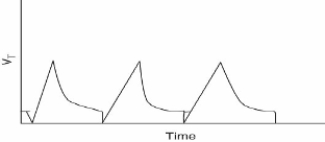
(Multiple Choice)
4.8/5 (91)
(91) On the basis of the following pressure-volume loop, what ventilator setting change should the therapist make? 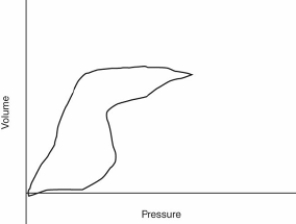
(Multiple Choice)
4.8/5 (84)
(84) When airway pressure release ventilation is used, what physiologic process occurs as the higher pressure is released and the lower is achieved?
(Multiple Choice)
4.7/5 (80)
(80) What is a frequent requirement when employing the low-volume strategy while ventilating a neonatal patient with pulmonary interstitial emphysema by HFV?
(Multiple Choice)
4.7/5 (89)
(89) During HFOV, which of the following factors has a direct influence on a neonate's delivered tidal volume?
(Multiple Choice)
4.9/5 (68)
(68) Why may HFOV be considered a suboptimal ventilation strategy for patients who have either fresh particulate meconium aspiration or bronchopulmonary dysplasia?
(Multiple Choice)
4.9/5 (69)
(69) What frequency defines high-frequency modes of ventilation?
(Multiple Choice)
4.9/5 (74)
(74) What is the recommended inspiratory time percent setting for HFOV?
(Multiple Choice)
4.7/5 (74)
(74) Which of the following modes of ventilation attempts to maintain a minimum target tidal volume with a constant pressure by manipulating the inspiratory flow?
(Multiple Choice)
4.8/5 (69)
(69) Which of the following factors need to be considered for HFV ventilator circuits?
I. Time for gas egress during exhalation
II. Circuit compliance
III. Endotracheal tube size
IV. Intrinsic timing mechanisms
(Multiple Choice)
4.9/5 (88)
(88) During HFOV manipulation of which of the following components establishes the continuous distending pressure?
(Multiple Choice)
4.8/5 (82)
(82) How is the minute ventilation decreased when a patient is being weaned from HFOV?
(Multiple Choice)
4.9/5 (81)
(81) Enhanced diffusion in HFV is a function of which of the following factors?
(Multiple Choice)
4.8/5 (83)
(83) How is the high-volume strategy achieved when the goal is to deliver a high lung volume to a neonate receiving HFV?
(Multiple Choice)
4.8/5 (72)
(72) The therapist is about to mechanically ventilate a neonate with a ventilator that delivers the volume guarantee mode. Which of the ventilator settings does the therapist need to set for this mode?
I. Minute ventilation
II. Tidal volume
III. Inspiratory time
IV. Inspiratory flow
(Multiple Choice)
4.9/5 (85)
(85) The therapist notices that gas exchange has dramatically improved in a neonate undergoing HFOV. However, weaning has not been implemented accordingly. What are the consequences of failing to quickly wean a neonatal patient from HFV?
(Multiple Choice)
4.9/5 (58)
(58) 
Filters
- Essay(0)
- Multiple Choice(0)
- Short Answer(0)
- True False(0)
- Matching(0)