



 Chat with AI
Exam 5: Pulmonary Function Testing and Bedside Pulmonary Mechanics

Exam 1: Fetal Lung Development8 Questions
Exam 2: Fetal Gas Exchange and Circulation9 Questions
Exam 3: Antenatal Assessment and High-Risk Delivery23 Questions
Exam 4: Examination and Assessment of the Neonatal and Pediatric Patient33 Questions
Exam 5: Pulmonary Function Testing and Bedside Pulmonary Mechanics19 Questions
Exam 6: Radiographic Assessment20 Questions
Exam 7: Pediatric Flexible Bronchoscopy20 Questions
Exam 8: Invasive Blood Gas Analysis and Cardiovascular Monitoring21 Questions
Exam 9: Noninvasive Monitoring in Neonatal and Pediatric Care16 Questions
Exam 10: Oxygen Administration17 Questions
Exam 11: Aerosols and Administration of Inhaled Medications23 Questions
Exam 12: Airway Clearance Techniques and Hyperinflation Therapy18 Questions
Exam 13: Airway Management26 Questions
Exam 14: Surfactant Replacement Therapy14 Questions
Exam 15: Noninvasive Mechanical Ventilation and Continuous Positive Pressure of the Neonate20 Questions
Exam 16: Noninvasive Mechanical Ventilation of the Infant and Child21 Questions
Exam 17: Invasive Mechanical Ventilation of the Neonate and Pediatric Patient28 Questions
Exam 18: Administration of Gas Mixtures22 Questions
Exam 19: Extracorporeal Membrane Oxygenation26 Questions
Exam 20: Pharmacology20 Questions
Exam 21: Thoracic Organ Transplantation18 Questions
Exam 22: Neonatal Pulmonary Disorders28 Questions
Exam 23: Surgical Disorders in Childhood That Affect Respiratory Care20 Questions
Exam 24: Congenital Cardiac Defects24 Questions
Exam 25: Pediatric Sleep-Disordered Breathing17 Questions
Exam 26: Pediatric Airway Disorders and Parenchymal Lung Diseases25 Questions
Exam 27: Asthma22 Questions
Exam 28: Cystic Fibrosis19 Questions
Exam 29: Acute Respiratory Distress Syndrome19 Questions
Exam 30: Shock20 Questions
Exam 31: Pediatric Trauma33 Questions
Exam 32: Disorders of the Pleura14 Questions
Exam 33: Neurological and Neuromuscular Disorders16 Questions
Exam 34: Transport of Infants and Children14 Questions
Exam 35: Home Care16 Questions
Exam 36: Quality and Safety12 Questions
Select questions type


The respiratory therapist places a face mask on an infant to measure FRC. What should the therapist do to minimize the presence of air leaks and improve accuracy of the test?

Free
(Multiple Choice)
4.8/5  (73)
(73) Correct Answer: Verified
D
How is airway resistance calculated?
Free
(Multiple Choice)
4.9/5 (78)
(78) Correct Answer:Verified
VerifiedA
A child has been diagnosed with vocal cord dysfunction. Which of the following flow-volume loops demonstrates this condition?
Free
(Multiple Choice)
4.9/5 (78)
(78) Correct Answer:Verified
VerifiedA
How should the therapist interpret the following pressure-volume loop obtained from a mechanically ventilated infant? 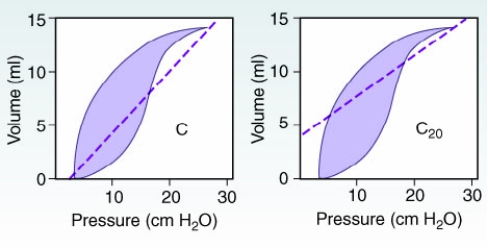
(Multiple Choice)
4.8/5 (81)
(81) According to the ATS-ERS acceptability criteria for an FVC maneuver performed on a 7-year-old child, what is considered a satisfactory exhalation time?
(Multiple Choice)
4.8/5 (79)
(79) Pulmonary function testing has been ordered in an infant. Which of the following represents a potential risk to this infant?
(Multiple Choice)
4.8/5 (78)
(78) A pre- and postbronchodilator, partial expiratory pressure-volume maneuver was performed on a 9-month-old boy. The child's prebronchodilator maxFRC was 67 mL/second and the postbronchodilator maxFRC was 94 mL/second. How should the therapist interpret these data?
(Multiple Choice)
4.9/5 (83)
(83) Which of the following pulmonary function values characterizes an obstructive lung disorder?
I. The forced vital capacity (FVC) is normal or decreased.
II. The forced expiratory volume in 1 second (FEV1) is decreased.
III. The ratio of residual volume to total lung capacity (RV/TLC) is decreased.
IV. RV is increased.
(Multiple Choice)
4.9/5 (74)
(74) On the basis of the data presented below, calculate the time constant.
Tidal volume (VT), 600 mL
Respiratory rate (RR), 12 breaths per minute
Lung compliance (C), 0.2 L/cm H2O
Airway resistance (Raw), 2.5 cm H2O/L/second
Peak inspiratory pressure (PIP), 30 cm H2O
Inspiratory time (TI), 2 seconds
Expiratory time (TE), 1 second
(Multiple Choice)
4.8/5 (69)
(69) A reduction in the DlCO may indicate the presence of which of the following conditions?
I. Pulmonary fibrosis
II. Pulmonary edema
III. Hematologic disorders
IV. Acute hemorrhageous bleeds
(Multiple Choice)
4.7/5 (92)
(92) Why must caution be exercised when using a face mask while performing pulmonary function testing on neonates?
(Multiple Choice)
4.8/5 (87)
(87) On the basis of the bronchial provocation data presented in the following table, identify the PD20. 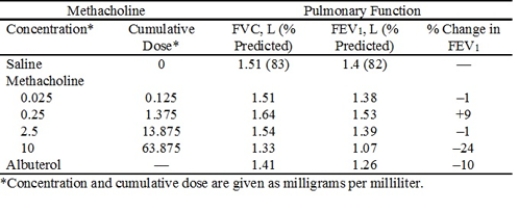
(Multiple Choice)
4.8/5 (68)
(68) The therapist is reviewing a flow-volume loop obtained from a pediatric patient and observes decreased volume and normal flows. On the basis of this observation, how should the therapist interpret this finding?
(Multiple Choice)
4.9/5 (87)
(87) Which of the following factors is the most important determinant of high airway resistance and air trapping in small infants?
(Multiple Choice)
4.9/5 (63)
(63) What is the clinical purpose for measuring the maximal inspiratory pressure (MIP)?
(Multiple Choice)
4.7/5 (74)
(74) The respiratory therapist is looking at a flow-volume curve that displays a concave shape on the expiratory tracing. What is this change most consistent with?
(Multiple Choice)
4.9/5 (72)
(72) On the partial expiratory flow-volume loop shown here, identify the point depicting the maximal expiratory flow at FRC. 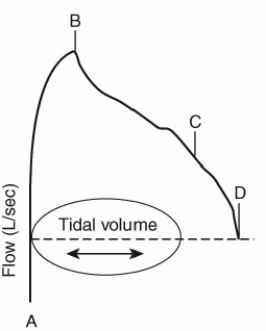
(Multiple Choice)
4.8/5 (65)
(65) Which of the following methods can be used to measure airway caliber on a 4-year-old patient with asthma?
(Multiple Choice)
4.8/5 (85)
(85) 
Filters
- Essay(0)
- Multiple Choice(0)
- Short Answer(0)
- True False(0)
- Matching(0)