



 Chat with AI
Exam 20: Antimicrobial Drugs

Exam 1: The Microbial World and You56 Questions
Exam 2: Chemical Principles52 Questions
Exam 3: Observing Microorganisms Through a Microscope58 Questions
Exam 4: Functional Anatomy of Prokaryotic and Eukaryotic Cells59 Questions
Exam 5: Microbial Metabolism64 Questions
Exam 6: Microbial Growth52 Questions
Exam 7: The Control of Microbial Growth63 Questions
Exam 8: Microbial Genetics58 Questions
Exam 9: Biotechnology and Dna Technology59 Questions
Exam 10: Classification of Microorganisms58 Questions
Exam 11: The Prokaryotes: Domains Bacteria and Archaea59 Questions
Exam 12: The Eukaryotes: Fungi, Algae, Protozoa, and Helminths58 Questions
Exam 13: Viruses, Viroids, and Prions62 Questions
Exam 14: Principles of Disease and Epidemiology60 Questions
Exam 15: Microbial Mechanisms of Pathogenicity58 Questions
Exam 16: Innate Immunity: Nonspecific Defenses of the Host59 Questions
Exam 17: Adaptive Immunity: Specific Defenses of the Host60 Questions
Exam 18: Practical Applications of Immunology58 Questions
Exam 19: Disorders Associated With the Immune System62 Questions
Exam 20: Antimicrobial Drugs60 Questions
Exam 21: Microbial Diseases of the Skin and Eyes59 Questions
Exam 22: Microbial Diseases of the Nervous System58 Questions
Exam 23: Microbial Diseases of the Cardiovascular and Lymphatic Systems59 Questions
Exam 24: Microbial Diseases of the Respiratory System58 Questions
Exam 25: Microbial Diseases of the Digestive System61 Questions
Exam 26: Microbial Disease of the Urinary and Reproductive Systems59 Questions
Exam 27: Environmental Microbiology58 Questions
Exam 28: Applied and Industrial Microbiology59 Questions
Select questions type


An official from an international health agency predicts that if all countries enacted legislation to only sell antibiotics with a prescription, then the rate of antibiotic resistant would ʺgrind to a halt.ʺ Do you agree? Explain.
(Not Answered)
This question doesn't have any answer yet
Use of antibiotics in animal feed leads to antibiotic-resistant bacteria because
(Multiple Choice)
4.8/5  (76)
(76) Protozoan and helminthic diseases are difficult to treat because
(Multiple Choice)
4.8/5 (91)
(91) Which of the following antibiotics causes misreading of mRNA?
(Multiple Choice)
4.7/5 (74)
(74) Which of the following antimicrobial agents is recommended for use against fungal infections?
(Multiple Choice)
4.8/5 (88)
(88) Penicillin was considered a ʺmiracle drugʺ for all of the following reasons EXCEPT
(Multiple Choice)
4.9/5 (70)
(70) Which of the following methods of action would be bacteriostatic?
(Multiple Choice)
4.9/5 (73)
(73) Table 20.2
The following results were obtained from a disk-diffusion test for microbial susceptibility to antibiotics. Staphylococcus aureus was the test organism. Antibiotic Zone of Inhibition 3 7 0 10
-In Table 20.2, the most effective antibiotic tested was
(Multiple Choice)
4.8/5 (87)
(87) Phage therapy has been used in the past as an antiviral treatment.
(True/False)
4.7/5 (89)
(89) Which of the following would be selective against the tubercle bacillus?
(Multiple Choice)
4.8/5 (79)
(79) Table 20.2
The following results were obtained from a disk-diffusion test for microbial susceptibility to antibiotics. Staphylococcus aureus was the test organism. Antibiotic Zone of Inhibition 3 7 0 10
-In Table 20.2, the antibiotic that exhibited bactericidal action was
(Multiple Choice)
4.9/5 (84)
(84) Which one of the following does NOT belong with the others?
(Multiple Choice)
4.8/5 (85)
(85) Which of the following organisms would MOST likely be sensitive to natural penicillin?
(Multiple Choice)
4.9/5 (72)
(72) Figure 20.1 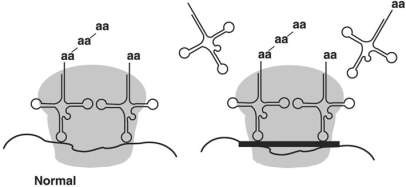 The antibiotic tetracycline binds to the 30S subunit of the ribosome, as shown by the dark black bar on the right portion of the diagram in Figure 20.1. The effect is to
 (Multiple Choice)
4.8/5 (82)
(82) Most of the available antimicrobial agents are effective against
(Multiple Choice)
4.7/5 (80)
(80) 
Filters
- Essay(0)
- Multiple Choice(0)
- Short Answer(0)
- True False(0)
- Matching(0)