



 Chat with AI
Exam 14: Principles of Disease and Epidemiology

Exam 1: The Microbial World and You56 Questions
Exam 2: Chemical Principles52 Questions
Exam 3: Observing Microorganisms Through a Microscope58 Questions
Exam 4: Functional Anatomy of Prokaryotic and Eukaryotic Cells59 Questions
Exam 5: Microbial Metabolism64 Questions
Exam 6: Microbial Growth52 Questions
Exam 7: The Control of Microbial Growth63 Questions
Exam 8: Microbial Genetics58 Questions
Exam 9: Biotechnology and Dna Technology59 Questions
Exam 10: Classification of Microorganisms58 Questions
Exam 11: The Prokaryotes: Domains Bacteria and Archaea59 Questions
Exam 12: The Eukaryotes: Fungi, Algae, Protozoa, and Helminths58 Questions
Exam 13: Viruses, Viroids, and Prions62 Questions
Exam 14: Principles of Disease and Epidemiology60 Questions
Exam 15: Microbial Mechanisms of Pathogenicity58 Questions
Exam 16: Innate Immunity: Nonspecific Defenses of the Host59 Questions
Exam 17: Adaptive Immunity: Specific Defenses of the Host60 Questions
Exam 18: Practical Applications of Immunology58 Questions
Exam 19: Disorders Associated With the Immune System62 Questions
Exam 20: Antimicrobial Drugs60 Questions
Exam 21: Microbial Diseases of the Skin and Eyes59 Questions
Exam 22: Microbial Diseases of the Nervous System58 Questions
Exam 23: Microbial Diseases of the Cardiovascular and Lymphatic Systems59 Questions
Exam 24: Microbial Diseases of the Respiratory System58 Questions
Exam 25: Microbial Diseases of the Digestive System61 Questions
Exam 26: Microbial Disease of the Urinary and Reproductive Systems59 Questions
Exam 27: Environmental Microbiology58 Questions
Exam 28: Applied and Industrial Microbiology59 Questions
Select questions type


Which of the following definitions is INCORRECT?

Free
(Multiple Choice)
4.9/5  (78)
(78) Correct Answer: Verified
E
Compromised hosts are always suffering from suppressed immune systems.
Free
(True/False)
4.9/5 (83)
(83) Correct Answer:Verified
VerifiedFalse
A host is not considered diseased until an infection changes oneʹs state of health.
Free
(True/False)
4.9/5 (86)
(86) Correct Answer:Verified
VerifiedTrue
Testing the effectiveness of a new drug for anthrax would be best performed as an experimental study.
(True/False)
4.9/5 (72)
(72) A disease in which the causative agent remains inactive for a time before producing symptoms is referred to as
(Multiple Choice)
4.8/5 (77)
(77) Figure 14.1 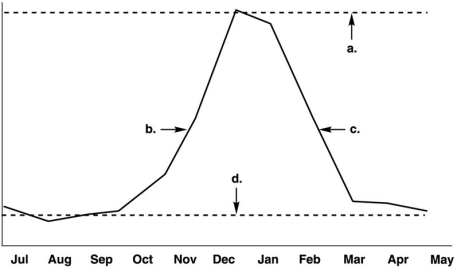 Figure 14.1 shows the incidence of influenza during a typical year. Which letter on the graph indicates the endemic level?
 (Multiple Choice)
5.0/5 (84)
(84) MMWR is a publication by the CDC that reports on only emerging diseases.
(True/False)
4.8/5 (72)
(72) Which of the following is NOT a predisposing factor of disease?
(Multiple Choice)
4.9/5 (98)
(98) When studying the epidemiology of a particular disease, why are retrospective studies commonly undertaken before prospective studies?
(Short Answer)
5.0/5 (84)
(84) Emergence of infectious diseases can be attributed to all of the following EXCEPT
(Multiple Choice)
4.8/5 (80)
(80) Figure 14.2 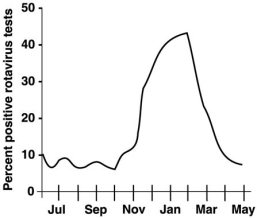 In Figure 14.2, when is the prevalence the highest?
 (Multiple Choice)
4.9/5 (67)
(67) In which of the following patterns of disease does the patient experience no signs or symptoms?
(Multiple Choice)
4.8/5 (80)
(80) Transient microbiota differ from normal microbiota in that transient microbiota
(Multiple Choice)
4.8/5 (82)
(82) If a prodromal period exists for a certain disease, it should occur prior to
(Multiple Choice)
4.9/5 (74)
(74) The method of transmission of the disease in Situation 14.1 was
(Multiple Choice)
4.9/5 (76)
(76) 
Filters
- Essay(0)
- Multiple Choice(0)
- Short Answer(0)
- True False(0)
- Matching(0)