



 Chat with AI
Exam 2: Chemical Principles

Exam 1: The Microbial World and You56 Questions
Exam 2: Chemical Principles52 Questions
Exam 3: Observing Microorganisms Through a Microscope58 Questions
Exam 4: Functional Anatomy of Prokaryotic and Eukaryotic Cells59 Questions
Exam 5: Microbial Metabolism64 Questions
Exam 6: Microbial Growth52 Questions
Exam 7: The Control of Microbial Growth63 Questions
Exam 8: Microbial Genetics58 Questions
Exam 9: Biotechnology and Dna Technology59 Questions
Exam 10: Classification of Microorganisms58 Questions
Exam 11: The Prokaryotes: Domains Bacteria and Archaea59 Questions
Exam 12: The Eukaryotes: Fungi, Algae, Protozoa, and Helminths58 Questions
Exam 13: Viruses, Viroids, and Prions62 Questions
Exam 14: Principles of Disease and Epidemiology60 Questions
Exam 15: Microbial Mechanisms of Pathogenicity58 Questions
Exam 16: Innate Immunity: Nonspecific Defenses of the Host59 Questions
Exam 17: Adaptive Immunity: Specific Defenses of the Host60 Questions
Exam 18: Practical Applications of Immunology58 Questions
Exam 19: Disorders Associated With the Immune System62 Questions
Exam 20: Antimicrobial Drugs60 Questions
Exam 21: Microbial Diseases of the Skin and Eyes59 Questions
Exam 22: Microbial Diseases of the Nervous System58 Questions
Exam 23: Microbial Diseases of the Cardiovascular and Lymphatic Systems59 Questions
Exam 24: Microbial Diseases of the Respiratory System58 Questions
Exam 25: Microbial Diseases of the Digestive System61 Questions
Exam 26: Microbial Disease of the Urinary and Reproductive Systems59 Questions
Exam 27: Environmental Microbiology58 Questions
Exam 28: Applied and Industrial Microbiology59 Questions
Select questions type


All forms of life function optimally at a pH of 7.

Free
(True/False)
4.9/5  (89)
(89) Correct Answer: Verified
False
Which of the following is the type of bond holding K+ and I- ions in KI?
Free
(Multiple Choice)
4.9/5 (67)
(67) Correct Answer:Verified
VerifiedA
Figure 2.1
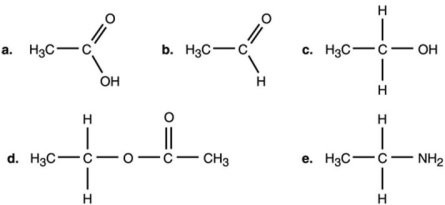 -Which compound in Figure 2.1 is an ester?
Free
(Multiple Choice)
4.9/5 (84)
(84) Correct Answer:Verified
VerifiedD
Individual covalent bonds are stronger than individual ionic bonds.
(True/False)
4.9/5 (85)
(85) Table 2.2 NaOH ⇌ Na+ + OH- base HF ⇌ H+ + F- - acid
MgSO4 ⇌ Mg2+ + SO42- salt KH2PO4 ⇌ K+ + H2PO4- acid H2SO4 ⇌ 2H+ + SO42- salt
Which of the following statements about the reactions in Table 2.2 is FALSE?
(Multiple Choice)
4.8/5 (92)
(92) Any compound that contains carbon is considered to be strictly organic.
(True/False)
4.9/5 (79)
(79) Which of the following is the type of bond between molecules of water in a beaker of water?
(Multiple Choice)
4.8/5 (87)
(87) Identify the following reaction: Lactose + H2O → Glucose + Galactose
(Multiple Choice)
5.0/5 (73)
(73) The antimicrobial drug imidazole inhibits sterol synthesis. This would most likely interfere with
(Multiple Choice)
4.8/5 (89)
(89) If an amino acid contained a hydrocarbon (a group of multiple carbons and hydrogens linked together) as its side group, in which of the following categories could it be appropriately designated?
(Multiple Choice)
4.8/5 (92)
(92) Elements only achieve the full complement of electrons in outermost energy cells by donating away or sharing electrons.
(True/False)
4.7/5 (88)
(88) Which of the following statements about the atom 12 C is FALSE? 6
(Multiple Choice)
4.8/5 (77)
(77) Figure 2.1
-Which compound in Figure 2.1 is an organic acid?
-Which compound in Figure 2.1 is an organic acid? (Multiple Choice)
4.9/5 (80)
(80) An E. coli culture that has been growing at 37°C is moved to 25°C. Which of the following changes must be made in its plasma membrane to help it cope with the decrease in temperature?
(Multiple Choice)
4.9/5 (77)
(77) Two glucose molecules are combined to make a maltose molecule. What is the chemical formula for maltose?
(Multiple Choice)
4.8/5 (75)
(75) Figure 2.3 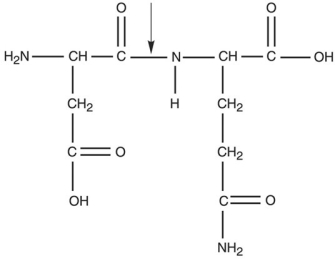 What kind of bond is at the arrow in Figure 2.3?
 (Multiple Choice)
4.7/5 (77)
(77) 
Filters
- Essay(0)
- Multiple Choice(0)
- Short Answer(0)
- True False(0)
- Matching(0)