



 Chat with AI
Exam 20: Antimicrobial Drugs

Exam 1: The Microbial World and You56 Questions
Exam 2: Chemical Principles52 Questions
Exam 3: Observing Microorganisms Through a Microscope58 Questions
Exam 4: Functional Anatomy of Prokaryotic and Eukaryotic Cells59 Questions
Exam 5: Microbial Metabolism64 Questions
Exam 6: Microbial Growth52 Questions
Exam 7: The Control of Microbial Growth63 Questions
Exam 8: Microbial Genetics58 Questions
Exam 9: Biotechnology and Dna Technology59 Questions
Exam 10: Classification of Microorganisms58 Questions
Exam 11: The Prokaryotes: Domains Bacteria and Archaea59 Questions
Exam 12: The Eukaryotes: Fungi, Algae, Protozoa, and Helminths58 Questions
Exam 13: Viruses, Viroids, and Prions62 Questions
Exam 14: Principles of Disease and Epidemiology60 Questions
Exam 15: Microbial Mechanisms of Pathogenicity58 Questions
Exam 16: Innate Immunity: Nonspecific Defenses of the Host59 Questions
Exam 17: Adaptive Immunity: Specific Defenses of the Host60 Questions
Exam 18: Practical Applications of Immunology58 Questions
Exam 19: Disorders Associated With the Immune System62 Questions
Exam 20: Antimicrobial Drugs60 Questions
Exam 21: Microbial Diseases of the Skin and Eyes59 Questions
Exam 22: Microbial Diseases of the Nervous System58 Questions
Exam 23: Microbial Diseases of the Cardiovascular and Lymphatic Systems59 Questions
Exam 24: Microbial Diseases of the Respiratory System58 Questions
Exam 25: Microbial Diseases of the Digestive System61 Questions
Exam 26: Microbial Disease of the Urinary and Reproductive Systems59 Questions
Exam 27: Environmental Microbiology58 Questions
Exam 28: Applied and Industrial Microbiology59 Questions
Select questions type


Antiviral drugs target viral processes that occur during viral infection.

Free
(True/False)
4.9/5  (76)
(76) Correct Answer: Verified
True
Which compound would be the most useful to treat candidiasis?
Free
(Multiple Choice)
4.8/5 (81)
(81) Correct Answer:Verified
VerifiedB
Which of the following is mismatched?
Free
(Multiple Choice)
4.8/5 (76)
(76) Correct Answer:Verified
VerifiedB
Table 20.2
The following results were obtained from a disk-diffusion test for microbial susceptibility to antibiotics. Staphylococcus aureus was the test organism. Antibiotic Zone of Inhibition 3 7 0 10
-In Table 20.2, which antibiotic would be most useful for treating a Salmonella infection?
(Multiple Choice)
4.9/5 (88)
(88) Which of the following statements about drug resistance is FALSE?
(Multiple Choice)
4.8/5 (77)
(77) An antibiotic that attacks the LPS layer would be expected to have a narrow spectrum of activity.
(True/False)
4.9/5 (93)
(93) Lamisil is an allylamine used to treat dermatomycoses. Lamisilʹs method of action is similar to that of
(Multiple Choice)
4.7/5 (74)
(74) Table 20.1
The following data were obtained from a broth dilution test. Concentration of AntibioticX Growth 2\mu/ + + 10\mu/ - + 15\mu/ - - 25\mu/ - -
-In Table 20.1, the minimal inhibitory concentration of antibiotic X is
(Multiple Choice)
4.9/5 (85)
(85) Figure 20.4 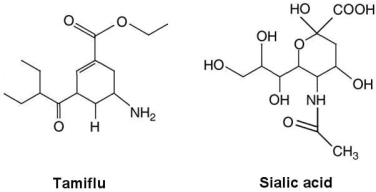 The structures of the influenza drug Tamiflu and sialic acid, the substrate for influenza virusʹs neuramidase, are shown in Figure 20.4. What is the method of action of Tamiflu?
 (Multiple Choice)
4.9/5 (75)
(75) Which of the following antibiotics is recommended for use against gram -negative bacteria?
(Multiple Choice)
4.7/5 (86)
(86) Community-acquired MRSA is typically more virulent than health care-associated MRSA.
(True/False)
4.8/5 (76)
(76) Which of the following drugs does NOT act by competitive inhibition?
(Multiple Choice)
4.9/5 (71)
(71) Which of the following does NOT constitute an advantage of using two antibiotics together?
(Multiple Choice)
4.8/5 (86)
(86) Explain the difficulties in developing antiviral drugs against DNA viruses, when compared to RNA viruses.
(Essay)
4.9/5 (64)
(64) The antimicrobial drugs with the broadest spectrum of activity are
(Multiple Choice)
4.7/5 (72)
(72) The antibiotic actinomycin D binds between adjacent G-C pairs, thus interfering with
(Multiple Choice)
4.9/5 (76)
(76) Which of the following antibiotics are used to treat fungal infections? 1. aminoglycosides
2) cephalosporins
3) griseofulvin
4) polyenes
5) bacitracin
(Multiple Choice)
4.8/5 (83)
(83) Penicillin does not directly kill bacteria. Why, then, is it considered to be bacteriocidal?
(Short Answer)
4.8/5 (84)
(84) 
Filters
- Essay(0)
- Multiple Choice(0)
- Short Answer(0)
- True False(0)
- Matching(0)