



 Chat with AI
Exam 20: Antimicrobial Drugs

Exam 1: The Microbial World and You56 Questions
Exam 2: Chemical Principles52 Questions
Exam 3: Observing Microorganisms Through a Microscope58 Questions
Exam 4: Functional Anatomy of Prokaryotic and Eukaryotic Cells59 Questions
Exam 5: Microbial Metabolism64 Questions
Exam 6: Microbial Growth52 Questions
Exam 7: The Control of Microbial Growth63 Questions
Exam 8: Microbial Genetics58 Questions
Exam 9: Biotechnology and Dna Technology59 Questions
Exam 10: Classification of Microorganisms58 Questions
Exam 11: The Prokaryotes: Domains Bacteria and Archaea59 Questions
Exam 12: The Eukaryotes: Fungi, Algae, Protozoa, and Helminths58 Questions
Exam 13: Viruses, Viroids, and Prions62 Questions
Exam 14: Principles of Disease and Epidemiology60 Questions
Exam 15: Microbial Mechanisms of Pathogenicity58 Questions
Exam 16: Innate Immunity: Nonspecific Defenses of the Host59 Questions
Exam 17: Adaptive Immunity: Specific Defenses of the Host60 Questions
Exam 18: Practical Applications of Immunology58 Questions
Exam 19: Disorders Associated With the Immune System62 Questions
Exam 20: Antimicrobial Drugs60 Questions
Exam 21: Microbial Diseases of the Skin and Eyes59 Questions
Exam 22: Microbial Diseases of the Nervous System58 Questions
Exam 23: Microbial Diseases of the Cardiovascular and Lymphatic Systems59 Questions
Exam 24: Microbial Diseases of the Respiratory System58 Questions
Exam 25: Microbial Diseases of the Digestive System61 Questions
Exam 26: Microbial Disease of the Urinary and Reproductive Systems59 Questions
Exam 27: Environmental Microbiology58 Questions
Exam 28: Applied and Industrial Microbiology59 Questions
Select questions type


PABA serves as the competitive inhibitor in the action of sulfanilamides.
(True/False)
4.8/5  (75)
(75) Both trimethoprim and sulfamethoxazole inhibit reactions along the same metabolic pathway.
(True/False)
5.0/5 (98)
(98) Which of the following statements about drugs that competitively inhibit DNA polymerase or RNA polymerase is FALSE?
(Multiple Choice)
5.0/5 (76)
(76) Which of the following antimicrobial agents has the fewest side effects?
(Multiple Choice)
5.0/5 (82)
(82) Figure 20.2 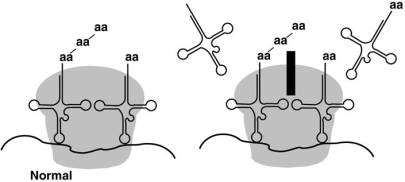 The antibiotic chloramphenicol binds to the 50S subunit of the ribosome, as shown in Figure 20.2. The effect is to
 (Multiple Choice)
4.8/5 (83)
(83) Which of the following antibiotics does NOT interfere with cell wall synthesis?
(Multiple Choice)
4.8/5 (81)
(81) Penicillin and streptomycin are commonly used in synergism because they display the same mode of action.
(True/False)
4.9/5 (81)
(81) Table 20.1
The following data were obtained from a broth dilution test. Concentration of AntibioticX Growth 2\mu/ + + 10\mu/ - + 15\mu/ - - 25\mu/ - -
-5) In Table 20.1, as illustrated by the data shown, the minimal bactericidal concentration of antibiotic X is
(Multiple Choice)
4.7/5 (73)
(73) Niclosamide prevents ATP generation in mitochondria. You would expect this drug to be effective against
(Multiple Choice)
4.7/5 (81)
(81) A drug that inhibits mitosis, such as griseofulvin, would be more effective against
(Multiple Choice)
4.8/5 (83)
(83) Due to its target, rifamycins can be effective over a broad spectrum.
(True/False)
4.8/5 (79)
(79) Explain why penicillin was called the ʺmiracle drugʺ when it was first used in the 1940s.
(Not Answered)
This question doesn't have any answer yet
Mebendazole is used to treat cestode infections. It interferes with microtubule formation; therefore, it would NOT affect
(Multiple Choice)
5.0/5 (91)
(91) In what way are semisynthetic penicillins and natural penicillins alike?
(Multiple Choice)
4.9/5 (93)
(93) Table 20.3 The following data were obtained from a broth dilution test: Concentration of Antibiotic X Growth 2.0\mu/ - 1.0\mu - 0.5\mu/ - 0.25\mu/ + 0.125\mu/ + 0 + Bacteria from the 0.25 ?g/ml tube were transferred to new growth media containing antibiotic X with the following results: Concentration of Antibiotic X Growth 2.0\mu/ - 1.0\mu + 0.5\mu/ + 0.25\mu/ + The data in Table 20.3 show that these bacteria
(Multiple Choice)
4.8/5 (76)
(76) Figure 20.3 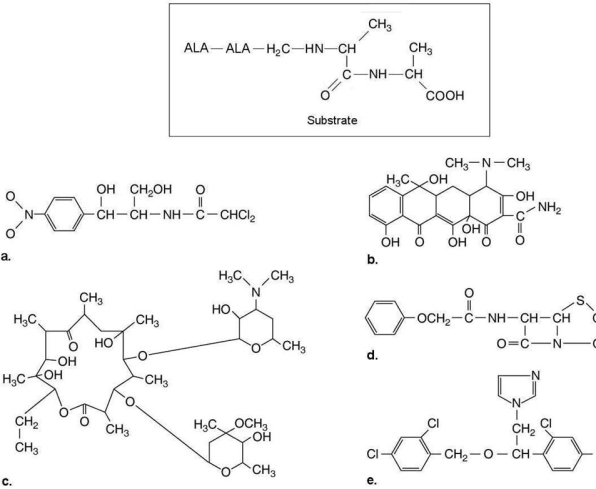 The substrate for transpeptidase used to synthesize peptidoglycan is shown in Figure 20.3. Which of the drugs shown would inhibit peptidoglycan synthesis?
 (Multiple Choice)
4.9/5 (80)
(80) Undergrowth of fungi after antibiotic use is commonly referred to as a superinfection.
(True/False)
4.8/5 (70)
(70) To date, most of our natural antibiotics have been found to be produced by members of what genus?
(Multiple Choice)
4.8/5 (61)
(61) 
Filters
- Essay(0)
- Multiple Choice(0)
- Short Answer(0)
- True False(0)
- Matching(0)