



 Chat with AI
Exam 6: Microbial Growth

Exam 1: The Microbial World and You56 Questions
Exam 2: Chemical Principles52 Questions
Exam 3: Observing Microorganisms Through a Microscope58 Questions
Exam 4: Functional Anatomy of Prokaryotic and Eukaryotic Cells59 Questions
Exam 5: Microbial Metabolism64 Questions
Exam 6: Microbial Growth52 Questions
Exam 7: The Control of Microbial Growth63 Questions
Exam 8: Microbial Genetics58 Questions
Exam 9: Biotechnology and Dna Technology59 Questions
Exam 10: Classification of Microorganisms58 Questions
Exam 11: The Prokaryotes: Domains Bacteria and Archaea59 Questions
Exam 12: The Eukaryotes: Fungi, Algae, Protozoa, and Helminths58 Questions
Exam 13: Viruses, Viroids, and Prions62 Questions
Exam 14: Principles of Disease and Epidemiology60 Questions
Exam 15: Microbial Mechanisms of Pathogenicity58 Questions
Exam 16: Innate Immunity: Nonspecific Defenses of the Host59 Questions
Exam 17: Adaptive Immunity: Specific Defenses of the Host60 Questions
Exam 18: Practical Applications of Immunology58 Questions
Exam 19: Disorders Associated With the Immune System62 Questions
Exam 20: Antimicrobial Drugs60 Questions
Exam 21: Microbial Diseases of the Skin and Eyes59 Questions
Exam 22: Microbial Diseases of the Nervous System58 Questions
Exam 23: Microbial Diseases of the Cardiovascular and Lymphatic Systems59 Questions
Exam 24: Microbial Diseases of the Respiratory System58 Questions
Exam 25: Microbial Diseases of the Digestive System61 Questions
Exam 26: Microbial Disease of the Urinary and Reproductive Systems59 Questions
Exam 27: Environmental Microbiology58 Questions
Exam 28: Applied and Industrial Microbiology59 Questions
Select questions type


Which of the following is an advantage of the direct microscopic count?
(Multiple Choice)
4.8/5  (86)
(86) Figure 6.3
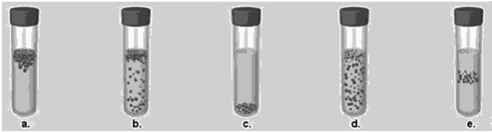 -In Figure 6.3, which tube shows the expected growth pattern for a microaerophile?
 (Multiple Choice)
4.9/5 (79)
(79) Figure 6.2
 -Figure 6.2 shows a typical bacterial growth curve with the y-axis indicating the log of the number of bacteria and the x-axis indicating time in culture. In the figure, which sections of the graph illustrate a logarithmic change in cell numbers?
 (Multiple Choice)
4.9/5 (73)
(73) Assume you inoculated 100 cells, with a generation time of 20 minutes, into 100 ml of nutrient broth. You then inoculated 100 cells of the same species into 200 ml of nutrient broth. After incubation for 4 hours, you can reasonably expect to have
(Multiple Choice)
4.9/5 (80)
(80) An experiment began with 4 cells and ended with 128 cells. How many generations did the cells go through?
(Multiple Choice)
4.9/5 (69)
(69) Figure 6.3
-In Figure 6.3, which tube shows the expected growth pattern for a facultative anaerobe?
-In Figure 6.3, which tube shows the expected growth pattern for a facultative anaerobe? (Multiple Choice)
4.9/5 (83)
(83) Patients with indwelling catheters (long-term tubes inserted into body orifices for drainage, such as through the urethra and into the urinary bladder) are susceptible to infections because
(Multiple Choice)
4.7/5 (88)
(88) Consider a culture medium on which only gram-positive organisms such as Staphylococcus aureus colonies can grow due to an elevated NaCl level. A yellow halo surrounds the growth, indicating the bacterium fermented a sugar in the medium, decreasing the pH as a result and changing the color of a pH indicator chemical. This type of medium would be referred to as a(n)
(Multiple Choice)
4.8/5 (74)
(74) Which group of microorganisms is most likely to spoil a freshwater trout preserved with salt?
(Multiple Choice)
4.7/5 (72)
(72) 
Filters
- Essay(0)
- Multiple Choice(0)
- Short Answer(0)
- True False(0)
- Matching(0)